
Giving aged care residents a voice in preventing healthcare-associated infections
People living in residential aged care homes are at high-risk of contracting healthcare-associated infections, which is the leading cause of morbidity and mortality in this setting.
Professor Helen Rawson co-leads the A-PRECISE Project, a multidisciplinary and consumer team, that is examining the facilitators and barriers to effective infection prevention and control practices in residential aged-care homes (RACHs), working closely with two Victorian aged care providers – The Village Baxter in Frankston and Olivet Care in Ringwood.
A second-generation registered nurse and Deputy Head of School, Nursing and Midwifery at Monash University, Professor Rawson is passionate about collaborating closely with RACHs staff, residents, and their families to co-design strategies to support better health.
She said the research team is very proud to be giving residents a voice in helping guide these health solutions as well as collaborating broadly within the residential aged care setting.
Strong partnerships, collaboration, and engagement are vital
Professor Rawson says successful collaborations are key if research outcomes are to have a positive impact on the people who its focused on.
“There’s no way you can do research that is about people living and working in the residential aged care space without working in collaboration with those people. Simply because you want to make sure that our research is relevant, it is feasible, it is applicable for context, and there's no way we're going to know that unless we work in collaboration and partnerships,” she said.
“People working in those areas know what things they want answered, know what they need to be able to support them to continue to do their work well. So, we, as researchers, must work in collaboration to ensure that we are answering relevant research questions that is supporting the residential aged care providers and relevant for them.
“So, I'm really excited about our project because we’ve worked in collaboration with people working in residential aged care, and that's all levels of staff from registered nurses to people working in the kitchens, for people working in maintenance, etc.
“But I am most excited about the fact that we have worked in collaboration with residents. We have got them to have a voice. We have them in our project where their voice is heard. That part of the solution, it is not being done to them. They're working with us.”
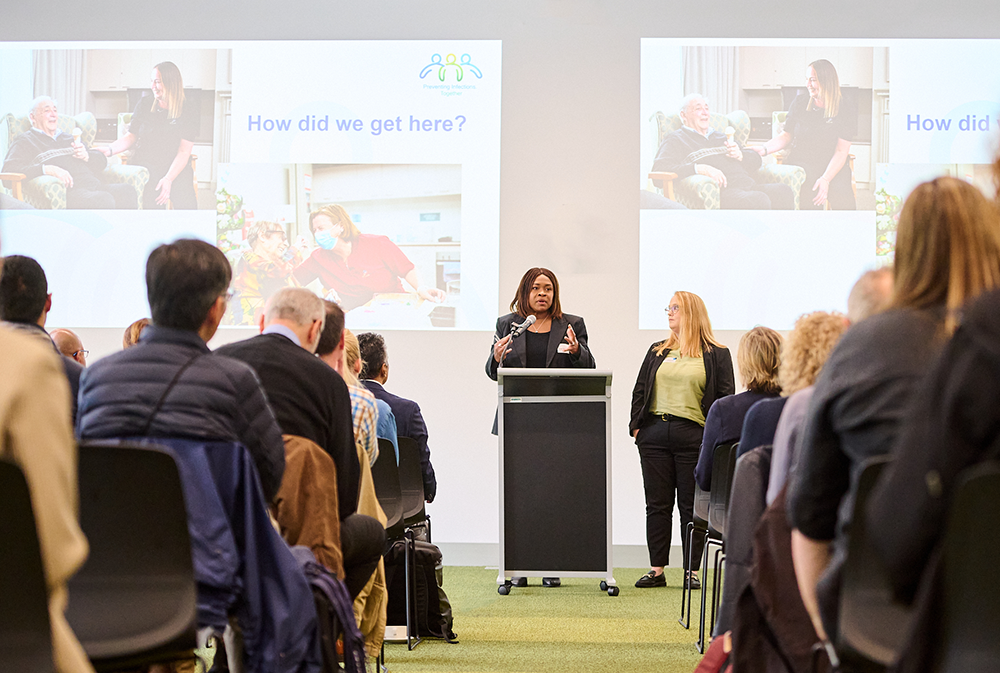
Image: Professor Helen Rawson, Monash University and NCHA, and Bridget Robinson, Village Baxter Aged Care
Building capacity to prevent and manage infections in residential aged care
Professor Rawson recently presented an update on the project at the National Centre for Healthy Ageing’s Showcase event with collaborator, Bridget Robinson, Director of Clinical Services at
Village Baxter Aged Care.
She said the three main ‘takeaways’ from their project experience so far has been:
- People living in residential aged care are “…not just things being cared for…”
- Research in collaboration with residential aged care providers
- True co-design involves everyone working together.
The A-PRECISE project, also co-led by Monash University’s Professor Phil Russo, has been undertaking research since 2022 and will end during 2025. The team aims to develop, implement, and evaluate a tailored and innovative strategy to identify needs and priorities for intervention to reduce HAIs in RACHs. This will include education and other resources for consumers and staff, and the first electronic tool for point prevalence surveillance of healthcare-associated infections in RACHs in Australia.
The Australian Commission on Safety and Quality in Health Care has released new resources to assist in prevention of HAIs. They state: “Effective infection prevention and control (IPC) is central to providing high-quality aged care for all older people and a safe working environment for those that work in aged care settings.
“In aged care settings, the focus of minimising infection-related risks in aged care requires careful consideration of the quality of life of the older people to whom services are provided as part of the approach for risk assessment. Putting older people at the centre of IPC and enabling them to take part in their own care involves considering their needs in relation to mental health and social wellbeing at all levels of decision-making.”
Discover more about NCHA’s Living Labs research.
Learn more about the National Centre for Healthy Ageing (NCHA) here: ncha.org.au