
Priorities to improve health of people experiencing homelessness: Community Forum
People who are experiencing homelessness have less opportunity to age healthily. They have much lower life-expectancy and greater rates of chronic disease than the rest of the community.
Unstable housing and homelessness pose significant risks to individuals' physical and mental health, exacerbating conditions such as chronic illnesses and mental health disorders. They also face numerous challenges with accessing consistent healthcare, perpetuating a cycle of disadvantage.
The National Centre for Healthy Ageing’s Deep End Living Lab team is working to improve health outcomes of people experiencing homelessness and unstable housing by improving screening for homelessness in healthcare and supporting health and social service navigation and integration.
Recently the Deep End Living Lab team led by Associate Professor Liz Sturgiss hosted a community forum in Melbourne, Victoria and online, involving people with lived experience and key stakeholders in housing and health including; Austin Health, Bolton Clarke, City of Melbourne Council, City of Melton Council, Council to Homeless Persons, Jesuit Social Services, Launch Housing, McAuley, Melbourne City Mission, Monash University, Mornington Peninsula Shire, On Call Group, Peninsula Health, Salvation Army, St Vincent’s Health Australia, Star Health, Victorian Health Promotion Foundation (VicHealth), Vincent Care and Wyndham City Council.
The Community Forum used a co-design approach to:
- Develop a prioritised list of knowledge gaps relating to homelessness and ageing healthily in Victoria. This will form the basis for research development and funding applications for ongoing work.
- Further build collaborative relationships with representatives from health and housing sector service providers, program managers and policy advisors.
Shared priorities
More than 30 ideas were raised to address current gaps in service delivery for people experiencing homelessness and unstable housing. Highlighted below are the top priorities framed as new, useful, and feasible by the Community Forum participants.
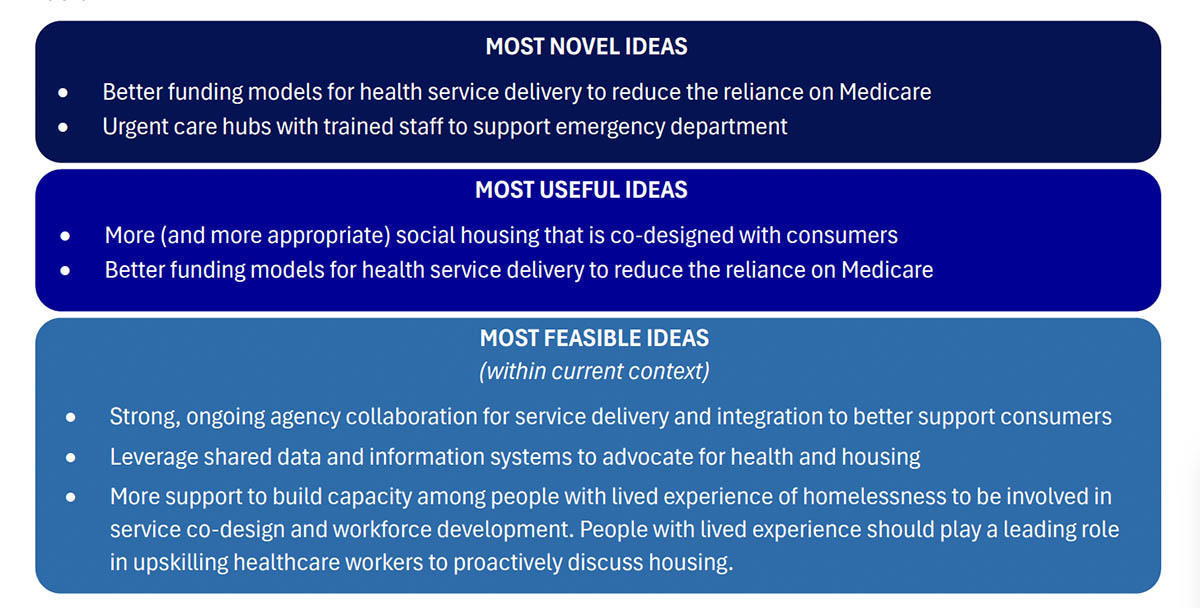
To address the interconnected challenges of housing instability and its detrimental effects on health, policymakers, healthcare providers, community organisations, and individuals need to prioritise collaborative efforts - which can begin with these shared priorities.
Next steps
The Deep End Living Lab team will continue to work with academic and community partners to reflect the shared priorities in its ongoing work and identify and address existing knowledge gaps through research.
The team has made the results available to all partners to support their own work and encourage others interested in this research to do the same.
The team is also involved in:
- supporting the health and housing sectors’ ongoing advocacy efforts by using research to highlight consumer perspectives on navigating health services while experiencing housing instability.
- building a freely available, online art gallery to showcase the community’s experiences including some of the artworks shown at the Community Forum.
- collaborating with a major hospital network and a consumer advocacy organisation to co-design a training module health care workers to expand health care workers’ knowledge of homelessness and housing instability.
Read or download the Deep End Living Lab Community Forum Final Report (PDF, 1.7 MB)
Contact the Deep End Living Lab Team
Email the team’s Project Manager and Research Officer, Nilakshi Gunatillaka at nilakshi.gunatillaka@monash.edu or discover more on our website.