
Microglia take centre stage in the earliest hours of stroke
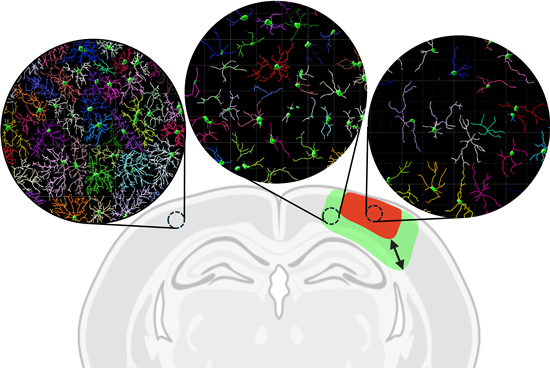
Microglia rapidly change in shape and inflammatory activity in response to ischaemic stroke. Infarct core - red; surrounding penumbra - green
Stroke is one of the leading causes of death and disability worldwide. When a stroke strikes, every minute matters: the sudden loss of blood flow starves brain cells of oxygen and nutrients, triggering irreversible damage and leaving survivors with life-altering impairments.
While current treatments focus on dissolving or removing clots, a hidden driver of damage is the inflammatory response that follows. Despite years of clinical trials, targeting immune cells that flood into the brain after stroke has not improved outcomes. Why?
A new study led by researchers at the Centre for Inflammatory Diseases, School of Clinical Sciences, Monash University has found the answer lies in what happens much earlier than expected. Published in Communications Biology, the team showed that the brain’s own immune cells, microglia, are the key culprits driving damaging inflammation within just three hours of stroke onset.
Looking earlier than ever
Most studies examine the brain’s immune response days after a stroke, when peripheral immune cells like neutrophils and monocytes infiltrate brain tissue. Instead, the Monash team focused on the hyperacute stage, within the first three hours, using advanced imaging, flow cytometry and cytokine analysis in preclinical stroke models.
They discovered that inflammatory cytokines were already surging in the brain well before peripheral immune cells arrived. Inflammatory cytokines are small proteins released by immune cells that act as chemical messengers. In stroke, they trigger and amplify inflammation, worsening brain injury.
Even when infiltrating immune cells were experimentally depleted, inflammation and impairments in motor function persisted. The missing link was microglia. Within hours, these resident immune cells changed shape, ramped up cytokine production, and fuelled a damaging inflammatory cascade.
“Research surrounding brain inflammation has previously focussed on days, or even weeks, following stroke onset. Our research has demonstrated that neuroinflammation actually arises far earlier, within just three hours of ischaemia,” said Dr Joshua Bourne, co-lead of the study & researcher in the Centre for Inflammatory Diseases.
“To this end, dampening the activity of the brain immune cells responsible within this timeframe may be the key to improving the quality of life for stroke victims.”
Why this matters
These findings help explain why previous trials aimed at blocking infiltrating immune cells have failed. The critical window for intervention may be far earlier, when microglia first activate.
“Our study provides evidence that inflammation is an integral part of stroke pathophysiology, and opens up new therapeutic opportunities that aim at modulating microglia function as a novel avenue to reduce brain injury after stroke,” said Professor Connie Wong, senior author and researcher in Centre for Inflammatory Diseases.
Dr Bourne added that this shift in understanding could reshape stroke treatment globally:
“It is often thought that inflammation is caused by white blood cells circulating in our blood. However, we found brain inflammation is uniquely driven by the brain’s own immune cells, called microglia. We believe that targeting microglia early could be key in reducing the damage caused by ischaemic stroke, and improving patient prognosis.”
Where to next
The study opens new avenues for therapies designed to modulate microglial activity immediately after stroke. This could help protect the “penumbra,” the salvageable tissue surrounding the core of injury. The team is now exploring whether more precise approaches, such as nanoparticle-based delivery systems, could safely dampen microglial inflammation without disrupting their beneficial roles in brain repair.
Dr Bourne explained the broader ambition:
“Ischaemic stroke is a global leading cause of death and disability. Existing treatment strategies have saved countless lives, but due to strict eligibility criteria, are available to less than a third of patients. Our research begins a path to not only improving the efficacy of existing treatment strategies, but also expanding eligibility for treatment opportunities.”
This research underscores the urgency of understanding stroke as not just a vascular emergency but also an immunological one, with timing proving critical to long-term recovery.
Read the full paper in Communications Biology.
About Monash University
Monash University is Australia’s largest university with more than 80,000 students. In the 60 years since its foundation, it has developed a reputation for world-leading high-impact research, quality teaching, and inspiring innovation.
With four campuses in Australia and a presence in Malaysia, China, India, Indonesia and Italy, it is one of the most internationalised Australian universities.
As a leading international medical research university with the largest medical faculty in Australia and integration with leading Australian teaching hospitals, we consistently rank in the top 50 universities worldwide for clinical, pre-clinical and health sciences.
For more news, visit Medicine, Nursing and Health Sciences or Monash University.
MEDIA ENQUIRIES