
Mollie Holman Award winner: Dr Wenhua Yu
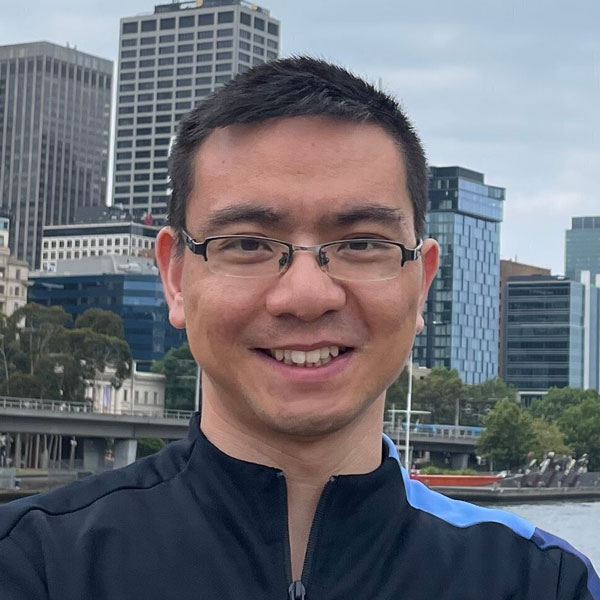
We’re celebrating a fantastic achievement by one of our PhD students – receiving one of the University’s annual Mollie Holman Awards. Established in 1998, the awards are named after the late pioneering physiologist, Emeritus Professor Mollie Holman AO.
The awards recognise the best theses across the University each year, and with the University’s largest cohort of PhD students, the Monash Faculty of Medicine, Nursing and Health Sciences bestows two of these each year.
Environmental health researcher Dr Wenhua Yu from our Climate, Air Quality Research Unit was one of the 2024 recipients from our Faculty.
His PhD – under the supervision of Professor Yuming Guo (Head, Monash Climate, Air Quality and Research Unit) and Professor Jiangning Song (Monash Biomedicine Discovery Institute) – applied advanced machine learning techniques to estimate global air pollution and its health effects, particularly mortality linked to short-term exposure.
His interest in environmental health was first piqued during his tenure as a public officer in environmental health supervision, where he worked on indoor environmental monitoring and exposure risk assessment. This frontline experience gave him valuable insights into the complex interface between environmental hazards and population health.
Wenhua also honed strong skills in statistical modelling and machine learning, which deepened his interest in applying data science to environmental health.
Seeking opportunities to help him down this path, he met Professor Yuming Guo and eventually applied to do his PhD at Monash.
“Leaving my stable position in the Chinese government to move to Melbourne and do my PhD has been a transformative journey for me,” he says.
Knowing that a scholarship would be essential, he spent two years as a Research Assistant with his current research team, building his research and English language skills, and burnishing his CV with valuable practical experience.
“Finding out that I’d been accepted into the PhD program at the School of Public Health and Preventive Medicine felt like a dream come true. I’m so grateful to everyone who has helped me along the way, particularly my supervisors,” he says.
Wenhua’s candidature wasn’t without challenges. Like many others, he faced research setbacks, manuscript rejections, peer pressure, and mental fatigue. But he never considered giving up. Each obstacle, he says, has been part of the learning curve, shaping him into a more confident, resilient, and capable researcher.
Before his doctoral research, accurate assessments of air pollution exposure and associated mortality at the global level remained largely unavailable. He identified an opportunity to address the gap, thereby transforming a critical scientific need into a data-driven, worldwide resource.
He developed a novel framework to produce high-resolution, daily pollution maps from 2000 to 2019, and to calculate related death tolls. To achieve this, he integrated data from over 5,446 monitoring stations across 65 countries and territories with satellite remote sensing products, meteorological and demographic variables, land use data, emission inventories, and outputs from chemical transport models.
It is the first global study to track daily pollution and its impacts at city, national, regional, and global levels over two decades.
The findings offer critical evidence to help policymakers, public health officials, and urban planners design targeted interventions, implement timely alerts, and formulate long-term strategies. This data-driven approach empowers communities with localized risk information, ultimately supporting efforts to reduce exposure, prevent pollution-related deaths, and promote environmental equity.
One of the most personally rewarding parts of his PhD has been contributing to science and society. His dataset has been featured by over 200 media outlets and is helping raise public awareness of air quality. It also enables researchers worldwide to explore the health effects of pollution. While he doesn’t expect his work to change the world overnight, knowing it could inform policy or support others inspires him to keep making his research rigorous, relevant, and real-world focused.
For the time being, Wenhua will continue working as a postdoctoral research fellow with Professor Yuming Guo at Monash University, focusing on addressing critical research gaps in environmental health. His upcoming work includes assessing the future impacts of climate change on air pollution and developing a global-level real-time alert system for air pollution and wildfire smoke exposure.
Click here for more news from the School of Public Health and Preventive Medicine