
Love Your Sister backs Monash-led graphene sensor for early cancer detection
Every cancer leaves traces of its DNA behind. Detecting these tiny fragments circulating in blood or urine could make it possible to spot cancer earlier, tailor treatment, and monitor recurrence — all with a simple, non-invasive test.
Monash Health and Monash University have received a $100,000 research grant from the Love Your Sister Foundation, through the Monash Health Foundation, to develop a breakthrough graphene oxide (GO)-based biosensor for early cancer detection using circulating tumour DNA (ctDNA).
“This project represents a perfect convergence of engineering innovation and clinical need,” said Dr Gwo Yaw Ho, Head of the Cancer Immunology Laboratory within the School of Clinical Sciences at Monash Health, Monash University. “If successful, our GO-ctDNA biosensor could revolutionise early cancer diagnostics by offering a simple, non-invasive blood test that detects cancer mutations with unprecedented sensitivity, potentially even before symptoms appear.”
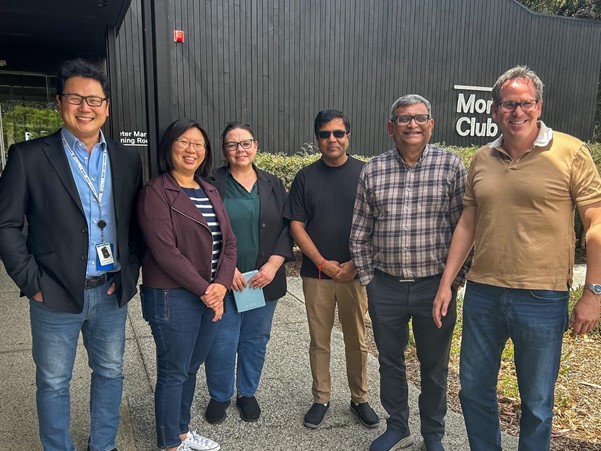
The GO-ctDNA research team meeting at Monash University to strategise project milestones. L-R: Dr Gwo Yaw Ho, Dr Yi Tian Ting, Dr Jenny Dyson, Dr Santosh Panjikar, Prof Raman Singh, Prof Nicolas Voelcker
The GO-ctDNA project is a large interdisciplinary collaboration spanning oncology, engineering, nanofabrication and structural biology across Monash Health, Monash University and national research facilities.
The GO-ctDNA team aims to create a portable, cost-effective biosensor capable of detecting minuscule traces of cancer-derived DNA circulating in blood and urine. Graphene oxide (GO) is an ultra-thin, carbon-based material with unique chemical and optical properties that make it highly sensitive to short pieces of DNA. The new GO-ctDNA biosensor will be designed to recognise specific cancer-linked mutations and emit a measurable fluorescent signal when these mutations are present.
To build the sensor, the team will engineer the surface of graphene oxide so that short strands of DNA can attach securely and light up when they detect cancer mutations. Using advanced synchrotron and nanofabrication technologies, they will fine-tune this surface and test how well it performs with real biological samples.
The long-term vision is to make cancer testing faster and more accessible by moving it beyond specialised laboratories. A portable version of this biosensor could one day allow clinicians in outpatient or regional settings to monitor treatment response and detect recurrence earlier, giving patients more timely and personalised care.
The GO-ctDNA project brings together a highly interdisciplinary team: Dr Gwo Yaw Ho, (Head of the Cancer Immunology Laboratory, Monash University), Professor Raman Singh (Professor, Mechanical and Aerospace Engineering), Professor Nicolas Voelcker (Director, Melbourne Centre for Nanofabrication), Dr Santosh Panjikar (Australian Synchrotron, ANSTO), Dr Yi Tian Ting (Structural Biology), and Dr Jenny Dyson (Manager, Mechanical and Aerospace Engineering).
Monash Health and Monash University extend their gratitude to the Love Your Sister Foundation and the Monash Health Foundation for supporting this initiative, which exemplifies the shared mission to advance precision medicine and equitable cancer care.
About Monash University
Monash University is Australia’s largest university with more than 80,000 students. In the 60 years since its foundation, it has developed a reputation for world-leading high-impact research, quality teaching, and inspiring innovation.
With four campuses in Australia and a presence in Malaysia, China, India, Indonesia and Italy, it is one of the most internationalised Australian universities.
As a leading international medical research university with the largest medical faculty in Australia and integration with leading Australian teaching hospitals, we consistently rank in the top 50 universities worldwide for clinical, pre-clinical and health sciences.
For more news, visit Medicine, Nursing and Health Sciences or Monash University.
MEDIA ENQUIRIES