
Monash University scientists to accelerate quantum computing for Australian Defence
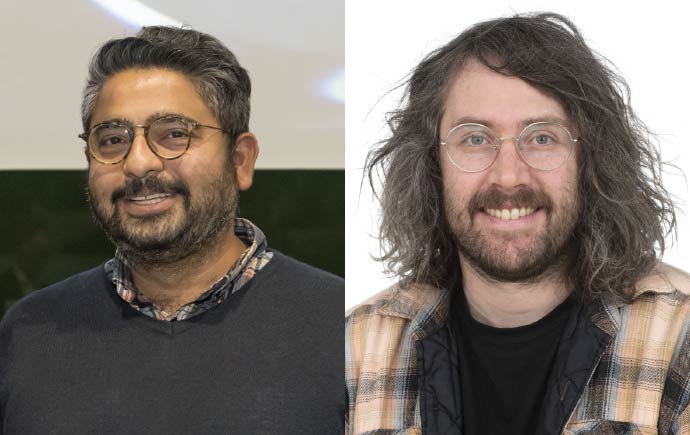
L-R: Professor Kavan Modi and Dr Michael Barson.
Monash University physicists have secured over $6.4 million in funding through the Government’s Advanced Strategic Capabilities Accelerator (ASCA) Emerging and Disruptive Technologies (EDT) program.
The ASCA program has signed 21 contracts as part of an investment of over $60 million with Australian universities and industry partners. The investment will bolster Australia's Defence capabilities by advancing the development of quantum computing technologies tailored to defence applications.
Of the 21 contracts, two have been awarded to Monash University researchers, Professor Kavan Modi and Dr Michael Barson both from the School of Physics and Astronomy with each being funded just over $3 million.
Professor Modi’s project will focus on developing optimised quantum error correction codes (QECCs) to address hardware noise, a critical barrier to achieving utility-scale quantum computing.
By overcoming this challenge, the project aims to significantly enhance Defence’s ability to optimise logistics, and detect anomalies with unprecedented speed and accuracy.
"Our research will bridge the gap between quantum hardware and its practical applications, creating a vital interface that optimises quantum algorithms for Defence needs,” Professor Modi said.
“By integrating advanced noise characterisation and machine learning techniques, we aim to build robust error correction methods that make quantum computing both scalable and efficient,” he said.
Quantum computers promise a revolutionary leap in computational speed, solving problems in minutes that would otherwise take traditional computers hours or even days.
The Monash team will collaborate with leading institutions, including the University of Queensland and Macquarie University, as well as industry partners such as NVIDIA and CSIRO, to develop a comprehensive software solution tailored to Defence requirements.
In addition to addressing computational challenges, Dr Barson’s project will explore the development of quantum sensors for applications such as communications, navigation and electromagnetic field sensing in radar and communication systems.
“Quantum sensors offer unprecedented capability in detecting weak signals,” Dr Barson said.
“However, they are often limited to very narrow bandwidth, limiting the application in detecting modern communication and similar electromagnetic signals,” he said.
“Our project aims to vastly improve the bandwidth of quantum sensors, by developing a compact optical magnetometer that can detect over many gigahertz (GHz) of bandwidth simultaneously.”
The Monash team is partnering with quantum diamond manufacturer Quantum Brilliance and international defence prime L3Harris to develop this technology to a readiness level suitable for field trials.
Announcing the funding for the ASCA EDT program the Minister for Defence Industry and Capability Delivery, the Hon Pat Conroy MP, highlighted the strategic importance of such projects.
“By investing in quantum technologies, we are not only strengthening our national security but also building a future made in Australia,” Minister Conroy said.
The Monash-led project is a cornerstone of this initiative, showcasing the University’s expertise in quantum computing and its commitment to advancing Australia’s strategic interests.
Further information
Silvia Dropulich
Marketing, Media & Communications Manager, Monash Science
T: +61 3 9902 4513 M: +61 435 138 743
Email: silvia.dropulich@monash.edu