
Designer crops: Using AI to future-proof rice crops against climate change
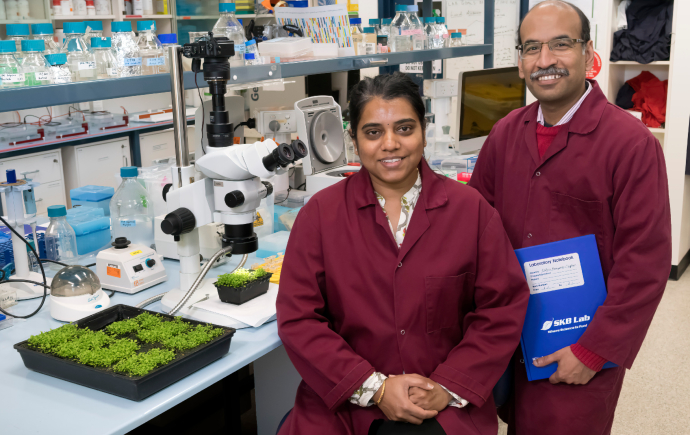
Dr Sridevi Sureshkumar and Professor Sureshkumar Balasubramanian. Credit: Steve Morton
A world-first research collaboration led by Monash University will use artificial intelligence and genome editing to help protect rice crops from rising global temperatures.
Today the Hon Dr Andrew Charlton MP, Assistant Minister for Science, Technology and the Digital Economy, announced five new joint research projects as part of the Australia India Strategic Research Fund (AISRF), worth $3.76 million.
The project, Designer crops: engineering thermotolerance for agricultural productivity, brings together researchers from Monash University and India’s National Institute for Plant Genome Research to engineer heat-tolerant rice varieties capable of maintaining yields under climate stress.
Climate change is expected to significantly reduce agricultural productivity worldwide, with both Australia and India particularly vulnerable to rising temperatures and increasing pressure on food security. Rice, a staple food crop for billions of people, plays a critical role in the diets and economies of both countries.
Using advanced artificial intelligence and CRISPR-based genome editing, the team of researchers will identify how plant proteins respond to heat stress and make precise genetic changes to improve thermotolerance. Promising rice lines will be tested in diverse environments to assess their performance and yield potential under real-world conditions.
Chief Investigator, Professor Sureshkumar Balasubramanian from the School of Biological Sciences said the project aims to deliver practical solutions for farmers facing a changing climate.
“As global temperatures rise, crops like rice are increasingly exposed to heat stress that can dramatically reduce yields,” Professor Balasubramanian said.
“By combining artificial intelligence with precision genome editing, we can accelerate the development of rice varieties that are better able to withstand higher temperatures, helping to safeguard food supplies for communities in Australia, India and beyond.”
Chief Investigator, Dr Sridevi Sureshkumar, from Monash School of Biological Sciences, said the theoretical designer crops, will be a league above modified crops already in use around the world.
“Now that we have been able to identify exactly which elements within the plants are temperature-responsive, we can genetically manipulate them with greater accuracy,” Dr Sureshkumar said.
Beyond crop development, the project will strengthen long-term research partnerships between Australia and India and provide hands-on training for students and early-career scientists in cutting-edge technologies at the intersection of AI, biology and agriculture.
“These new projects highlight the strength of our partnership with India and the importance of joint research in tackling global challenges.
“By investing in joint research, we’re building the foundations for innovation that benefits both nations and contributes to a more sustainable and secure future,” Assistant Minister for Science, Technology and the Digital Economy, Dr Andrew Charlton said.
By improving the resilience of one of the world’s most important food crops, the project aims to deliver tangible benefits for farmers, food systems, and communities in Australia, India, and beyond.
Further information
Silvia Dropulich
Marketing, Media & Communications Manager, Monash Science
T: +61 3 9902 4513
M: +61 435 138 743
Email: silvia.dropulich@monash.edu