
Dr Lesley Alton: Curiosity drives science and maths underpins every discipline
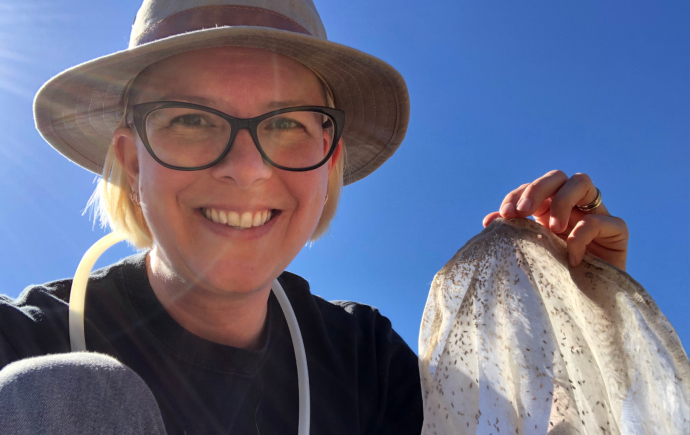
Dr Lesley Alton
For Dr Lesley Alton, understanding how animals cope with a rapidly changing world is both a scientific challenge and an urgent responsibility. As an ecological and evolutionary physiologist, she studies how animals respond to human‑induced environmental change, particularly climate warming, through physiological acclimation and evolutionary adaptation. “My work aims to improve our ability to predict and manage the effects of environmental change on animal populations,” she explains. “These populations are crucial for biodiversity, food production, and even human health.”
Lesley’s research is grounded in rigorous laboratory experimentation, using ectothermic animals, including Drosophila, to understand how rising temperatures reshape the energetic demands of life. Her ARC Future Fellowship, awarded in 2025, is a testament to the significance of this work. With a success rate of just 15%, the fellowship supports her project on predicting the energetic costs of climate warming, a study that will shed new light on how animals evolve under environmental stress. “This fellowship allows me to continue research that I expect will lead to exciting new discoveries about the evolution of animal physiology,” she says.
Her path into science was anything but linear. Growing up, she didn’t know a scientific career was even possible. It was the influence of excellent high‑school teachers and a love of maths, physics, and chemistry that led her to a Bachelor of Science. “I followed my interests,” she recalls. “I majored in environmental biology and did honours in animal physiology, despite never taking biology in high school.” It was at university that she discovered her passion for research and the realisation that she could build a life in science.
Lesley’s journey has included its share of challenges, particularly the tension between career mobility and personal commitments. With a partner in secure employment, she chose not to relocate for fixed‑term postdoctoral roles, a common expectation in academia. Instead, she carved her own path. “I applied for a travel grant that funded a one‑month visit to a research group overseas,” she says. “The experiment I conducted there became foundational to my current research program.” For her, it’s a reminder that small opportunities can have transformative impact.
She credits every supervisor, collaborator, and student she has worked with as shaping her career. “You can always learn something from the people you work with,” she says. “These lessons guide you to become the scientist you want to be.”
Her advice to young women is refreshingly practical: “Be curious and take maths. Curiosity drives science and maths underpins every discipline.”
Lesley is also helping shape the future of her field. She has dramatically expanded the capacity to measure physiological and behavioural traits in animals, from tens to hundreds per day, enabling her to test century‑old theories about how physiology evolves. “We’re entering an exciting time,” she says. “I’m fortunate to be contributing to shaping its direction.”
Outside the lab, Lesley loves good food and exploring Melbourne’s restaurant scene. And she shares a fun twist in her journey: before studying science, she briefly pursued interior design. “My artistic skills haven’t gone to waste,” she laughs. “As a scientist, I produce images that communicate discoveries so the art still matters.”
Her story is a powerful reminder that science is not a straight line, nor a single identity. It is a space where curiosity, creativity, and persistence converge and where women like Lesley are redefining how we understand and protect the natural world.
This piece is part of our International Day of Women and Girls in Science profile series. Read more here.
Further information
Silvia Dropulich
Marketing, Media & Communications Manager, Monash Science
T: +61 3 9902 4513 M: +61 435 138 743
Email: silvia.dropulich@monash.edu