
Monash Science researchers secure more than $1.5 million in ARC Linkage funding for next-generation technologies
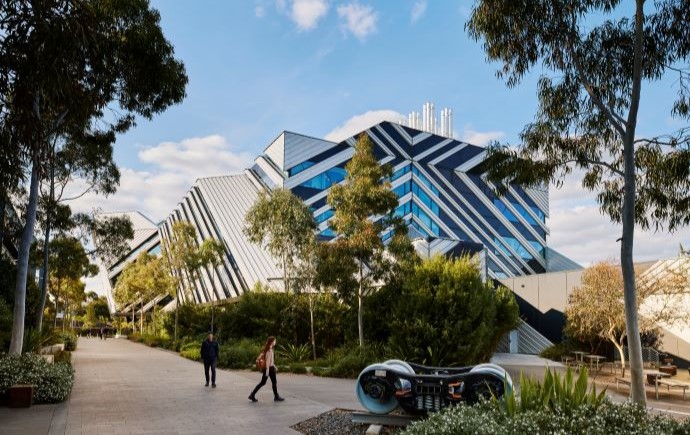
New Horizons Research Centre, Clayton campus.
Researchers from the Monash University Faculty of Science have secured more than $1.5 million in Australian Research Council (ARC) Linkage Projects funding, contributing to the $5,416,611 awarded across eight Monash University projects supporting collaborative research with industry and community partners.
More than $99.8 million in Australian Government funding through the ARC Linkage Projects 2025 Round 2 scheme will support 178 new Australian research partnerships tackling some of the nation’s most pressing social, economic and environmental challenges.
The funding will support two projects led by researchers from the School of Physics and Astronomy in partnership with industry, designed to advance next-generation technologies in energy-efficient computing and optical imaging.
The projects bring together expertise from across physics, materials science and emerging technologies to address significant challenges, from reducing the energy demands of modern computing to enhancing night-vision systems through advanced optical engineering.
Building a new generation of energy-efficient computing
A team led by researchers from the School of Physics and Astronomy has secured $896,519 to develop a breakthrough low-energy transistor technology in partnership with TQ Transistors Pty Ltd.
The project, Prototyping a Breakthrough Low-Energy Transistor, will be led by Professor Michael Fuhrer alongside Professor Nikhil Medhekar, Dr Jerry Johnson and Mr Thomas Wrappe.
Information technology currently consumes approximately eight per cent of global electricity use and continues to grow rapidly. The research aims to demonstrate and benchmark an entirely new transistor design, the fundamental building block of modern computing, capable of significantly reducing energy consumption.
The project will investigate a novel negative capacitance topological quantum field-effect transistor (NC-TQFET) concept, combining experimental and modelling approaches to identify promising materials and interfaces for future semiconductor technologies.
Beyond the scientific advances, the work is expected to help train future researchers and strengthen Australia’s capabilities in advanced semiconductor technologies.
Enhancing night vision through next-generation optics
Researchers from the School have also secured $614,883 for a project designed to transform night-vision imaging systems using advanced optical technologies.
Led by Professor Stefan Maier with Dr Haoran Ren and Mr Avner Klein, the project Enhancing Night Vision with Metasurface-Enabled Edge Detection is being delivered in partnership with Point Trading Group.
The project aims to integrate ultracompact optical metasurfaces into night-vision devices to enable all-optical edge detection across larger fields of view, potentially extending imaging performance beyond current technologies.
Expected outcomes include scalable manufacturing approaches for large-area metasurfaces and their integration into practical imaging systems with high optical performance.
The work has the potential to strengthen Australia’s position in optical imaging and display technologies.
For a full list of funded projects, visit the ARC announcement.
Further information
Silvia Dropulich
Marketing, Media & Communications Manager, Monash Science
T: +61 3 9902 4513 M: +61 435 138 743
Email: silvia.dropulich@monash.edu