
Citizen science project identifies 20 new astronomical discoveries
A citizen science project, which invites members of the public to take part in identifying cosmic explosions, has already identified 20 new astronomical discoveries.
Over 2,000 volunteers across 105 different countries have worked on 600,000 classifications over a six-month period.
The project ‘Kilonova Seekers’ aims to find kilonovae - the cosmic explosions of neutron stars and black holes colliding in distant galaxies.
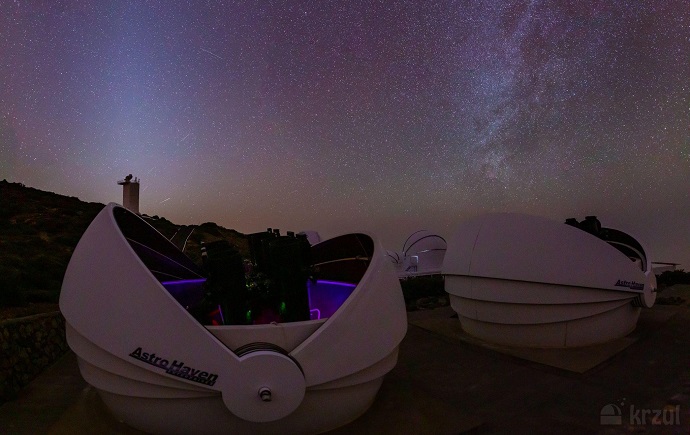
Volunteers are asked to play ‘spot the difference’ using data from the two Gravitational-wave Optical Transient Observer (GOTO) telescopes, which are located on opposite sides of the planet - on La Palma, in Spain’s Canary Islands, and Australia’s Siding Spring Observatory.
“Our citizen scientist partners play an important part in our observational efforts,” said GOTO collaborator Associate Professor Duncan Galloway from the Monash University School of Physics and Astronomy.
“Their involvement allows us to more reliably detect interesting cosmic phenomena that might be lost in the noise otherwise.”
“The human eye can quite accurately detect various anomalies in astronomical images, making it a powerful tool for discovering kilonovae, which are of great interest to the astronomical community, in GOTO data,” said GOTO collaborator Mr Sergey Belkin, also from the School of Physics and Astronomy.
Dr Lisa Kelsey, from the University of Portsmouth’s Institute of Cosmology and Gravitation, which is leading the effort, said : “The success of Kilonova Seekers demonstrates the invaluable role of public participation in scientific discovery. The contribution of citizen scientists is really helping us push the boundaries of our understanding of the universe.”
Although all of the 20 discoveries haven’t been classified yet, the researchers have identified five as Type la Supernovae, which are powerful and bright explosions of stars.
Type la Supernovae are important in astronomy because they have a consistent peak brightness, which makes them useful as ‘standardisable candles’ to measure distances in space. By knowing how bright these supernovae should be, astronomers can calculate how far away they are, which helps measure the accelerating expansion of the universe.
Scientists monitor alerts from gravitational wave detectors LIGO, Virgo and KAGRA, which trigger GOTO telescopes within 30 seconds to begin searching the sky. Any images taken are then shared with the public via the Zooniverse, the world’s largest and most popular platform for facilitating citizen science.
Kilonova Seekers launched publicly on Zooniverse on 11 July 2023 and there were 1,000 classifications within the first 30 minutes. Based on data obtained from Google Analytics, there are participants from every continent, except Antarctica.
The United States is by far the largest contributor, with a total of 1284 users. The United Kingdom has about half that, with 615 users. However, users from Portugal are the most active, with each person viewing over 2,750 pages on average.
Dr Kelsey added: “The project not only contributes to the discovery of transient phenomena but also enhances the development of next-generation classification algorithms. This means that with the help of the public, we can create better ways to sort and understand the information.
Dr Tom Killestein, from the University of Turku in Finland, said: “Alongside all the discoveries the volunteers have made, they’ve created a list of over 20,000 gold standard examples that we’ve used to improve our machine learning classifiers. This powerful synergy between machine learning and citizen science will allow us to continually improve our algorithms, and directly increase the number of discoveries of supernovae and other exciting objects.”
The first stage of Kilonova Seekers is presented in a paper published in Monthly Notices of the Royal Astronomical Society. GOTO is run by an international collaboration of researchers.
Media enquiries:
Silvia Dropulich
Marketing, Media & Communications Manager, Monash Science
T: +61 3 9902 4513 M: +61 435 138 743
Email: silvia.dropulich@monash.edu