
A thoughtfully-designed approach to campus lighting
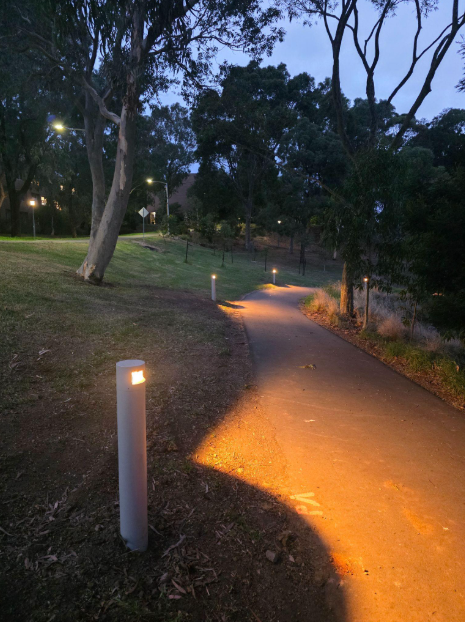 Monash University is leading the way among Australian universities when it comes to campus lighting.
Over the next four years, we are heavily investing in our lighting network across all campuses to make sure our campuses are thoughtfully lit. We want to ensure our spaces are safely lit, while getting the balance right for the Monash community and our environment.
To support this, we’re undertaking proactive uplift and maintenance work to any areas and fixtures that require attention over the next four years. This will ensure the brightness of our lights (known as lux levels) complies with Australian standards and is fit for purpose.
Planning campus lighting is a highly detailed process. We use a careful, evidence-based approach to ensure our spaces are lit effectively, taking a wide range of factors into consideration when deciding exactly where lights should go and how bright they need to be.
Guided by strategic landscape design
Outdoor campus lighting is an important part of our landscape design principles. Our goal is to declutter the landscape by using lighting fixtures that blend in visually. We design our lighting to maximise performance, user comfort, security, and safety, all while being sensitive to our local ecology.
Did you know?
We thoughtfully plan our lighting and walking routes to support how you move and participate in activities across our campuses. This is the exact same approach that local councils and cities use when planning their public lighting. By understanding exactly how our community uses these spaces – day and night – we can design pathways that guide our campus community smoothly and safely to where you need to be.
To achieve this, we use a hierarchy-based approach. This means lighting is selective rather than uniform, and we decide what is needed on a case-by-case basis. We base these choices on clear and consistent guidelines that have been agreed upon by experts in the industry, within our Buildings and Property team, local councils and other leading Australian authorities. We prioritise our primary walking routes and key decision points, and we strengthen the lighting at entrances and crossings.
To make sure everything is working as it should, we are currently checking the brightness – known as a lux level analysis – of key areas across campus. This includes:
- Primary walks (main pedestrian routes – the busiest paths students use to move across campus)
- Secondary walks (pedestrian pathways creating links between primary walks and building entrances etc)
- Tertiary walks (minor pedestrian routes – quieter, informal paths between buildings that are used less often)
- Eco-sensitive areas (zones with higher biodiversity value where light is disruptive to nocturnal fauna)
- Gathering spaces and plazas
- Primary car parks (multi-level)
- Secondary car parks
- After-hour activation areas.
As part of the Monash Masterplan, we encourage using our primary and secondary walks if you are getting around campus after dark. These routes handle high foot traffic, so they’re well lit to ensure you can move around comfortably at night.
View the primary and secondary walks
Protecting our environment
Importantly, we also ensure that we protect our environment. Monash campuses are home to incredible biodiversity, and we have a responsibility to protect the wildlife that shares our spaces.
It is neither practical nor desirable to light up large landscapes entirely. Shining bright lights into natural habitats (such as the Jock Marshall Reserve at Clayton campus) can disrupt local ecosystems. To balance perceived human safety relating to bright lights, with wildlife protection, our lighting choices are carefully considered.
In natural spaces, we use smart lighting choices:
- Lights are designed to shine downwards, giving you the visibility you need to walk safely without creating light pollution
- We use low-level bollard lights and gentle fixtures that are ecologically sensitive and do not disturb animals
- We use warm-coloured lighting that doesn't disrupt animals' natural sleep patterns, and well-shielded fittings in parkland settings
- Busy pathways get brighter overhead lights, while quiet natural areas use softer, lower lights.
Security is always here to help
Even with the best lighting in the world, walking alone at night can feel uncomfortable. Please remember that Monash Security is here for you 24/7 – and they aren't just here for emergencies.
If you are studying late or walking back to your hall in the dark, you can request a security escort to walk you anywhere on campus, or use the Security Help points located across the campus to speak to Security.
Additionally, Monash Security buses run across the Clayton and Caulfield campuses, leaving every 30 minutes from 5.30pm to 12.30am, Mondays to Sundays, from selected pick up points.
For Help points, pick up locations, and Security bus routes and stops, visit the Monash Security webpage and read more in the FAQs below.
