Leading the charge towards a sustainable future
View
Leading the charge towards a sustainable future
View

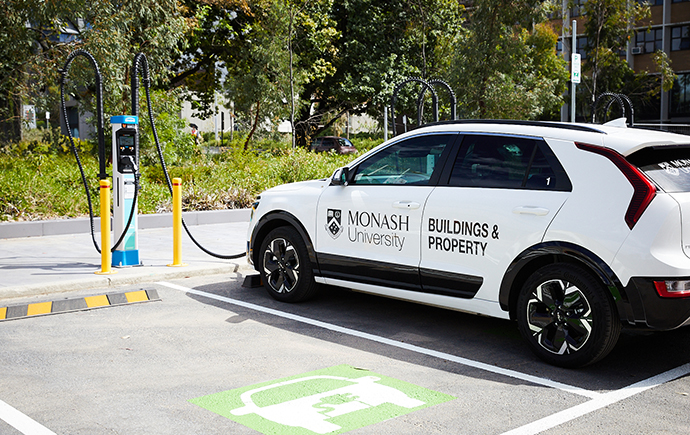
Monash University is advancing towards a sustainable future by installing 48 new electric vehicle (EV) charging bays across its Clayton, Caulfield, and Peninsula campuses, making it the Australian university with the most extensive EV charging network. This initiative supports Monash's commitment to achieving Net Zero emissions by 2030.
The project, facilitated by a grant from the Victorian Government's Zero Emissions Vehicles Commercial Sector Innovation Fund, includes partnerships with ENGIE Australia & New Zealand for supply and maintenance. The installation aims to reduce carbon footprints and promote sustainable transport options, with plans to transition the entire fleet to electric vehicles, reducing CO2 emissions by 677 tonnes annually.


 Update on Monash University's Net Zero by 2030 commitment
View
Update on Monash University's Net Zero by 2030 commitment
View
Monash University has updated its Net Zero by 2030 commitment, advancing its goal to source 100% of electricity from renewable sources to 2025 and adjusting the target for full electrification of gas infrastructure to 2040. The university has made significant progress, including a 57% reduction in Scope 1 and 2 emissions since 2015, installation of solar panels, and sourcing electricity from a wind farm.
Despite the challenges of transitioning from natural gas, Monash remains committed to achieving its Net Zero target by using high integrity carbon offsets.

 Upgraded pool vehicle service
View
Upgraded pool vehicle service
View
The Monash University Buildings and Property Division is upgrading the pool vehicle service as part of the Net Zero Transport Strategy. Starting 14 October, the existing petrol-powered Holden Cruze vehicles will be replaced with Toyota RAV4 hybrid vehicles.
This transition aims to reduce the carbon footprint and align with sustainability objectives. The service will be available at Clayton and Caulfield campuses, with a new pricing structure introduced to remain competitive with commercial carshare options.