
Acoustic superheroes: how seals mastered hearing on land and at sea
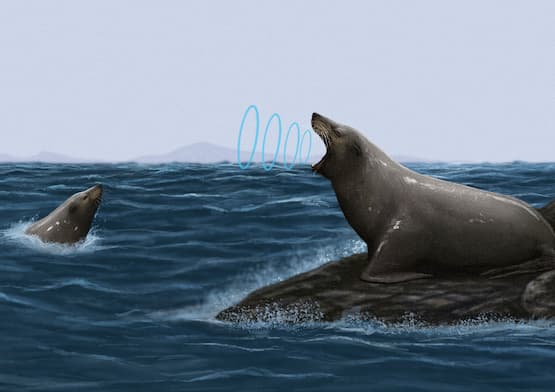
The earliest eared seals, such as the 10 million-year-old Pithanotaria starii, improved their amphibious hearing abilities. Their in-air hearing was especially acute. Image credit: Jaime Bran
New research from an international team of scientists has identified how a specialised tissue in the ears of seals enables them to hear both underwater and on land.
The study, published today in Proceedings of the Royal Society B: Biological Sciences, reveals that the earliest marine seals evolved amphibious hearing over 26 million years ago. Amphibious hearing is the ability to hear effectively in both air and water. The findings suggest that amphibious hearing is fundamental to the lives of seals.
Lead author, Dr James Rule from the School of Biological Sciences at Monash University, conducted the research during his time as a postdoctoral researcher at London’s Natural History Museum and said pinnipeds (true seals, eared seals and walruses) have a unique superpower.
“Seals have a superpower, the ability to hear and communicate on land and in the ocean. How they hear sounds underwater, and when this remarkable ability evolved, has until now remained a mystery,” Dr Rule said.
“Our research found that amphibious hearing in seals originated roughly 26 million years ago. Most mammals are unable to hear properly underwater, but seals evolved ears specialised for hearing underwater without compromising their ability to hear on land. This evolutionary innovation facilitated the remarkable vocal diversity of pinnipeds, which allows them to communicate both on land and in the ocean.
“This ancient origin means that amphibious hearing is as fundamental to being a seal as their flippers,” Dr Rule said.
Together with evolutionary analysis of 3D scans of seal ears acquired by CT-imaging, data from both modern and fossil museum specimens and recent advances in pinniped evolution, researchers were able to understand the origins of their amphibious hearing and thus their complex underwater communication.
Dr Natalie Cooper, a Merit Researcher at the Natural History Museum, said historical archives hold the keys to solving modern ecological crises.
“This research really shows the power of museum collections to allow us to answer exciting questions about evolution. We analysed anatomical specimens that were preserved for generations, and they provided the exact evolutionary clues we needed to map how these mammals adapted to hearing in two different environments,” Dr Cooper said.
“This work is highly relevant as we begin to understand how noise pollution might influence species in our oceans. The underwater world is getting louder every day due to commercial shipping, sonar, and offshore construction. If we don’t understand the baseline of how a seal’s unique hearing functions naturally, we can't accurately measure the damage this anthropogenic noise is causing. These museum vaults are effectively helping us protect the future of marine life,” Dr Cooper said.
The study is the largest dataset yet assembled of the ears of living and extinct pinnipeds, and their terrestrial relatives. The international team of researchers investigated whether proposed adaptations for amphibious hearing within pinnipeds differ from their nearest terrestrial relatives, when and how amphibious hearing evolved, and how pinnipeds balance the physical constraints of two markedly different auditory environments.
Professor Alistair Evans, Head of the EvoMorph Research Group, which specialises in the biology that influences the evolution, development and function of animals, said the research highlights just how rich and complex a seal's sensory experience truly is.
“Seals are the only creatures in their class to have evolved this sensory flexibility. It allows them to transition seamlessly between two entirely different acoustic worlds without a single drop in performance, giving them an evolutionary edge whether they are resting, hunting or communicating,” Professor Evans said.
Read the research paper: https://doi.org/10.1098/rspb.2026.0178
MEDIA ENQUIRIES
Hande Cater
Media and Communications Manager
P: +61 456 428 906
E: hande.cater@monash.edu
GENERAL MEDIA ENQUIRIES
Monash Media
P: +61 3 9903 4840
E: media@monash.edu
For more experts, news, opinion and analysis, visit Monash News.