
Monash helps develop a new pregnancy app for First Nations women across the Top End
A new digital pregnancy education app, Dangudbila, is being piloted to transform how maternity care information is delivered to Aboriginal and Torres Strait Islander women across Australia’s Top End.
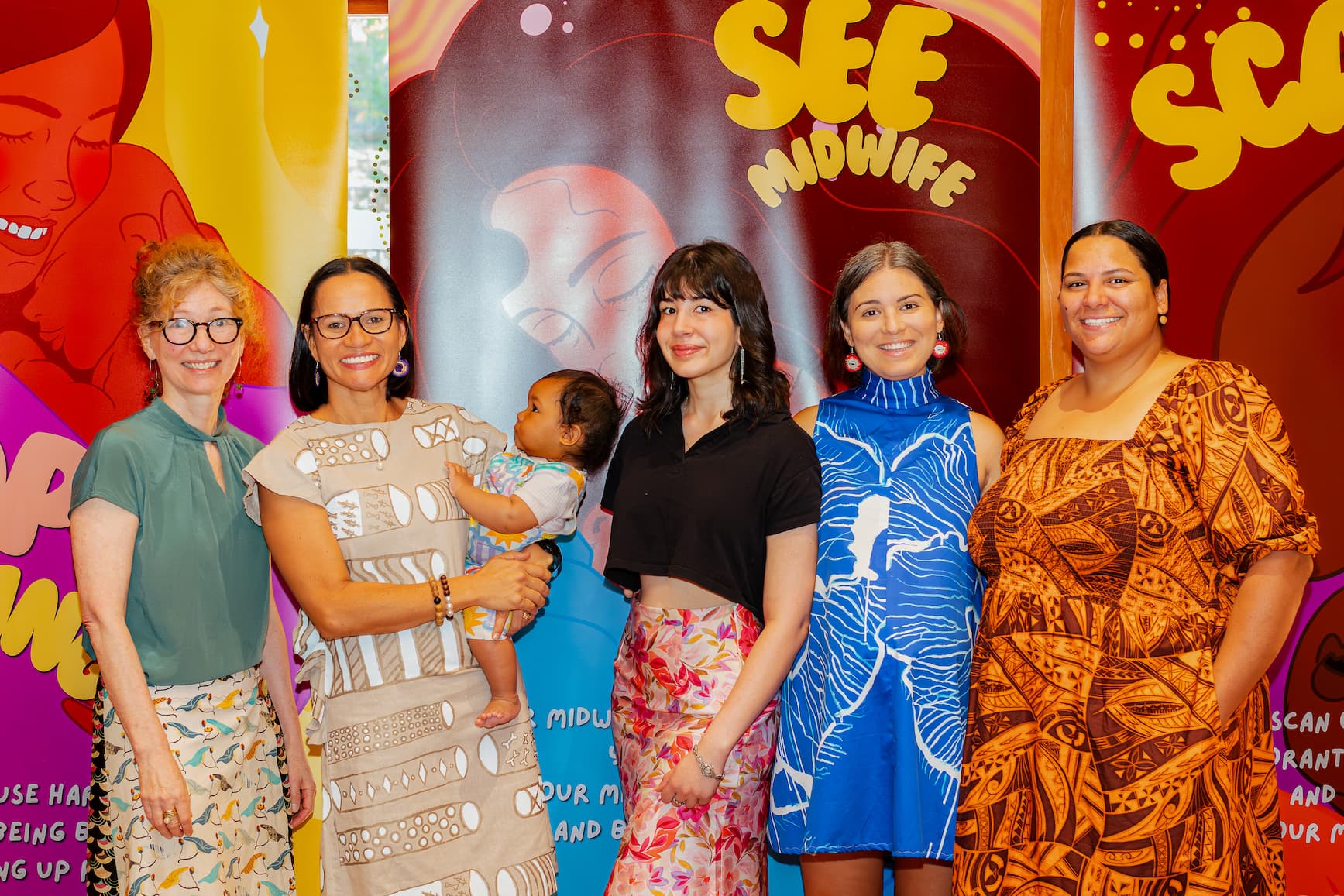
The Dangudbila team celebrates the launch of the new pregnancy education app designed to support Aboriginal and Torres Strait Islander women. Pictured (L-R): Associate Professor Jacqueline Boyle (Monash University), Senior Research Fellow Dr Kiarna Brown (Menzies), PhD Candidate Ms Ananya Alagh (Monash University), Clinical Research Manager Jess Murray and Digital Health Education Coordinator Jessica McKenzie (Menzies).
Led by Menzies School of Health Research (Menzies), the technical aspects of the Dangudbila application were developed by human-computer interaction researchers from Monash University’s Action Lab based at the Faculty of Information Technology.
This version of the App was co-designed with Aboriginal and Torres Strait Islander women across Darwin, Palmerston and Wurruimyanga (Tiwi Islands), ensuring it reflects their voices, experiences and needs.
The new application was shaped from start to finish by extensive consultation and codesign. Initial Yarning Circles with Aboriginal and Torres Strait Islander women highlighted significant gaps in antenatal education, and these insights drove a multi-year effort to secure funding before engaging the women again for the design process.
The app brings together a range of content designed to support women throughout pregnancy, including animations in local languages, podcasts featuring Top End women and healthcare providers, as well as culturally designed resources.
Researchers, including PhD Candidate Ms Ananya Alagh from Monash University’s Action Lab, who led the technical development of the application and were closely involved in the co-design activities, said it was designed for different digital literacies, needed to be accessible and reflect the lived experiences of Aboriginal and Torres Strait Islander women.
“While building the application, we ensured it was culturally sensitive and met the needs of First Nations women — particularly recognising different literacies,” Ms Alagh said.
“We included audio in plain language, lived-experience stories in the form of mini podcasts from community members about their own birthing experiences, and expert medical views, so women could engage with the content in whatever way suited them.
“And in this early pilot, we built it to work offline, so it can be used in very different settings across the Top End.”
Dangudbila was named, with permission from Senior Larrakia Elder and Chair of Menzies’ Australian First Nations Reference Group for Child and Maternal Health, Dr Aunty Bilawara Lee, after the Larrakia word for Kangaroo and the marsupial trait of pausing embryo development until conditions are safe: a metaphor for safe, full-term birthing.
Lead of Menzies Maternal Health Program, Menzies Principal Research Fellow, Father Frank Flynn Fellow, and Aboriginal and Torres Strait Islander Obstetrician, Associate Professor Kiarna Brown said the project was about rethinking how pregnancy education is delivered.
“By making an accessible, culturally safe, and co-designed app, we’re helping ensure that every woman, no matter where she lives, has the information she needs to give her baby the best possible start to life,” Associate Professor Brown said.
“Dangudbila will also support clinicians to have better, more meaningful conversations with women; helping bridge gaps in communication and strengthen culturally safe care. This is going to revolutionise maternity education for women across the Top End.”
The information provided in the app aligns with health schedules in the Northern Territory, to support women to understand what they will be offered at each stage of their pregnancy journey, and shares insights and key questions to ask at these appointments.
Menzies Clinical Research Manager, Maternal Health Program, Jess Murray, said when Aboriginal and Torres Strait Islander women were first consulted, the idea was to understand their experiences of preterm birth. But what the women shared was much broader.
“They spoke about the lack of consistent, culturally appropriate pregnancy education, and how access depended on where they lived, and whether the information felt safe or relevant to them,” Ms Murray said.
“We spent years working to secure the funding needed to go back to the Top End women and involve them in designing something new. Something that truly reflected their needs.”
Women’s health and obstetrics expert Associate Professor Jacqueline Boyle, from Monash's Eastern Health Clinical School, guided the app's clinical content to ensure it was accurate and aligned with best-practice maternity care.
Through the new application, women can listen, watch, read and learn from other women’s experiences in the app, at a time and location that is suitable for them. It works to make maternity healthcare safer, supporting self-determination and presenting pregnancy concepts in ways that are digestible, engaging, culturally relevant and safe, whilst also celebrating culture and strengths.
The development of the Dangudbila application was led by Menzies in partnership with Monash University researchers, along with Avant Foundation and the Australian Preterm Birth Prevention Alliance.
Ms Ananya Alagh from Monash University’s Action Lab is available for interviews and information regarding the technical considerations and development of the application.
Learn more and download the Dangudbila app: https://www.menzies.edu.au/page/Resources/The_Dangudbila_App/
- ENDS -
MEDIA ENQUIRIES
Teju Hari Krishna
Media and Communications Manager
T: +61 450 501 248
E: teju.harikrishna@monash.edu