
Students develop cave safety prototype during 48-hour hackathon
As rescue teams work to save seven people trapped inside a cave in Laos, a team of Monash University students has developed a prototype device during a 48-hour hackathon (UNIHACK) to help prevent similar underground emergencies.
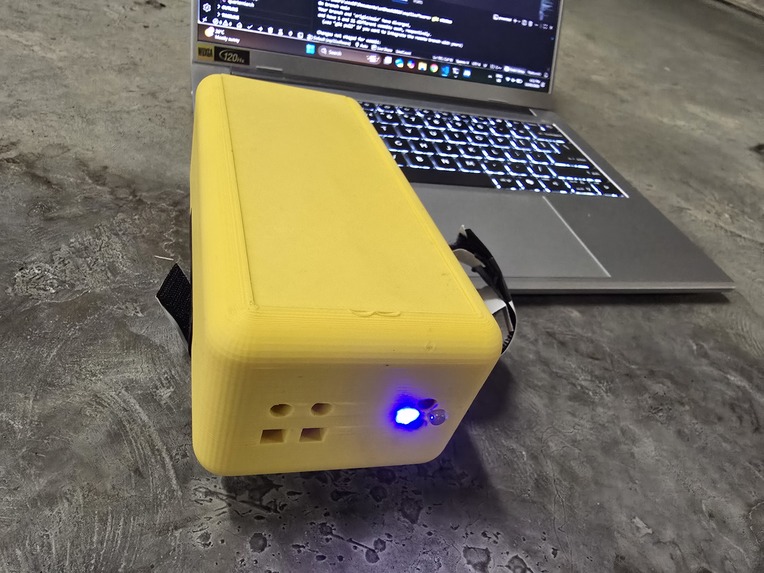 The student team created ANTRUM, a wearable tracking and navigation system, designed for high-risk underground settings such as caves and mines, where GPS and phone signals are often unavailable.
The palm-sized devices are strapped to a user’s leg before heading into a cave. In underground environments, external signals such as GPS or standard radio waves cannot penetrate through solid rock to cover the distance.
To solve this, ANTRUM uses a technique called Dead Reckoning paired with Zero Velocity Updates (ZUPT). Leg-mounted motion sensors track the user’s footsteps to continuously calculate their relative position, allowing the system to reliably track and record a route even when all external communication signals fail.
During UNIHACK 2026, where ANTRUM won first prize, the team developed a fully functional proof-of-concept complete with integrated hardware, software, electronics and a 3D-printed casing. They are now hoping to develop a waterproof version that could support underwater cave divers.
The project was inspired by the 2018 rescue of the Thai youth soccer team trapped in the Tham Nang Non cave system in Thailand's Chiang Rai province.
“We were inspired by the story of the Thai youth soccer team cave rescue and wanted to explore whether technology could help prevent people from becoming stranded in the first place,” said project team member Maria Demina, a third-year Bachelor of Electrical and Computer Systems Engineering student.
ANTRUM also includes a web dashboard, ANTRUM DASH, which records movement data during use. Once users return to the surface, the data uploads to the cloud, allowing them to review and analyse their route.
The project highlights how student hackathons can foster innovative thinking to tackle complex, real-world safety challenges.