
Vice-Chancellor and President highlights role of universities in strengthening Australia-China relations
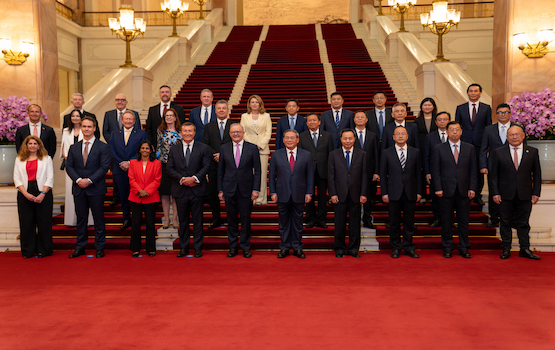
Monash University Vice-Chancellor and President, Professor Sharon Pickering, has joined business and government leaders in Beijing as part of the 8th Australia-China CEO Roundtable, held alongside Prime Minister Anthony Albanese’s official visit to China.
The high-level forum, hosted by the Business Council of Australia and the China Development Bank, brings together CEOs from leading businesses in both countries to advance economic cooperation and shared interests.
Professor Pickering emphasised the important role universities play in sustaining strong bilateral ties through education, research and innovation.
“Our participation and active contribution to one of Australia’s most significant diplomatic efforts in China is recognition of the important role universities play in fostering ties between our two nations – advancing education and research, fostering collaboration and delivering innovation for our shared prosperity,” Professor Pickering said.
Monash’s long-standing engagement with China was a key focus of the Vice-Chancellor’s remarks, highlighting the depth and scale of partnerships, student mobility and alumni networks.
More than 21,000 Monash alumni are currently based in China, with more than 20,000 Chinese students enrolled at Monash campuses globally. In the past decade, nearly 3,000 Monash Australia students have travelled to China for transformative learning and cultural experiences.
“Universities are deeply human enterprises. The people-to-people relations and networks Monash has fostered with China over many years are crucial to deepening our mutual understanding, offering reciprocal benefits – both tangible and intangible,” she said.
The Vice-Chancellor identified three areas of opportunity to further strengthen bilateral ties: expanding two-way student mobility, elevating education in government-to-government dialogue, and the establishment of an Australia-China Industrial Centre of Excellence in Decarbonisation.
“The Centre of Excellence in Decarbonisation will realise our world leading capabilities in capturing and repurposing carbon dioxide emissions from steel, advancing the promise of hydrogen in steel production, utilising the most advanced experimental facilities and mathematical modelling, adapting our sustainable reaction technologies to move quickly to prototype scale, all with the ultimate goal of developing new technologies for steel that replaces coal,” said Professor Pickering. “Much of this in partnership with Chinese universities that we have been working with for a long time.”
Monash’s leadership in joint education and research initiatives was a central theme, with Professor Pickering referencing the university’s long standing partnership with Southeast University in Suzhou. Established in 2012, it was the first Chinese-foreign graduate school to operate in China. More than 2,600 students have graduated since its establishment, with 1,600 currently enrolled.
Monash also operates the Monash Suzhou Research Institute in the Suzhou Industrial Park, where researchers collaborate with industry and other Chinese universities on shared challenges such as sustainability, energy, medical technology and resource recovery.
Monash’s international campus network, including campuses in Malaysia, Indonesia and Prato in Italy, along with a major research academy in India, enables significant reach and scale in education and research collaboration.
“As a genuinely international university, Monash offers unrivalled reach and capability. Together with our partners in China, we look forward to building on these strong foundations,” Professor Pickering said.