
Crystalline futures: how a Monash Science researcher shaped the Nobel Prize landscape
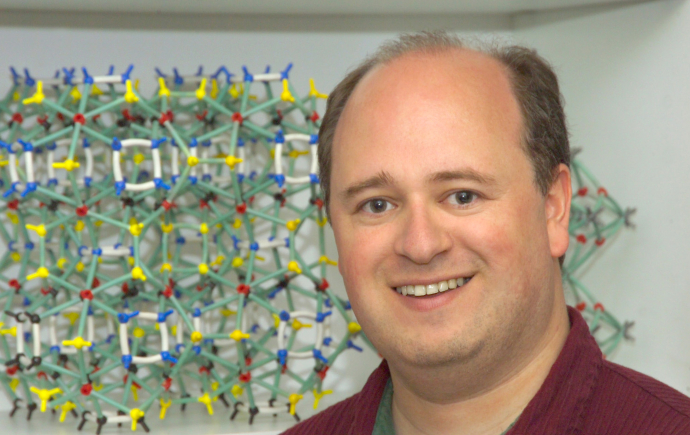
Photo: Professor Stuart Batten
Credit: Steve Morton
It’s a curious thing, proximity to greatness.
In science, it rarely looks like the movies, it’s more likely to resemble a cluttered lab bench, a shared citation, or a first-author paper from the early ’90s. For Professor Stuart Batten, from the Monash University School of Chemistry who heads the Batten Research Group, greatness came in the form of molecular scaffolds, metal-organic frameworks, or MOFs, that are now redefining how we extract metals, capture carbon, and, as of last week, win Nobel Prizes.
“This was a moment decades in the making,” Professor Batten says. He’s reflective and detailed in his recollection.
“I joined Richard Robson’s lab a year after his seminal 1989 paper, and I was the first student in his group to work in this field.
“In fact my very first paper as a result of my honours year level research is cited in the Nobel Prize
press release.
“I was there at the very start of the journey and one of the great pleasures of my career has been to watch the birth and rapid explosion of a completely new field of chemistry from a front row seat.”
“To see the applications that have followed on from curiosity-driven research to understand how chemistry works is remarkable.”
The 2025 Nobel Prize in Chemistry went to Professor Robson, along with Professor Susumu Kitagawa and Professor Omar Yaghi, for pioneering the field of MOFs.
Professor Batten, ever modest, does not claim ownership, but the intellectual scaffolding of his own career has long been entangled with theirs. His early work helped shape the direction of the field, he was, quite literally, there at the beginning.
Professor Batten’s lab today is a veritable temple of crystalline possibility, where MOFs are deployed like microscopic Swiss army knives: separating rare earth elements, absorbing greenhouse gases, and turning e-waste into gold, figuratively, and in some cases, nearly literally.
“What excites me now,” Professor Batten says, “isn’t just the recognition of the field’s origin, it’s where it’s going.
Chemistry may start in the lab but its impact is global, it’s structural, it’s responsive. And Monash is at the centre of that.”
Professor Batten’s work is a quiet confirmation of Nobel-calibre excellence. It’s a reminder that the long arc of scientific progress bends not just toward prizes, but toward deeper understanding, cleaner technologies, and, hopefully, a planet still worth inhabiting.
This story isn’t just about citation metrics or publication counts.
It’s about legacy, proximity, and a university that dares to claim a seat at science’s most prestigious table.
“We’re not just reacting to global trends,” Professor Batten says. “We’re helping set them.”
“In science, proximity matters,” he says. “Entanglement doesn’t happen from afar.”
Neither, it seems, do Nobel Prizes.
Further information
Silvia Dropulich
Marketing, Media & Communications Manager, Monash Science
T: +61 3 9902 4513 M: +61 435 138 743
Email: silvia.dropulich@monash.edu