
The chemist who went to sea: Dr Khay Fong and the invisible plague of plastic
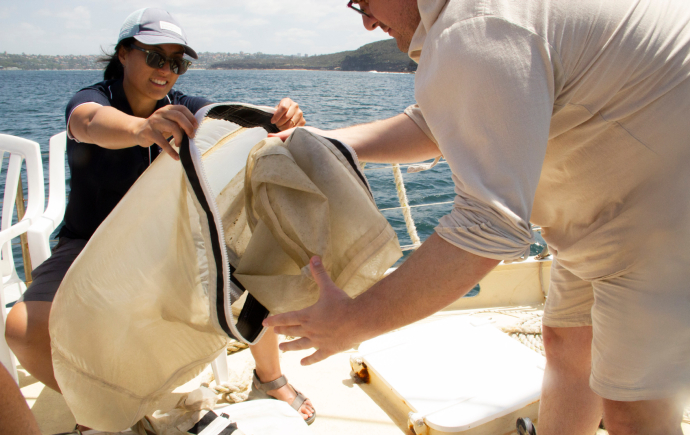
Dr Khay Fong collecting microplastic samples.
Dr Khay Fong didn't stumble into environmental chemistry.
She charged into it with the same conviction she brought to her university days, where she once marched in student protests for environmental and social justice.
But it was only after broadening her interests from a pharmacy focus at University of Newcastle that the pieces clicked. “Microplastics brought it all together - my passion for the environment, my background in nanotechnology and teaching in environmental chemistry," says Dr Fong, from the Monash University School of Chemistry.
That fit would eventually lead her from the labs of academia to the restless expanse of the ocean.
"We knew about microplastics," she explains. "But I didn’t realise how big the problem truly was."
In 2020, while partnering with Swiss NGO Sail & Explore, Dr Fong helped build a new sampling device that could detect plastic particles down to 50 microns, smaller than the eye can see.
"That was the turning point. We realised microplastics don’t just disappear; they fragment infinitely. They’re in everything."
Her team's findings were sobering. These were further underscored by other independent international studies which found that microplastics were turning up not only in fish, but in soils, coral reefs, even in human placentas. “There’s a study out of Hawaii that found plastic particles in placental tissue in 60% of placental samples from 2006, in 90% of 2013 samples, and in 100% of 2021 samples.”
Plastic, she admits, was once considered a miracle of modern chemistry.
"As a chemist, I consider it one of the best inventions ever. It can be made light or heavy, durable or degradable, a barrier to contaminants and so cheap to make that the disposable versions were sold in the '50s as the future of modern living."
But decades of assuming the environment could absorb endless amounts of human-made waste created an ecological time bomb. "It was a mix of bad attitude and worse infrastructure. They just assumed the Earth could take it," Dr Fong says.
Her expeditions with Sail & Explore aren’t just scientific endeavours they’re floating laboratories for democracy and diplomacy.
"We had two scientists and eight citizen scientists on a boat for a week. Yes, we were sampling ocean plastic. But we were also cooking, cleaning, managing egos, planning routes, dealing with feelings, all while trying to find microplastic ghosts in the water.
"The physical demands were high, but the emotional labour was higher. You end up being both a scientist and a tour guide."
Still, for Dr Fong, the challenge is worth it. "You can’t fix what you can’t measure. And most NGOs don’t have the chemistry background to build that yardstick. That’s what we’re trying to provide." With partnerships spanning Samoa, Port Phillip Bay, and Australia’s east coast, her work is carving a new standard for microplastic detection and environmental science.
Recently, Dr Fong co-developed an AI tool that dramatically speeds up the identification of microplastics in environmental samples. "You need data before you can make policy," she says. "We’re giving our collaborators, from our medicine faculty to local councils, hard evidence."
The goal? Real-world data that drives real-world decisions.
But for Dr Fong, the deeper transformation lies in green chemistry, a discipline long relegated to niche status but now emerging as a front-line solution in the climate change/environment crisis.
At Monash University, she is the Course Coordinator for the Master of Green Chemistry and Sustainable Technologies, a program she helped shape to reflect a radically different approach to science education.
"Everything we use, everything we touch, is chemistry. The only truly recyclable unit is the atom. Your shoes, your clothes, at the moment are only single-use before they're just waste. We need to design materials differently."
The program doesn’t just train chemists; it trains architects of sustainable systems.
"It’s not just learning. It’s applying knowledge to solve this generation’s defining issues. We’re training innovators who care where their chemistry ends up."
On the policy front, Dr Fong is clear-eyed about the barriers. "There have been five UN Environmental Program meetings just to decide how to talk about a legally binding international treaty to solve the plastic problem. We still don’t have global action. What we need is enforceable extended producer responsibility, make companies take back their own waste."
International frameworks are stalling, but Dr Fong continues to make progress at the intersection of science and education.
"Being an academic puts us in a unique position. We’re both at the forefront of discovery, and also encouraging the next generation to challenge convention and drive change from the bottom up."
When asked about her legacy, she laughs. "I’m still early in my career. But if there is one, I hope it’s as an educator who pushes innovation, but also deeply cares where her students go. We’re arming them with the tools to change things. That’s what gives me hope."
On World Environment Day 2025, when the world again wrings its hands over plastic pollution, Dr Fong will be where she always is: at the confluence of data and conviction, chemistry and change, equipping others to chart cleaner waters.
Further information
Silvia Dropulich
Marketing, Media & Communications Manager, Monash Science
T: +61 3 9902 4513 M: +61 435 138 743
Email: silvia.dropulich@monash.edu