
Dhruti Bhatta
Medicine, Nursing and Health Science
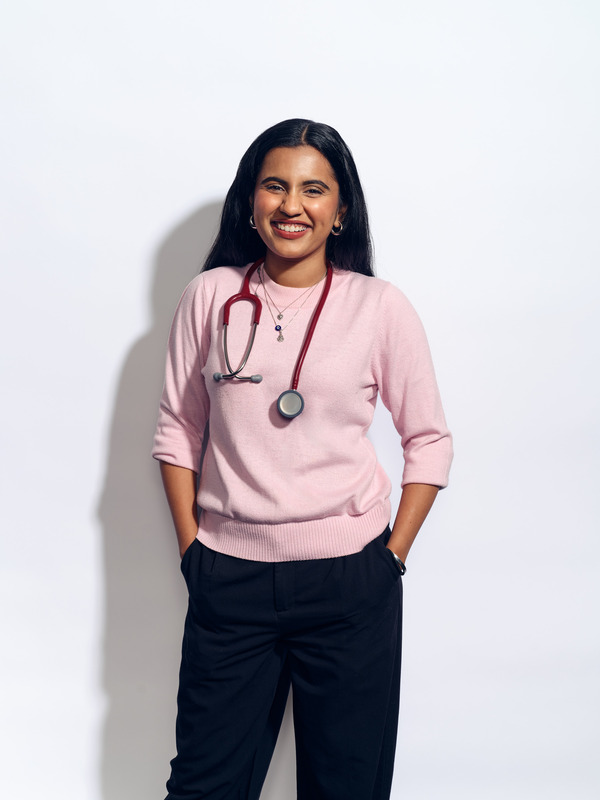
Born and raised in Singapore to Indian migrant parents, she often found herself existing in the spaces in between. As a self-described third culture kid, belonging was never something she took for granted. It was something she learnt to build.
Dhruti was largely raised by her grandparents while her parents worked tirelessly to create stability. Her grandparents had experienced extreme hardships and had already made profound sacrifices so that her father could access an education. To complete his education he had to study under a kerosene lamp after the sun set, and to take his public exams he had to walk over 15 kilometres each way.
"University was always something I thought of as a sacrifice," she says. "If I wanted a further education, it meant everyone was going to have to give something up for me."
The love that shaped her childhood was quiet but powerful. Her grandparents learned English in their seventies to communicate with her. They taught her to read, write and navigate the world, all while carrying experiences of hardship that Dhruti only fully understood as she grew older.
"I never realised that everything I enjoyed came at the cost of everything they had given up."
Dhruti never imagined leaving Asia. As the daughter of migrants, she assumed that her future included remaining close to home, continuing to build on the foundations her parents had worked so hard to create.
Her decision to pursue medicine changed this. Inspired by the women in her family, particularly her mother and grandmother, she became increasingly committed to improving health outcomes for women and culturally diverse communities who have historically been overlooked by healthcare systems.
When Dhruti told her family she wanted to study medicine, their first response was no. They had spent their lives protecting her from struggle, and this path seemed filled with hardwork and uncertainty. Despite this her parents soon backed her ambitions, making sacrifices of their own so she could pursue opportunities they had never imagined for themselves.
Arriving at Monash meant stepping further from home than she had ever been. During Orientation Week, everything felt unfamiliar, from the late summer sunsets to moving into a residence room that didn't yet feel like hers. But in shared kitchens, open doorways and conversations with other students finding their own footing, Dhruti discovered something unexpected: community.
As a woman of colour entering medicine, however, finding confidence in those spaces did not happen immediately.
During a clinical placement, a senior emergency consultant noticed this.
He looked at me and he's like, stop saying sorry. ”
The educator observed that Dhruti frequently apologised before entering a space or asking questions. He challenged her to consider why she felt the need to minimise herself and ask for permission to enter spaces and discussions that she had worked extremely hard to earn a place in.
His words stayed with her.
For years, Dhruti had unconsciously softened parts of herself to fit in. She had adjusted the way she spoke, tried to blend into clinical environments and distanced herself from aspects of her identity in the hope of belonging. For the first time, someone had not only noticed, but encouraged her to show up fully as herself.
"I think I felt my brain chemistry changed that day," she said. Today, Dhruti introduces herself to patients using her name exactly as it is meant to be pronounced. She no longer apologises before entering spaces or contributing to discussions.
Instead, she takes up space unapologetically, not just for herself, but for everyone who isn't in these rooms yet. Every room she enters she carries the sacrifices, resilience and dreams of the generations before her with pride.