
Geraldine Burke
Faculty of Education
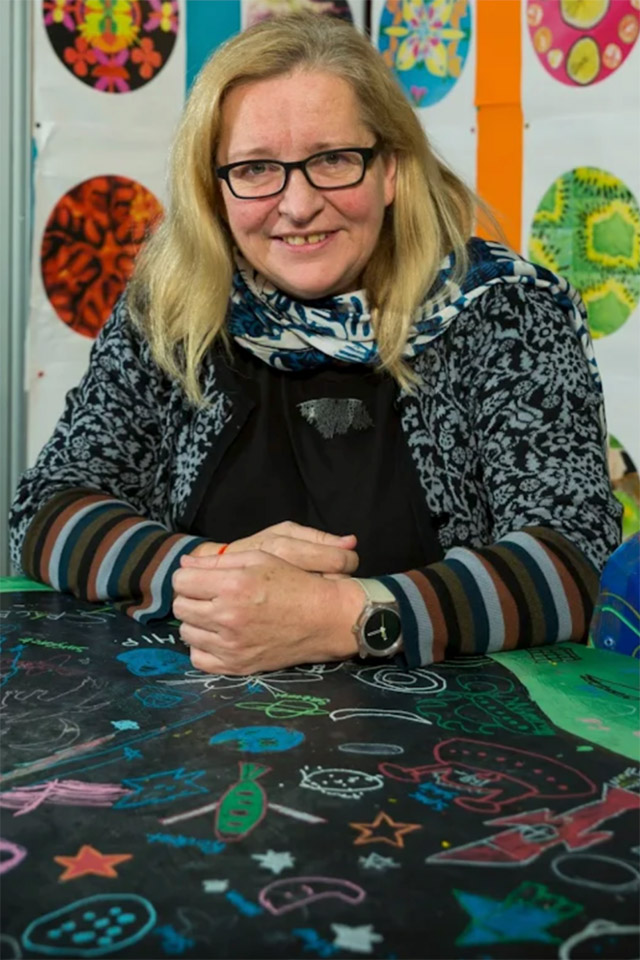
Transforming education through Art Reach
Geraldine integrates intergenerational, community and First Nations knowledge beyond the classroom.
What are you doing differently in your field that you believe is driving real change?
By embedding ‘Art Reach’ projects into my units, we are able to undertake intercultural, intergenerational, cross-sectoral and interdisciplinary learning together. These dynamic learning experiences see Monash students get to teach/learn/create art/and engage with and learn alongside First Nations artists, seniors, children, gallery educators and teachers. These Art Reach experiences are uplifting for all and shift understandings, stereotypes and our capacity to make a difference.
How do you help students build confidence, not just knowledge?
I often say to the students, it’s ok to make mistakes in their artmaking or their initial plans for art lessons. Mistakes can be reimagined as opportunities for learning, and true creative learning involves stumbling blocks, perseverance, and breakthrough moments. By engaging in their own creative journeys, students gain a sense of agency in their creative expression, and a stronger sense that, in turn, they can plan and curate creative classes for the children they will go on to teach.
What do you hope your students take away from their time with you?
I want them to take away a sense of hope that moves into action! We live in a time where there are a lot of real-world worries and anxieties. Through art education we can explore big issues and topics together that impact our lives. Artistic expression can be a way to stay motivated and resilient. I hope our students take away strategies for hope through creative expression and that they remember that artful play can foster a sense of relationality and co-creation with the world around us.
I love it when our students share gratitude statements with the children, seniors and First Nations artists they work with. Many students have expressed their gratitude to First Nations artists for their generosity and wisdom, and have suggested that in their future teaching they will make a commitment to exploring Indigenous art and knowledge in respectful ways that work with Indigenous protocols. I also notice how the students begin to consider intergenerational possibilities as a means to share local knowledge, wisdom and experiences. When our students learn alongside seniors and children, they report shifts in their thinking about each other, leading to less stereotypical assumptions of each other.
By engaging in their own creative journeys, students gain a sense of agency in their creative expression, and a stronger sense that, in turn, they can plan and curate creative classes for the children they will go on to teach. ”
What mindset do you want your students to carry into their careers?
Art education doesn’t just teach technique—it empowers individuals to envision and create a better world. We live in times where there are lots of worries. Art education can work at building understandings and actions for change through intergenerational awareness, cultural sensitivity and community connection. I hope that students develop a mindset where they can call on the arts as a form of relational practice that includes humans and non-humans. That art can transform into artivism as a response to the times in which we live. That art can be an act of care between people and that art can also lead to a type of affirmative ethics, where we can explore our present and speculate towards an inclusive future.
What does being a 'Changemaker’ mean to you personally?
I think it's about chipping away at status quo approaches that need to be reimagined, and working relationally with people, so that people understand the direction and the intention of the change and why it's important. Sometimes it's uncomfortable to be a changemaker – it places you at the edge of boundaries, yet through art and the sensitivities that the arts allow, and the conversations the arts enable, we can address shifts in thinking and work at understanding between people. I think this is a highlight of intergenerational learning where different generations can come together to rethink stereotypes about each other through their mutual engagement.
How do you tailor your teaching approach to engage and inspire today's students?
I tailor my teaching approaches so that students live their inquiry. When our Monash students co-facilitate art reach experiences with children, seniors or First Nations artists, they learn that their actions make tangible change. The Monash students learn that they can inspire others and amplify the creative stories and expressions of those they teach. At the same time, the Monash students explore their creative potential as a means to build confidence and foster empathy and social awareness.
What does being a teacher allow you to do that nothing else can?
Currently I am part of a Monash Collective that is exploring the project 'Learning with the Land: Learning with Respect'. Through arts-based approaches, I am learning to learn with Country and with First Nations artists and knowledge holders in ways that challenge status quo approaches to art education. I am so grateful for these experiences that move way beyond the classroom in ways that I hope will build system change and a deeper respect for First Nations knowledge.