
Jae Pyun
Faculty of Pharmacy and Pharmaceutical Sciences
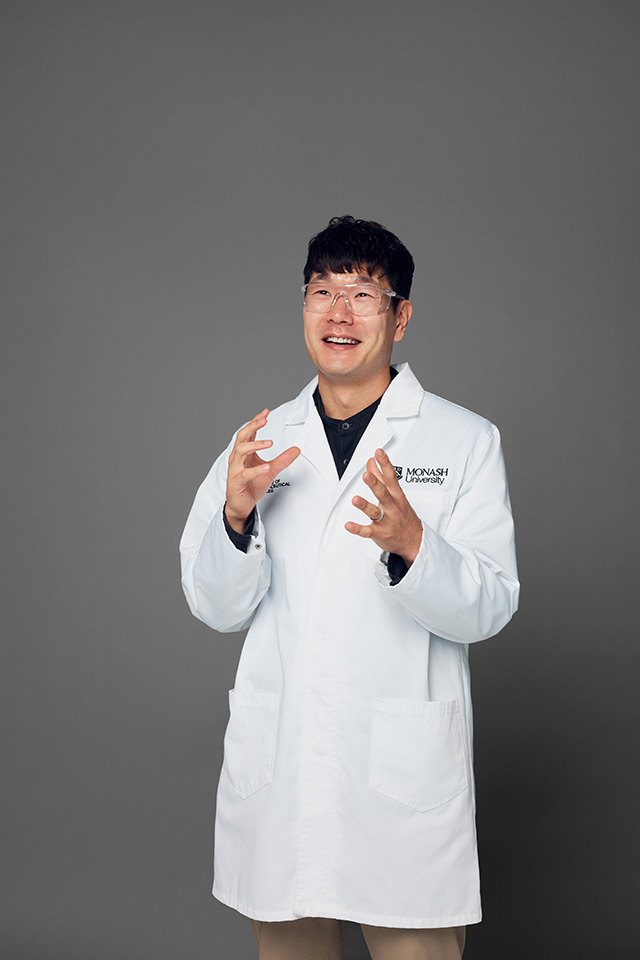
AI – not just a tool, but a partner in how we teach
Jae embeds real-world scenarios to spark curiosity, and designs assessments that help students recognise their own growth.
What are you doing differently in your field that you believe is driving real change?
As an education-focused academic in pharmacy and pharmaceutical sciences, I’m at the forefront of integrating AI, particularly custom GPTs into higher education to transform learning and assessment. I’m not just exploring AI as a tool, but as a pedagogical partner. Through funded research projects across Monash and with the University of Warwick, I’ve been developing and evaluating AI-driven feedback systems, and interactive digital support tools that respond to how students think, not just what they know. This is not about replacing teachers, but enhancing the way we foster curiosity, reflection, and problem-solving skills our students need for the future of work.
How do you help students build confidence, not just knowledge?
Confidence grows when students feel connected to what they’re learning and see its relevance. I use real-world scenarios to spark curiosity like linking a lab experiment on a diagnostic process or how students would use this in their prospective careers. Students have those ‘aha’ moments that change their perspective. I also build assessments to help them reflect on feedback, improve iteratively, and recognise their own growth. They realise they can think like scientists and professionals, and that builds intrinsic motivation and shapes benefits for lifelong learning.
I want students to carry a mindset of curiosity, ethical responsibility, and confidence in ambiguity. ”
Is there a student moment you’ll never forget, and why?
One moment I’ll never forget was when a student who had doubted their ability told me, “You have made me so curious about the brain and how things go wrong in neurodegenerative disease. I want to know more! (the student went on to pursue a PhD in neuroscience).” That moment reminded me why I teach not to deliver content, but to open doors and minds. Watching students go from hesitant to self-assured, then progress into research or industry roles, is incredibly fulfilling.
What mindset do you want your students to carry into their careers?
I want them to carry a mindset of curiosity, ethical responsibility, and confidence in ambiguity. Whether they end up in biotech startups, regulatory bodies, or hospitals and communities, I want them to keep asking questions, reflect critically, and embrace lifelong learning.
What legacy or ripple effect do you hope to leave behind?
I strive to leave a legacy where education in pharmacy and pharmaceutical sciences are as dynamic and innovative as the industries themselves. By pioneering AI-enhanced learning, student-centred assessments and showing the sector how we can realisticallyassess in the age of AI, I hope to inspire a cultural shift, one where educators feel empowered to innovate and students feel truly prepared for real-world complexity.
What’s something about Monash that would surprise people?
Monash University genuinely backs educational innovation. I’ve been supported to lead international collaborations, apply for teaching-focused grants, and embed AI research into curriculum all in an education-focused role. It’s rare to find an institution that values teaching impact at this level, and I’m proud to be part of that culture.
What motivates you to continue pushing boundaries in your work?
Students. Their curiosity, challenges, and potential fuel my drive to innovate. Seeing the impact of a well-designed activity or hearing how a AI tooI helped create unlocked someone's understanding, that's what keeps me going. Education is never static, and neither am I.
Was there a turning point that brought you to becoming an educator, or did you always know you'd end up here?
There was definitely a turning point during my work as a lab demonstrator. I started teaching and saw how transformative the classroom could be, not just for students, but for me too. That first moment when a student connected the dots because of something I designed or explained which made it clear and the positive feedback was a major turning point.
How would you explain your role to someone who’s never met a university educator?
I’m a guide, a designer, and a connector. I create environments where students don’t just learn facts but rather they learn how to think, communicate, and adapt in real-world contexts. I help shape the future of education by researching and trialling new ways of teaching, especially with digital and AI tools.