Monash Report 2024 – Goal 1

Something missing?

Explore more Sustainable Development Goals (SDGs)




 2024 Research Performance
View
2024 Research Performance
View

In 2024 Monash University researchers produced 78 publications related to SDG 1, with a mean Field-Weighted Citation Impact (FWCI) of 1.07.
What is Field-Weighted Citation Impact?
Field-Weighted Citation Impact (FWCI) refers to the ratio of the actual number of citations received by a research output and the total citations expected based on the average of the subject field. An FWCI value of 1 may be interpreted as having ‘world average impact’. Thus, a publication with an FWCI of more than 1 indicates higher than expected citations based on the global average for similar publications. As FWCI reflects citations received to date, a publication’s FWCI value may fluctuate over time.
 From crunch to crisis: How Australians are changing their spending habits
View
From crunch to crisis: How Australians are changing their spending habits
View

Monash University's Australian Consumer and Retail Studies (ACRS) conducted research revealing that Australians are increasingly spending more on necessities like housing, insurance, and groceries due to cost-of-living pressures. The study highlights a significant shift in consumer behaviour, with many Australians perceiving these essential items as unfairly priced and reporting increased spending across these categories compared to the previous year. The research also indicates a trend towards more price-driven purchasing decisions, with consumers opting for lower-priced brands and pre-owned products. Despite these challenges, a majority of Australians are still managing to save a portion of their income, although a notable percentage are unable to save at all. This research is crucial in understanding the financial challenges faced by Australians and the impact on their spending habits, contributing to the broader goal of reducing poverty.


 Can blockchain-based microcredit transform financial inclusion?
View
Can blockchain-based microcredit transform financial inclusion?
View

The study funded by the Ethereum Foundation explores the potential of blockchain-based microcredit systems to enhance financial inclusion in Kenya, particularly for microentrepreneurs. This initiative aligns with SDG 1 by aiming to alleviate poverty through improved access to financial services. It also supports SDG 8 by promoting economic growth and entrepreneurship. The research identifies financial literacy as a barrier and suggests educational strategies to overcome it, aligning with SDG 4. The study highlights the potential of blockchain to address limitations of existing systems like M-Pesa, contributing to SDG 9 and SDG 10 by fostering innovation and reducing inequalities. Monash Business School and the Monash Blockchain Technology Centre are involved in this research, emphasizing the university's role in advancing financial inclusion through innovative technologies.


 Unit statistics and highlights
View
Unit statistics and highlights
View
In 2024, Monash offered 34 units directly related to SDG 1, with 6432 total enrolments.
Highlighted below are a few of the units at Monash related to Ending Poverty:
 Unit Spotlight: ECF5590 - Poverty, inequality and opportunity
View
Unit Spotlight: ECF5590 - Poverty, inequality and opportunity
View
The unit "Poverty, inequality and opportunity" (ECF5590) at Monash University examines the multidimensional nature of poverty and inequality through an economic lens, exploring both theoretical frameworks and empirical evidence. Students analyze how poverty is conceptualized and measured across different contexts, investigate the complex relationships between economic growth, inequality, and poverty reduction, and evaluate various policy interventions designed to address these challenges.
The unit takes a global perspective, comparing approaches across developed and developing economies while considering the roles of institutions, governance, and social protection systems. Through critical engagement with contemporary research and case studies, students develop the analytical skills needed to assess the effectiveness of poverty reduction strategies and contribute to evidence-based policy discussions on creating more equitable and inclusive societies.

 Building a sustainable future
View
Building a sustainable future
View
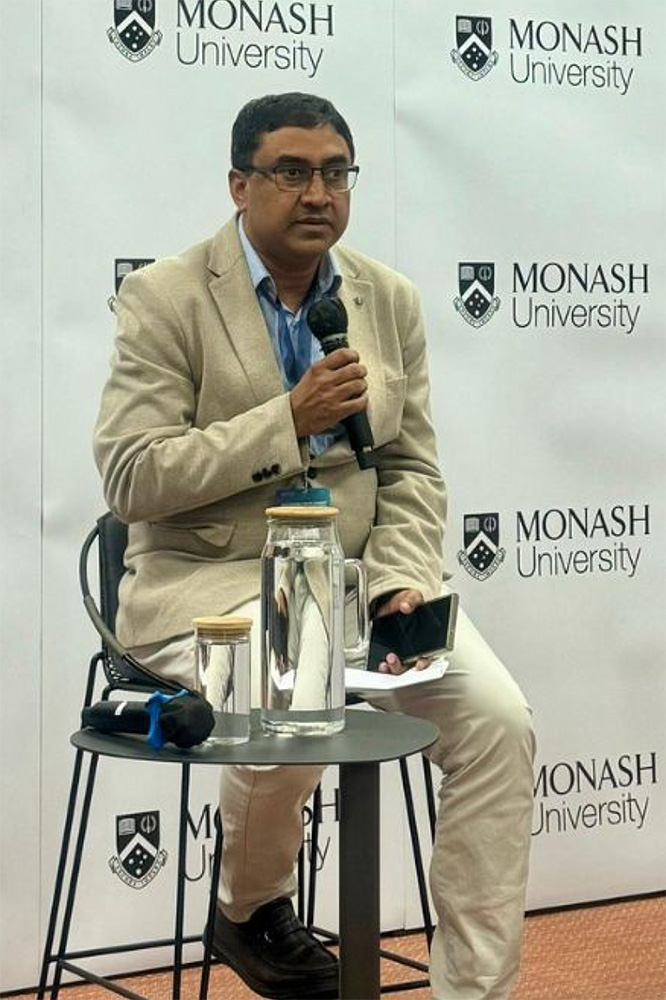
The 2024 Sustainable Development for Thriving Communities Conference, held at Monash University in Indonesia, brought together researchers and policymakers to address sustainable development and climate change. Organised by the Centre for Development Economics and Sustainability (CDES) at Monash Business School, in partnership with Monash University in Indonesia and Malaysia, the World Bank’s East Asia and Pacific Chief Economist Research Center (EAPCE), and the Asian Development Bank Institute (ADBI), the conference focused on topics such as climate change adaptation, renewable energy, sustainable agriculture, and inclusive economic development. The event highlighted the importance of collaboration between researchers, policymakers, and stakeholders, and the use of big data and data science for evidence-based policymaking. A policy session on Social Protection and Poverty Alleviation underscored the role of research in reducing poverty in Indonesia, showcasing the impact of evidence-based approaches like Randomised Controlled Trials (RCTs).
Read the full article from Monash Malaysia News


 Youth barometer paints a bleak picture of young Australians in 2024
View
Youth barometer paints a bleak picture of young Australians in 2024
View

The 2024 Australian Youth Barometer highlights the challenges faced by young Australians, including housing affordability, employment, and climate change. The report reveals that many young people experience anxiety, financial difficulties, and underemployment, with a significant portion feeling pessimistic about their financial future. Despite these challenges, a large number of young Australians are actively volunteering, particularly in welfare, arts, and environmental activities. The findings emphasise the need for increased government support and community involvement to address these issues.
 Support for students experiencing financial hardship
View
Support for students experiencing financial hardship
View

Monash University offers comprehensive financial assistance to support students experiencing financial hardship. This includes emergency support payments, food assistance, and help with essential living costs. The university provides scholarships and grants for disadvantaged students, interest-free loans, and assistance with housing, textbooks, and transportation. Financial counseling services, budgeting workshops, and employment assistance are also available to aid students' financial stability.
Access Monash Mentoring
View

Monash students participating in the Access Monash Mentoring program delivered intensive one-on-one mentoring to Year 11 and 12 students from low socio-economic status backgrounds aspiring to attend university. In 2023, Monash student mentors paired with 500 Year 11 and 12 students from partner schools to support them in their transition to higher education.