Monash Report 2023 – Goal 10

Close

 2023 Publications Performance
View
2023 Publications Performance
View

Monash Research Outputs: 281
Mean Field Weighted Citation Impact (FWCI): 1.53
3 Year Rolling Mean FWCI: 1.8
 Global Survey of Professionals Supporting Deafblind Individuals
View
Global Survey of Professionals Supporting Deafblind Individuals
View
Faculty of Arts researchers collaborated with Able Australia and the National Accreditation Authority for Translators and Interpreters (NAATI) to conduct a global survey on the experiences and perspectives of professionals who provide support services to deafblind individuals. The study highlighted the need for improved training and standardization in the field.

Further relevant SDGs:


 Reducing Homophobic Behaviours in Sport
View
Reducing Homophobic Behaviours in Sport
View
Monash research showed an education approach used widely by sport organisations to stop harmful homophobic behaviour and other forms of discrimination was ineffective. Published in the British Journal of Sports Medicine, the study evaluated the effectiveness of using professional rugby athletes to educate young players about the harms of homophobic behavior in sports. The study found this approach had no effect on reducing homophobic language.
Further relevant SDGs:


 Fostering Trust in Interpreting Services
View
Fostering Trust in Interpreting Services
View
Faculty of Arts researchers have explored the challenges faced by interpreters, particularly in gaining public trust and ensuring quality in interpreting services for minority language speakers in Australia, including the Korean diaspora and Indigenous communities. Their study addresses issues in legal and institutional settings, emphasising the need for professional ethics, confidentiality, and impartiality in interpreting.

Further relevant SDGs:
 Building Self-Determination in Young People with Disability
View
Building Self-Determination in Young People with Disability
View
Researchers from Monash University's Krongold Clinic have been awarded the Scope Dr Jennifer Fitzgerald Research Grant to develop a digital toolkit that empowers young people with disability to engage in community programs in ways that builds their autonomy and competence. The grant will enable the researchers to understand the key barriers and enablers for self-determination of young people with disability in community settings.

Further relevant SDGs:
 Protecting Children with Disability in Child Protection
View
Protecting Children with Disability in Child Protection
View
Faculty of Medicine, Nursing and Health Sciences researchers led a study highlighting the systemic neglect and criminalisation of children with disabilities within child protection systems in Australia. The study, conducted in collaboration with Western Sydney University and the Centre of Evidence and Implementation, was published by the Royal Commission into Violence, Abuse, Neglect and Exploitation of People with Disability.
Further relevant SDGs:
 AI and Ageism in Aged Care
View
AI and Ageism in Aged Care
View
A study by Arts and Medicine, Nursing and Health Sciences researchers published in the Journal of Applied Gerontology found that the use of artificial intelligence in aged care can exacerbate ageism and social inequalities, due to the choices of carers on how best to use technology for older people in these settings. The study highlights the need for AI technologies to be integrated thoughtfully into aged care, considering the dignity, autonomy, and well-being of older residents.
Further relevant SDGs:

 Confronting Inequality in Leadership Recruitment
View
Confronting Inequality in Leadership Recruitment
View
Researchers at Monash Business School showed that ethnic discrimination is particularly pronounced in the recruitment for leadership positions. The study sent over 12,000 job applications to test callback rates for ethnic minorities versus those with English names, and significant discrimination for applicants with non-English names, especially in leadership roles.
Further relevant SDGs:
 The HEARD Project
View
The HEARD Project
View
A research project designed to address health inequalities experienced by Malaysia’s Deaf community received the inaugural Nature Award for Inclusive Health Research. The HEAlth caRe needs of the Deaf (HEARD) project, led by researchers in Monash University Malaysia Jeffrey Cheah School of Medicine and Health Sciences, tackles the unmet health needs of the approximately 55,000 people in Malaysia registered as Deaf and hard of hearing, and delivers practical solutions to help improve their health outcomes.
Further relevant SDGs:
 Unit Statistics and Highlights
View
Unit Statistics and Highlights
View
In 2023, Monash offered 174 units directly related to SDG10 with 13,140 total enrolments.
The units highlighted below are a small sample of the units at Monash relating to reducing inequality:
 Indigenous Graduate Program Prato Experience
View
Indigenous Graduate Program Prato Experience
View
Monash University's inaugural Indigenous Graduate Program cohort traveled to the Monash Prato Centre in Italy for a two-week professional development experience. The program, designed in collaboration with various Monash faculties, focuses on enhancing intercultural communication skills and understanding the university's global reach. Activities include professional development sessions, a cultural exchange workshop, and networking with international colleagues.

Further relevant SDGs:

 Graduate Disability Internship Program
View
Graduate Disability Internship Program
View
The Graduate Disability Internship program, hosted by the Rossjohn Laboratory in the Monash Biomedicine Discovery Institute, offers student scholarships and graduate internships to people with disabilities in order to broaden the diversity of people engaged in scientific discovery and to offer an inclusive opportunity to gain career experience in biomedical research.

Further relevant SDGs:
 National Indigenous Space Academy
View
National Indigenous Space Academy
View
Led by Monash's Professor Christopher Lawrence and supported by the Australian Space Agency, the National Indigenous Space Academy (NISA) paves the way for First Nations STEM students across Australia to intern at NASA’s Jet Propulsion Laboratory (JPL) in the US. As part of the program, students will spend time at Monash’s Faculty of IT for a ‘Space Boot Camp’ internship preparation program to familiarise themselves with aerodynamics, robotics, astrophysics, planetary science, engineering, computer and earth sciences as well as past and current space exploration missions at NASA.

Further relevant SDGs:
AllPlay Footy
View
AllPlay Footy, a partnership between the Faculty of Education’s Monash Krongold Clinic and the AFL, aims to make community football accessible for children with disabilities. The program involves the development of over 360 tools and resources to support inclusive participation in football, addressing physical, mental health, and social inclusion benefits.

Further relevant SDGs:
 Monash Sensory Science
View
Monash Sensory Science
View
Monash Biomedicine Discovery Institute’s inclusive science literacy initiative Monash Sensory Science, was named a finalist in the 2023 Victorian Premier's Design Awards. The program uses multisensory design to make biomedical science accessible to blind, low vision, and diverse-needs communities, enhancing science communication through exhibitions and multisensory books.

Further relevant SDGs:
 Exploring Comedy's Impact on Social Change
View
Exploring Comedy's Impact on Social Change
View
Media & Communication Studies in the Faculty of Arts hosted a panel discussion exploring the impact of comedy on social change in Australia. The discussion focused on the role of comedy in reflecting and shaping societal values, inclusion, and democratisation, particularly highlighting the contributions of Indigenous, migrant, and LGBTQI communities.

Further relevant SDGs:
 Contribution to Australian Book Review's Indigenous Issue
View
Contribution to Australian Book Review's Indigenous Issue
View
Sir John Monash Distinguished Professor Professor Lynette Russell AM was guest editor of the Australian Book Review’s special Indigenous Issue, enhancing representation of First Nations voices in Australian critical culture. The issue addressed historical omissions and supported the Voice to Parliament, advocating for informed legislative processes regarding First Nations people.
Further relevant SDGs:
 Pride at Play Exhibition
View
Pride at Play Exhibition
View
The Pride at Play exhibition, curated by Dr. Xavier Ho from Monash Design, showcased queer indie game design, celebrating LGBTQIA+ narratives in games. It featured interviews and playable games, aiming to make queer games more accessible and to highlight the contributions of LGBTQIA+ game makers.

Further relevant SDGs:
IMPARO Project
View
The Interpreting Mentoring and Professional Advancement Regional Opportunities (IMPARO) project was developed by Arts and IT researchers in partnership with Wise Well Women to empower interpreters and translators in regional communities, particularly those from refugee and migrant backgrounds. It focuses on professional development and certification pathways for Non-Professional Interpreters and Translators (NPITs) through workshops, mentorship, and digital resources.

Further relevant SDGs:
 Voice to Parliament Handbook
View
Voice to Parliament Handbook
View
The Monash Club hosted a Voice to Parliament Handbook reading event with co-author Thomas Mayo to educate and engage the community about the Indigenous Voice to Parliament, its significance in addressing social inequalities and promoting equal rights for Indigenous Australians and for fostering reconciliation in Australia.
Further relevant SDGs:
 Disability Support Services
View
Disability Support Services
View
Monash promotes access and equity for students who have a disability, ongoing medical or mental health condition. In 2023, 3807 students were registered with Disability Support Services at Monash University, an increase of 12 per cent (or 453 registrations) from 2022. There were 1617 new student registrations compared to 1455 in 2022.
Further relevant SDGs:
 Ally Network
View
Ally Network
View
The Ally Network champions Monash as a safe and inclusive space for individuals of diverse sexual orientations, gender identities and expressions, encompassing lesbian, gay, bisexual, transgender and gender diverse, intersex, queer and questioning, asexual and aromantic, plus other identities (LGBTIQA+) students and staff.
In 2023, 207 staff and 91 students completed the LGBTIQA+ Ally training program, contributing to the number of registered allies across our Australian campuses. Additionally, 404 staff and 1210 students completed Queer 101 training.

Further relevant SDGs:
Indigenous Employment and Engagement Team
View
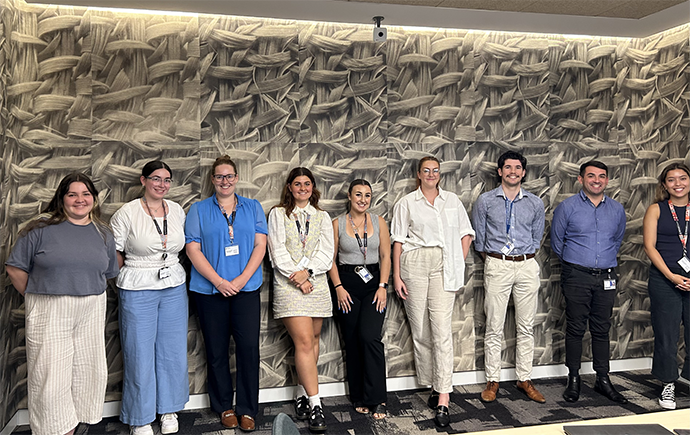
Monash HR and the William Cooper Institute established an Indigenous Employment and Engagement Team to promote employment and professional development opportunities for Indigenous people. The initiative followed the launch earlier in 2023 of the Monash Indigenous Graduate Program as well as an Indigenous Traineeship program, enhancing Monash's reputation as a culturally safe and inclusive employer. in recognition of these efforts to address barriers to Indigenous employment, Monash was awarded the Australian Human Resources Institute's "Best Diversity, Equity and Inclusion Strategy Award".
Further relevant SDGs: