
AI-enabled health evidence for South-East Asia and the Western Pacific one step closer
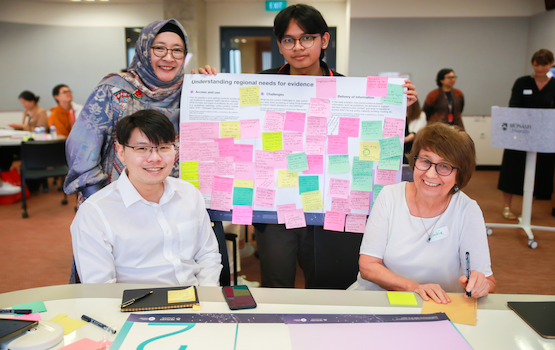
Monash University hosted workshops with participants across 10 countries to discuss how an AI-enabled platform could improve access to health and medical research. Photo credit: Ricky Apriyanto
Key points
- Clinicians, patients and governments often rely on outdated guidance when making clinical decisions, potentially leading to poorer and avoidable health outcomes
- Monash University and regional partners will leverage Artificial Intelligence (AI) to give users access to the latest health and medical research and evidence in near real-time
- The proposed AI-enabled platform will be especially critical during health emergencies, such as disease outbreaks or other crises
Monash University is set to develop a technology roadmap for an AI-enabled platform that will connect healthcare professionals, policymakers and community members with the latest health and medical research in near real-time.
Outdated clinical guidelines present major challenges for the healthcare sector, where even small delays can compromise responses to emergencies such as pandemics or local outbreaks.
To inform the roadmap, Monash hosted two workshops in 2025 in collaboration with the World Health Organization (WHO) and Cochrane, attended by over 70 health representatives across Australia, China, India, Indonesia, Malaysia, New Zealand, Philippines, South Korea, Switzerland and Thailand.
The landmark regional project identified the needs, barriers and enablers to providing continuously updated health and medical research evidence to decision-makers across South-East Asia and the Western Pacific.
The workshops’ findings have been published in a new report, Co-designing a Living Evidence Architecture: Understanding the needs of South-East Asia and the Western Pacific, which reveals how an AI-supported, regionally coordinated evidence platform could transform access to the latest health research.
The initiative is being led by Monash’s Australian Living Evidence Collaboration (ALEC), Monash Art, Design and Architecture (MADA), Faculty of Information Technology (FIT), and Monash Indonesia.
Professor Tari Turner, Director of ALEC, said living evidence is a new infrastructure for health knowledge, one that can evolve with our understanding and adapt to local realities.
“This work shows that through collaboration and co-design, we can make evidence truly living and global in impact,” Professor Turner said.
Associate Professor Leah Heiss, co-design lead from MADA, said this regionally-led research positions Australia at the forefront of reimagining how the world uses evidence to improve health outcomes.
“Participants called for an AI-enabled centralised platform that is adapted to the needs of different communities to deliver trusted health information,” Associate Professor Heiss said.
Associate Professor Grace Wangge, from the Master of Public Health program at Monash University, Indonesia, said the initiative will spotlight evidence and best practices from South-East Asia.
“Too often, the valuable medical insights generated right here in the region don’t make their way into everyday clinical practice, even though they’re highly relevant to our local contexts,” Associate Professor Wangge said.
Professor John Grundy, from the Faculty of Information Technology, said ethical, locally developed AI is vital for our region.
“Our next step is to develop a technology roadmap to support creation of a living evidence platform that reflects local needs and values and supports transparent, equitable decision-making,” Professor Grundy said.
Once the technology roadmap is completed, the project team will actively pursue funding to support its development, testing and implementation across the region.
Funded by the Monash University 2025 Incubator Program, this initiative builds the foundation for a regional Living Evidence Architecture (LEA) — a long-term vision to accelerate the translation of health research into policy and practice across borders.