2022 Publications Performance
View
2022 Publications Performance
View

Monash Research Outputs: 304
Mean Field Weighted Citation Impact (FWCI): 1.71
3 Year Rolling Mean FWCI: 1.59
 Enhanced Telehealth
View
Enhanced Telehealth
View
The Enhanced Telehealth Capabilities project led by Human Centred Computing in the Faculty of IT (and funded by the national Digital Health CRC) seeks to enhance the reach of traditional telehealth services, which only offer basic voice and video communication, by providing more advanced additional functions like automated documentation, automated voice translation or real time in-consultation monitoring (e.g. to enable a medical practitioner to see a patient’s heart rate trace on screen).
The project seeks to reduce inequalities, both by giving greater access to existing telehealth services (e.g. to those from culturally and linguistically diverse backgrounds), but also by increasing the number of clinical situations that can be handled by such systems. The latter is particularly important in underserved rural and remote communities around the world.
Other SDGs:

 Land Tenure and Climate Mobility in the Pacific
View
Land Tenure and Climate Mobility in the Pacific
View
Land Tenure and Climate Mobility in the Pacific examines the land, climate and conflict intersections in jurisdictions in the Global South. Prof Daniel Fitzpatrick, Faculty of Law, prepared the research under the guidance of the Pacific Resilience Partnership Technical Working Group on Human Mobility (PRP TWG-HM), chaired by the International Organization for Migration. The research reviews climate change for land tenure; reflects on lessons learned and best practices, and provides policy and programmatic recommendations to support policy development. A set of practical instruments were also produced to implement the research brief recommendations in 2023.
Other SDGs:



RetroFit Kit
View
RetroFit Kit is an ongoing research project led by Monash Art, Design and Architecture (MADA) in collaboration with the Australian Human Rights Commission Disability Discrimination Commissioner. It is conducted through education units in MADA. The project aims to increase the volume and supply of dignified and inclusive homes for people with disability through design-enabled strategies. It demonstrates design tools for how common house types can be systematically modified to achieve accessible home environments for people with disability, their families, carers and future residents.
In 2022 the RetroFit Kit Exhibition was delivered in partnership by the Australian Human Rights Commission and MADA. The project received the Award of Merit in the 2022 DIA - Awards and was a finalist in the 2022 Victorian Premier’s Design Awards.

 Digital technologies and the State in Pandemic Times
View
Digital technologies and the State in Pandemic Times
View
Dr Stefan Bächtold from the Monash University Malaysia School of Arts and Social Science has analysed how digital technologies challenged, but also performed and stabilised state authority in Malaysia and Myanmar during the global COVID-19 pandemic. His work used discourse analysis and ethnographic methods to observe the digital practices that stabilise and destabilise state authority in pandemic times, improving our understanding of how digital technologies are interacting with politics and power in Southeast Asia.
 Unit Statistics and Highlights
View
Unit Statistics and Highlights
View
In 2022, Monash offered 243 units directly related to SDG10 with 13,588 total enrolments.
The units highlighted below are a small sample of the units at Monash relating to reducing inequality:
 Borders, People and Identity
View
Borders, People and Identity
View
Hosted by Monash University Malaysia’s School of Arts and Social Science, AMU2625 Borders, People and Identity - Migration in the 21st Century is a cornerstone unit that explores the political, economic and social determinants of national migration policies and the impact that these policies have on migrants around the world, including underprivileged migrants (in low or semi-skilled jobs) and involuntary migrants such as refugees and asylum seekers.

Master of Indigenous Business Leadership
View
The Master of Indigenous Business Leadership is jointly offered by the William Cooper Institute and Monash Business School to strengthen Australia’s Indigenous workforce in public, private and community sectors. The course collaborates with the Munarra Centre for Regional Excellence in Shepparton to deliver business hackathons, as well as Deloitte Indigenous Services Group, whose support for the programme includes work experience and internship placement, mentoring and sponsorship opportunities.
The program received a 2022 Wurreker Award by the Victorian Aboriginal Education Association Inc for excellence in Indigenous education and community partnership to Support career development and employment outcomes for Indigenous students.

Indigenous Business Leadership Study Program
View
This capstone unit in the Monash Master of Indigenous Business Leadership, unit BEX5504 Indigenous Business Leadership Study Program has students examine a broad range of social, legal and political issues that can impact on the strategy and operations of operating in an Indigenous business environment. Through the use of readings, case studies, and an analysis of current events, the unit confronts students with some specific challenges of doing business in an Indigenous context. This unit develops skills and understanding of citizenship, cultural sensitivity and effective teamwork.
Tracking Access and Success: Underrepresented Groups
View
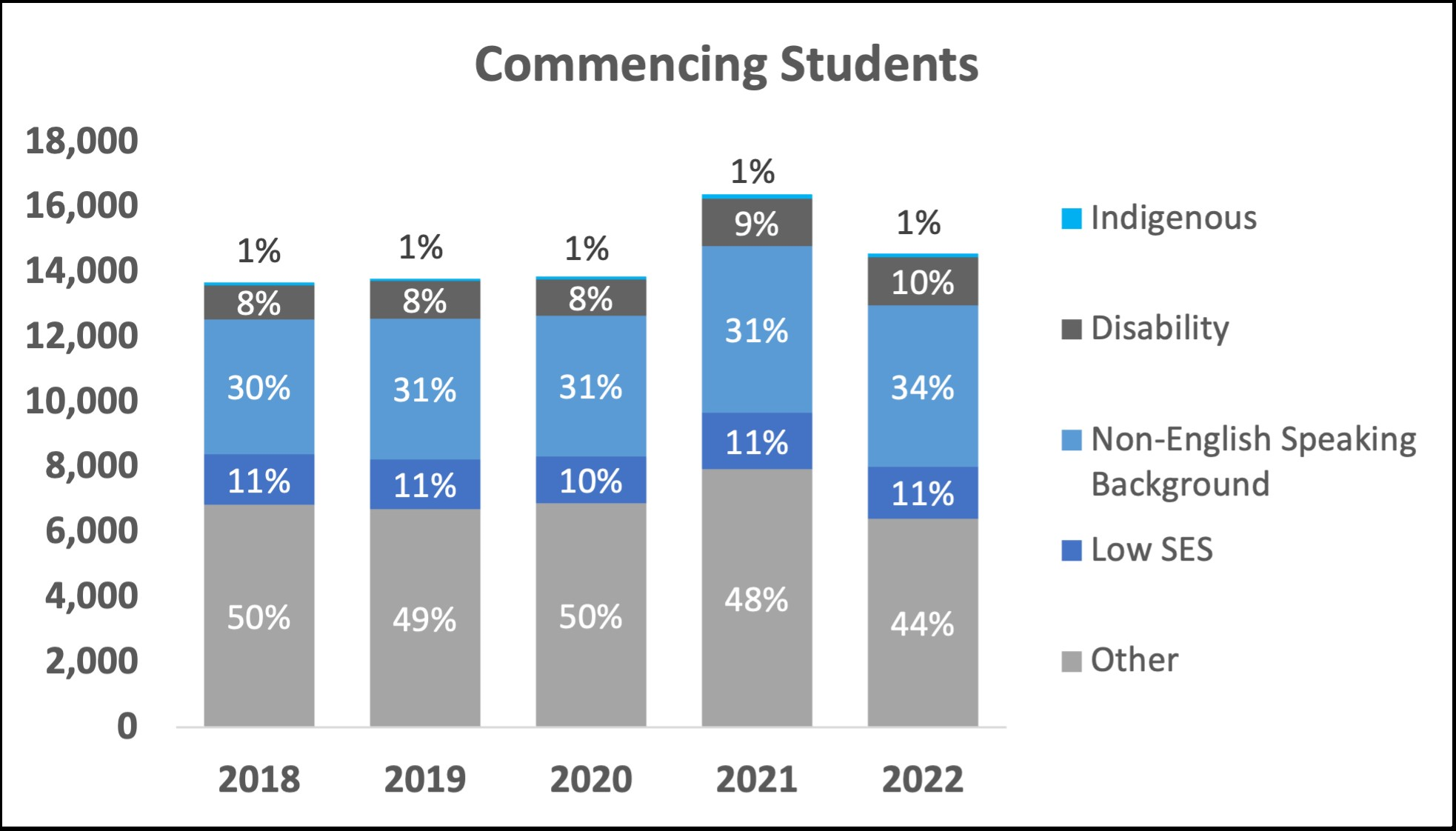
Monash University is committed to supporting students from underrepresented backgrounds and tracks commencing rates, retention and success rates by equity group.

 Eleos Justice: Restricting and Abolishing the Death Penalty in the Asia Pacific
View
Eleos Justice: Restricting and Abolishing the Death Penalty in the Asia Pacific
View
Eleos Justice in the Faculty of Law is a leading hub that offers vital advocacy, evidence-based research and teaching aimed to restrict and abolish the death penalty in the Asian region, where over 90 per cent of the world’s executions take place.
The Anti-Death Penalty Clinic provides Law students an opportunity to engage in death penalty research and advocacy as part of their studies. Students work in small groups under a Clinical Supervisor to undertake case and policy research, provide legal assistance in death row matters and engage in advocacy campaigns in the Asia-Pacific region.
In 2022, Eleos researchers produced a report, “A Deadly Distraction: Why the Death Penalty is not the Answer to Rape in South Asia”, explored the ramifications of capital rape laws.

Other SDGs:

Exploring Public Discourse around Cycles of Disadvantage in Australia
View
The Monash Data Futures Institute has brought together an interdisciplinary team of researchers to explore public discourse around cycles of disadvantage in Australia by analysing public texts across media and parliamentary speeches. Improving our understanding of what the public thinks about disadvantage and the factors that shape it will also help us understand what forces in turn shape the discourse.
The project built an interactive interface which is featured on large wall panels in the Paul Ramsay Foundation exhibition space at Darlinghurst and online. It allows visitors to explore the changing narratives around disadvantage. The data is compiled from the text of thousands of articles and speeches and so is complex and multifaceted.
Ally Network
View
The Ally Network at Monash promotes Monash as a safe and inclusive space for lesbian, gay, bisexual, transgender and gender-diverse, intersex, queer and questioning, asexual and aromantic, plus other related identities (LGBTIQA+) students and staff.
By the end of 2022, 2364 staff and students had completed Ally training since the network began, with 1291 registered allies across our Australian campuses, the Malaysia campus and the Prato Centre. Feedback from the Ally training program showed 93 per cent of students and staff who completed the training knew how to respond to incidents of queerphobia, compared to 42 per cent pre-training

 Give Respect Art Competition
View
Give Respect Art Competition
View
Monash established the Give Respect Initiative in 2017 to heighten awareness of respectful behaviours, and to encourage them at Monash and throughout the wider community. The Give Respect Art Competition promotes these values by providing Monash students and staff an opportunity to contribute towards building a more respectful and equitable University community with their artwork. Submissions must be an original piece of art that could convince somebody to think more deeply about behaving respectfully.