
Monash students take top three places at UNIHACK 2026
Monash University students have claimed first, second and third place at UNIHACK 2026, Australia’s largest student hackathon, for the second consecutive year.
Sponsored for the first time by the European Union and Monash, this year’s event was the largest in UNIHACK’s history, attracting 1010 participants from more than 20 universities across Australia and New Zealand.
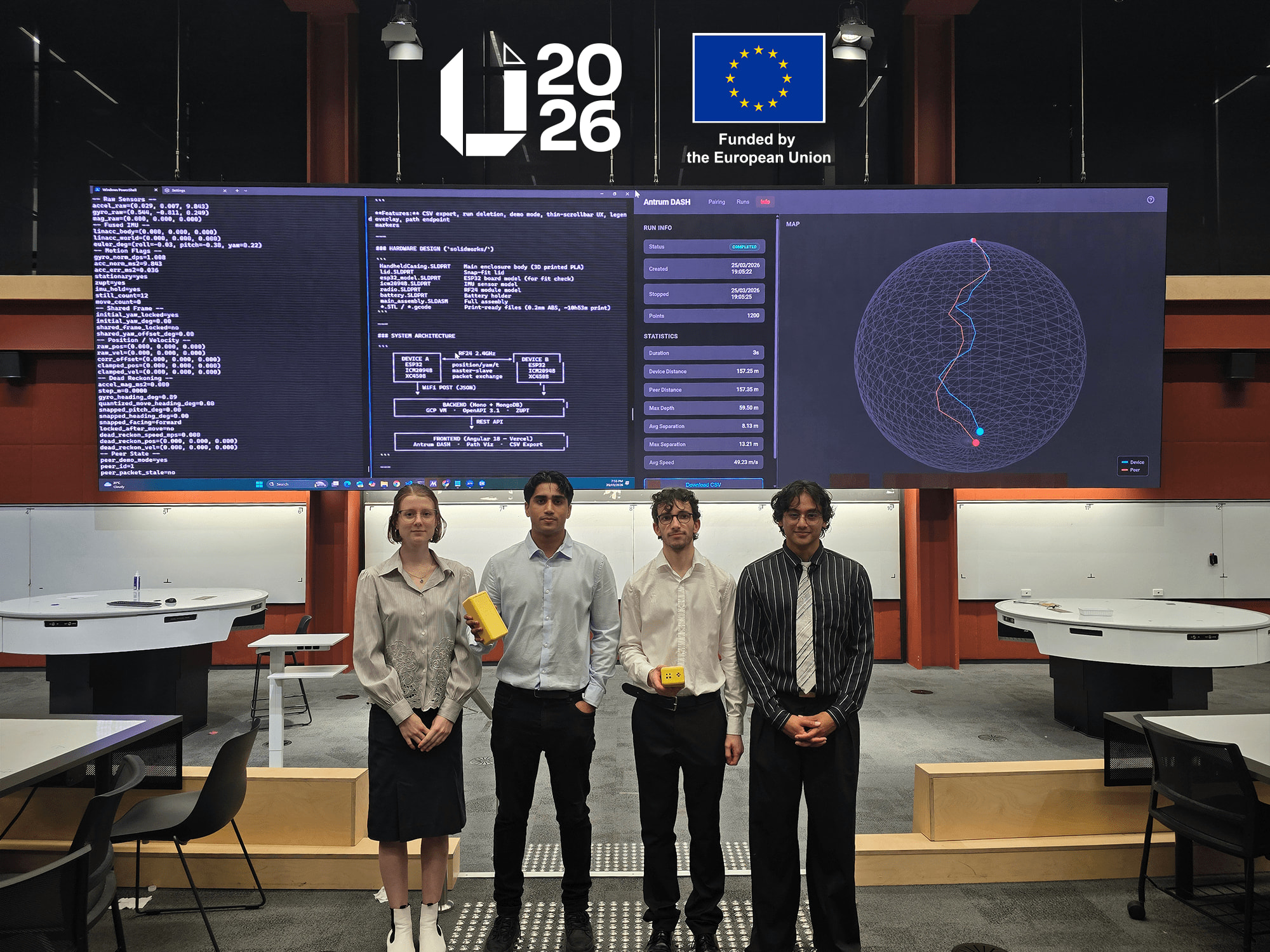
From left: Maria Demina, Jenul Ferdinand, Christopher Whalley and Manan Chavda.
The winning team included two students from Monash’s Faculty of Information Technology, Jenul Ferdinand and Christopher Whalley who are both studying a Bachelor of Computer Science, alongside Bachelor of Electrical Engineering student Maria Demina and Bachelor of Mechanical Engineering student Manan Chavda.
Together, the team developed ANTRUM, a device to improve safety in high-risk underground environments such as caves and mines where GPS and phone signals are limited.
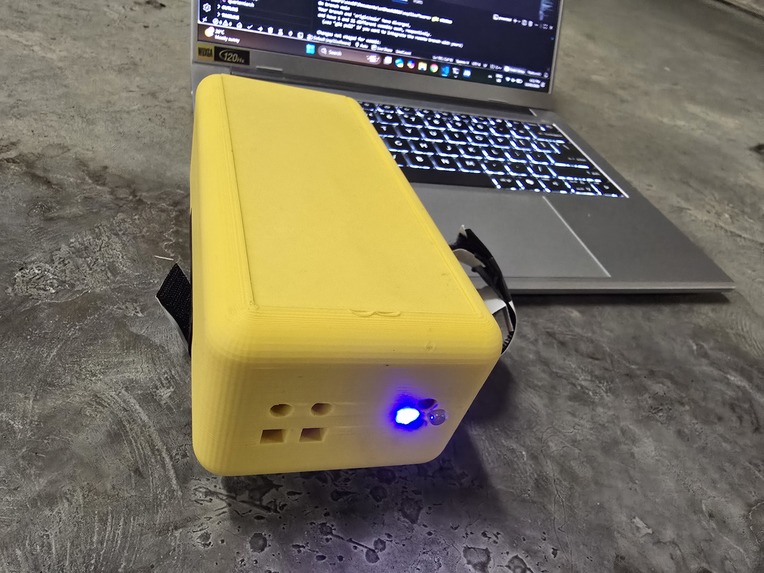
ANTRUM device
The system uses palm-sized wearable units strapped to a user’s leg before entering an underground environment. Once paired, the devices use motion sensors and radio communication to offer two key modes: one to help users locate their exploration partner, and another to guide them back towards the cave entrance from the point where route recording began.
‘We were inspired by the story of the Thai youth soccer team cave rescue and wanted to explore whether technology could help prevent people from becoming stranded in the first place,’ said Maria.
ANTRUM also includes a web dashboard, ANTRUM DASH, which records movement data while the device is in use. Once the user returns to the surface, the data is uploaded to the cloud, allowing them to review their route and better understand the paths they took.
‘Everyone on our team brought unique strengths, from hardware to software to electronics. That’s why over the competition weekend, we could deliver a full working system of hardware, a web platform and a 3D-printed casing, rather than just an isolated prototype,’ said Jenul.
The team received $5000 in prize money, as well as Bose headphones, NOMAD Tracking Card Air devices and Rushfaster EDC backpacks. Entries were judged on polish and execution, technical difficulty, originality, creativity and overall wow factor.
Looking ahead, the team hopes to develop a waterproof Mark 2 version of ANTRUM that could support underwater cave divers.
Second prize for this year’s competition went to Sentinel AI, a project focused on autonomous drones controlled using natural language. It was developed by Bachelor of Computer Science students Aditya Desai, Atharv Desai, Gabriel Rips and Yameen Ahmed.
Third prize was awarded to Cowdar, an app that uses LiDAR technology to help small-scale farmers estimate cattle weight accurately. It was created by Bachelor of Computer Science student Aadi Dapurkar, Bachelor of Software Engineering student Tim Blair, and Bachelor of IT students Ajay Bellamkonda, Josh Ainsworth and Reef Snell.
Founded in 2014 by WIRED Monash, the Faculty of IT’s largest student club, UNIHACK has since grown into an annual 48-hour hybrid competition for university and TAFE students across Australia and New Zealand.