Monash Report 2023 – Goal 13

Close

 2023 Publications Performance
View
2023 Publications Performance
View

Monash Research Outputs: 221
Mean Field Weighted Citation Impact (FWCI): 1.84
3 Year Rolling Mean FWCI: 2.34
 DAC2Bio Project
View
DAC2Bio Project
View
DAC2Bio, a project led by Faculty of Engineering researchers that focuses on advancing Direct Air Capture (DAC) technology to produce carbon dioxide and water from atmospheric air, was awarded funding under the Department of Education’s Australia Economic Accelerator Seed Grant. The funding, supported by university and industry partners, will help to scale up DAC technology for commercial use in bioindustries, promoting sustainability and contributing to net-zero 2050 targets.

Further relevant SDGs:


 Mapping Changes in Sea Ice Coverage
View
Mapping Changes in Sea Ice Coverage
View
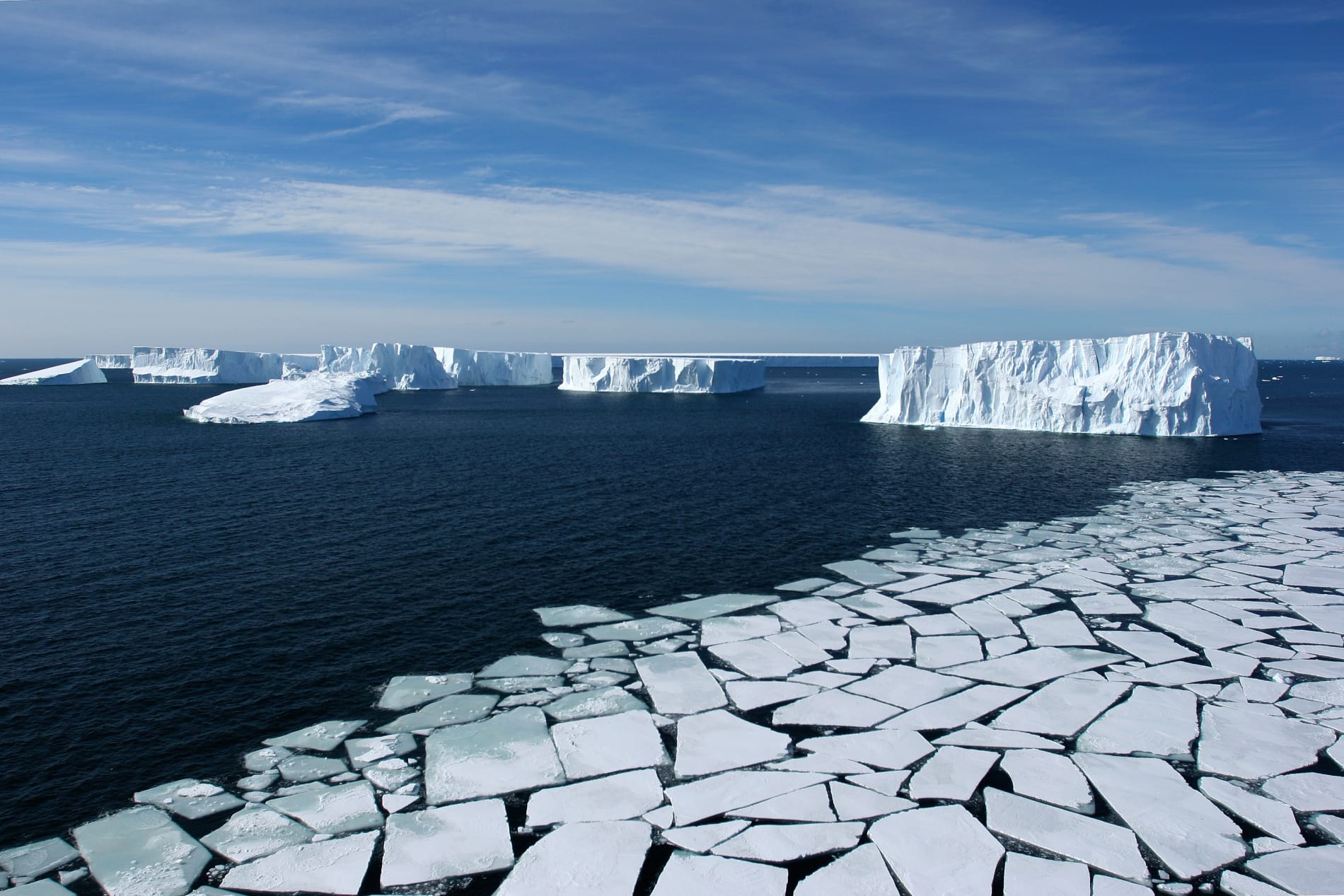
Research by the Faculty of Science in collaboration with the University of Tasmania and published in Communications Earth & Environment has revealed a significant, possibly permanent reduction in Antarctic sea ice coverage, marking a shift from historical patterns. The findings, which links the changes in sea ice coverage to subsurface ocean warming, has serious implications for global climate regulation, ocean circulation and wildlife habitats.
Further relevant SDGs:

 Surveying Australian Attitudes to Climate Change
View
Surveying Australian Attitudes to Climate Change
View
New research by the Monash Climate Change Communication Research Hub (MCCCRH) revealed more than 80 per cent of Australians surveyed were either Cautious, Concerned or Alarmed about climate change, but many were reluctant to change their diets to help address the problem. The research showed women were more likely to adopt climate-friendly diets than men, with 32 per cent of women surveyed had having already changed their diet compared to just 18 per cent of men.

Further relevant SDGs:


 Health Impacts of Climate Change
View
Health Impacts of Climate Change
View
Researchers from the School of Public Health and Preventive Medicine contributed to a paper discussing the health impacts of climate change in Australia, including heatwaves, bushfires, floods, and droughts. The paper criticised the inadequate response by Australia’s government and called for greater inclusion of Indigenous Australians in developing mitigation measures.
Further relevant SDGs:



 Pacific Action on Climate Transitions (PACT) Funding
View
Pacific Action on Climate Transitions (PACT) Funding
View
The Fiji Government announced it would provide $2 million in funding to the Pacific Action on Climate Transitions (PACT) partnership between Fiji National University and Monash Business School. PACT focuses on integrating business strategies with climate change mitigation and adaptation. The funding will facilitate co-designed projects between academia, civil society and the Fiji ministries that will build resilience in response to climate change, strengthen the Fijian economy and contribute to Fiji's regional leadership in addressing climate change.
Further relevant SDGs:

 Producing Acetic Acid from Captured CO2
View
Producing Acetic Acid from Captured CO2
View
A team led by researchers in the Faculty of Engineering and published in Nature Communication have developed a new method to produce acetic acid from captured CO2 using an economical solid catalyst. This innovative approach replaces less efficient liquid catalysts and could significantly reduce industrial carbon emissions and environmental impact of acetic acid production.

Further relevant SDGs:
 GeoXPM: Predicts, Models and Mitigates Geo-Disasters
View
GeoXPM: Predicts, Models and Mitigates Geo-Disasters
View
Civil engineers at Monash University, led by Associate Professor Ha Bui, have developed GeoXPM, a pioneering software capable of predicting and modeling climate-induced geo-disasters like landslides and mine tailings dam failures. The software is also capable of suggesting design changes to mitigate geo-disasters, potentially saving lives and reducing environmental impact.

Further relevant SDGs:
 Unit Statistics and Highlights
View
Unit Statistics and Highlights
View
In 2023, Monash offered 95 units directly related to SDG13 with 7,868 total enrolments.
The units highlighted below are a small sample of the units at Monash relating to climate action:
 Climate Justice
View
Climate Justice
View
The Climate Justice Student Leadership Program is an opportunity for up to five Monash students to join students from seven partner universities worldwide to collaborate on climate justice. In the five-week online training—a pilot Global Virtual Classrooms project—students explore linkages between climate change and inequality through the lens of power and privilege. They explore cross-cultural perspectives on climate justice and learn how to develop globally-minded leaders with a focus on local activism for global impact.
The Climate Justice Clinic is a specialist clinic at the Monash Law Chambers that offers students practical experience of a range of law practice areas with an overarching focus on climate justice. Students work with leading environmental organisations, senior barristers working in environment and climate law, community organisations and campaign groups, and collaborate with community legal services throughout Victoria. The Climate Justice Clinic also helps students contextualise this work within the broader climate justice movement, and features regular guest speakers from law firms and environmental NGOs.
Further relevant SDGs:

 Student Global Climate Change Simulation
View
Student Global Climate Change Simulation
View
Monash University and the School of Public Health and Preventive Medicine were co-hosts of the 2023 Global Climate Change Simulation run by the Association for Pacific Rim Universities (APRU). The APRU Student Global Climate Change Simulation 2023 is a role-playing exercise in which students form multi-country, multi-disciplinary teams to play the role of delegates to the UN Climate Change Negotiations. Over three sessions, students participate in an online simulation activity using materials from World Climate Interactive collaborated with MIT. These live sessions are supplemented with short lectures and materials developed and curated by APRU experts.
Further relevant SDGs:
 The Real Carbon Price Index
View
The Real Carbon Price Index
View
The Real Carbon Price Index, a Monash Centre for Financial Studies project which monitors real-time carbon prices, is now available on Bloomberg Terminal. Developed in collaboration with C2Zero and SparkChange the index provides real-time data on global carbon prices to help finance professionals, investors and policymakers make informed decisions related to climate change and carbon pricing.

Further relevant SDGs:
 Pathways to Industrial Decarbonisation
View
Pathways to Industrial Decarbonisation
View
Climateworks Centre and CSIRO, in consultation with industry and research partners, prepared a report outlining pathways for Australian heavy industry to decarbonise and help limit global warming to 1.5 degrees. The Pathways to Industrial Decarbonisation report was prepared on behalf of the Australian Industry Energy Transitions Initiative and emphasises collaboration among Australia's largest companies. Climate and Energy Minister Chris Bowen launched the report at an event in Sydney
Further relevant SDGs:

 Climateworks Centre Decarbonisation Scenarios 2023
View
Climateworks Centre Decarbonisation Scenarios 2023
View
Climateworks Centre released new scenario modelling which showed how Australia would be able to achieve net zero emissions by 2039 or 2050, aligning with the 2019 Paris Agreement's goal of limiting global warming to 1.5 degrees celsius. The scenarios emphasised the need for increased action across all sectors, including the adoption of renewable energy, electrification, and hydrogen technologies.
Further relevant SDGs:
 ESG Assessment Guidelines for Indonesian State-Owned Enterprises
View
ESG Assessment Guidelines for Indonesian State-Owned Enterprises
View
Indonesian government organisation Badan Pengawasan Keuangan Pembangunan (BPKP) launched ESG Assessment Guidelines for Indonesian State-owned Enterprises, which were developed with technical assistance from experts from Monash University and the Climateworks Centre. The guidelines aim to improve sustainability reporting and support decarbonisation in line with Indonesia's climate goals.
Further relevant SDGs:
 Monash @ COP 28
View
Monash @ COP 28
View
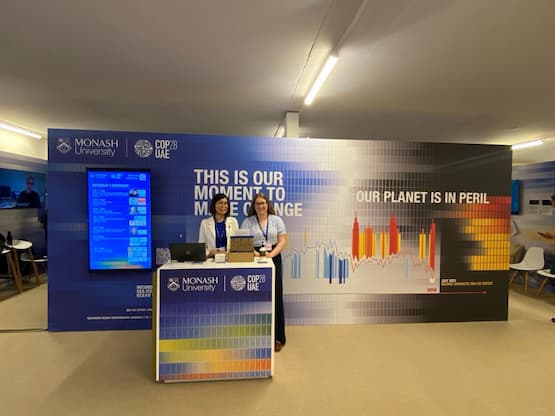
Monash University hosted a pavilion in the high profile UNFCCC managed Blue Zone at COP28. The pavilion served as a collaborative space for Monash's experts, scholars and students, alongside partners from the Asia Pacific and beyond, to converge, deliberate and advance climate action solutions. It was a space for transformative conversations, partner engagement and collaboration for climate action. Events included panels, workshops, networking events, fireside chats, and displays of creative practices.
Monash’s COP28 delegation included staff and students who shared their climate action expertise and knowledge whilst strengthening partnerships across the key themes: Just energy transitions; Climate and health; Antarctica and oceans; Indigenous wisdom; and Education and youth.
Further relevant SDGs:
 Bringing the Voices of Australian Youth to COP28
View
Bringing the Voices of Australian Youth to COP28
View
Monash Sustainable Development Institute, in collaboration with UNICEF Australia and SDSN, has facilitated the creation of the 2023 National Child and Youth Statement on Climate Change, representing perspectives of Australia’s young people at COP28. The statement, developed through consultations with over 200 young Australians, addresses the impacts of climate change on youth and advocates for increased climate action and education.
Further relevant SDGs:
Net Zero Initiative
View
Monash University is committed to achieving net zero emissions across its Australian campuses. Its strategy to do so is based on the following pillars:
In 2023, Monash undertook the following activities to help realise its Net Zero commitments:
Further relevant SDGs:
Measuring Greenhouse Gas (GHG) Emissions
View
Monash continues to make significant progress to reaching its Net Zero target. Greenhouse gas emissions from natural gas (Scope 1) and electricity (Scope 2) totalled 42,988 tCO2e in 2023. This was 12.7 per cent lower than in 2022 and 57 per cent below the 2015 baseline.
The intensity of Monash carbon emissions (measured as kgCO2e per square metre) decreased by 13 per cent year on year. Emissions intensity is now less than one third the 2015 baseline.

Further relevant SDGs:
 Campus Guide Paves the Way for Universities to Fulfil Net Zero
View
Campus Guide Paves the Way for Universities to Fulfil Net Zero
View
The Monash Energy Institute and Climateworks Centre, in partnership with the UN Sustainable Development Solutions Network, has developed the ‘Net Zero on Campus Guide’ to assist universities worldwide in accelerating their progress on sustainable development and climate change. The guide provides tools and strategies for decarbonising campus operations and promotes a global community of practice for sharing knowledge and best practices in sustainability.
Further relevant SDGs: