2023 Publication Performance
View
2023 Publication Performance
View

Monash Research Outputs: 85
Mean Field Weighted Citation Impact (FWCI): 1.74
3 Year Rolling Mean FWCI: 1.87
 Measuring the Impact of Fire Regimes on Animal Species
View
Measuring the Impact of Fire Regimes on Animal Species
View
A study by School of Biological Sciences researchers and published in Biological Conservation has shown that anthropogenic and natural fire regimes have the capacity to affect the genetic patterns of animals. The findings highlight the importance of integrating genetic research into fire ecology to ensure that conservation management decisions are well-informed.

Further relevant SDGs:


 Using Genome Science to Support Endangered Species
View
Using Genome Science to Support Endangered Species
View
A School of Biological Sciences research team was awarded more than $720,000 in Australian Research Council Linkage grant funding to investigate how genome science can be used to support preservation of four endangered species in changing climates and apply these learnings to help other species to survive and thrive. The funding was expected to contribute to larger, healthier populations of the endangered species, new ways of saving other species, and the provision of important resources for conservation managers.
Further relevant SDGs:
 Saving the Helmeted Honeyeater
View
Saving the Helmeted Honeyeater
View
The School of Biological Sciences is collaborating with Zoos Victoria to conduct a genetic rescue program for the helmeted honeyeater, a critically endangered bird, by breeding members of the remnant population with a subspecies from Gippsland. This program aims to enhance genetic diversity and fitness of the species, which has suffered due to inbreeding and environmental changes.

Further relevant SDGs:

 Unit Statistics and Highlights
View
Unit Statistics and Highlights
View
In 2023, Monash offered 84 units directly related to SDG15 with 6,179 total enrolments.
The units highlighted below are a small sample of the units at Monash relating to life on land:
 Securing Biodiversity and Ecosystems
View
Securing Biodiversity and Ecosystems
View
Postgraduate students in this School of Biological Sciences unit examine the ways in which multiple forms of global change interact to drive the loss of biodiversity and ecosystem services and discuss the solutions for securing biodiversity and ecosystem services and ensuring the protection and sustainable use of renewable resources. Students evaluate relevant biodiversity and ecosystem policies and management approaches, considering the scientific evidence base underpinning these, and identifying gaps and future solutions. Example topics covered include integrated land-use planning, area- and species-based conservation strategies, biosecurity, and the development of sustainable harvest systems.
Further relevant SDGs:


 Natural Capital Measurement Catalogue
View
Natural Capital Measurement Catalogue
View
Climateworks Centre launched the pilot of its Natural Capital Measurement Catalogue, a comprehensive, open-source set of measures for natural capital at the property level in Australia. Aligning with the global Taskforce on Nature-related Financial Disclosures (TNFD) framework, the initiative makes nature's value visible in business decision-making by measuring impacts and dependencies on ecosystems, which is crucial for assessing risks and opportunities related to nature. The project involves collaboration with partners across finance, retail, and government sectors to pilot incentives for natural capital management.
Further relevant SDGs:


 Survey on Action to Preserve Biodiversity
View
Survey on Action to Preserve Biodiversity
View
As one of eleven university members of the Biodiversity Council, Monash University contributed to a national survey to gauge Australians’ support for increased action and funding to conserve biodiversity. The survey, involving 4000 voters, revealed a high level of concern about biodiversity loss and support for pro-nature policies, such as ending native forest logging and requiring businesses to report their environmental impact.
Further relevant SDGs:

 National Indigenous Disaster Resilience Summit
View
National Indigenous Disaster Resilience Summit
View
National Indigenous Disaster Resilience (NIDR) is a stream within MSDI’s Fire to Flourish initiative, led by Bhiamie Williamson, a Euahlayi man from north-west NSW, and in partnership with Indigenous and non-Indigenous organisations and agencies. NIDR champions Indigenous leadership in disaster resilience and emergency management preparedness and response by enhancing and instilling a caring for Country mindset across all agencies and organisations within the emergency, resilience and land management sector. A conversation between and about Indigenous peoples disaster resilience was initiated at the inaugural NIDR summit, held in Meanjin/Brisbane in August. Attendees included Indigenous and non-Indigenous researchers, emergency management practitioners, and agency heads, including friends from Aotearoa New Zealand.

Further relevant SDGs:

 Nature+ Strategy
View
Nature+ Strategy
View
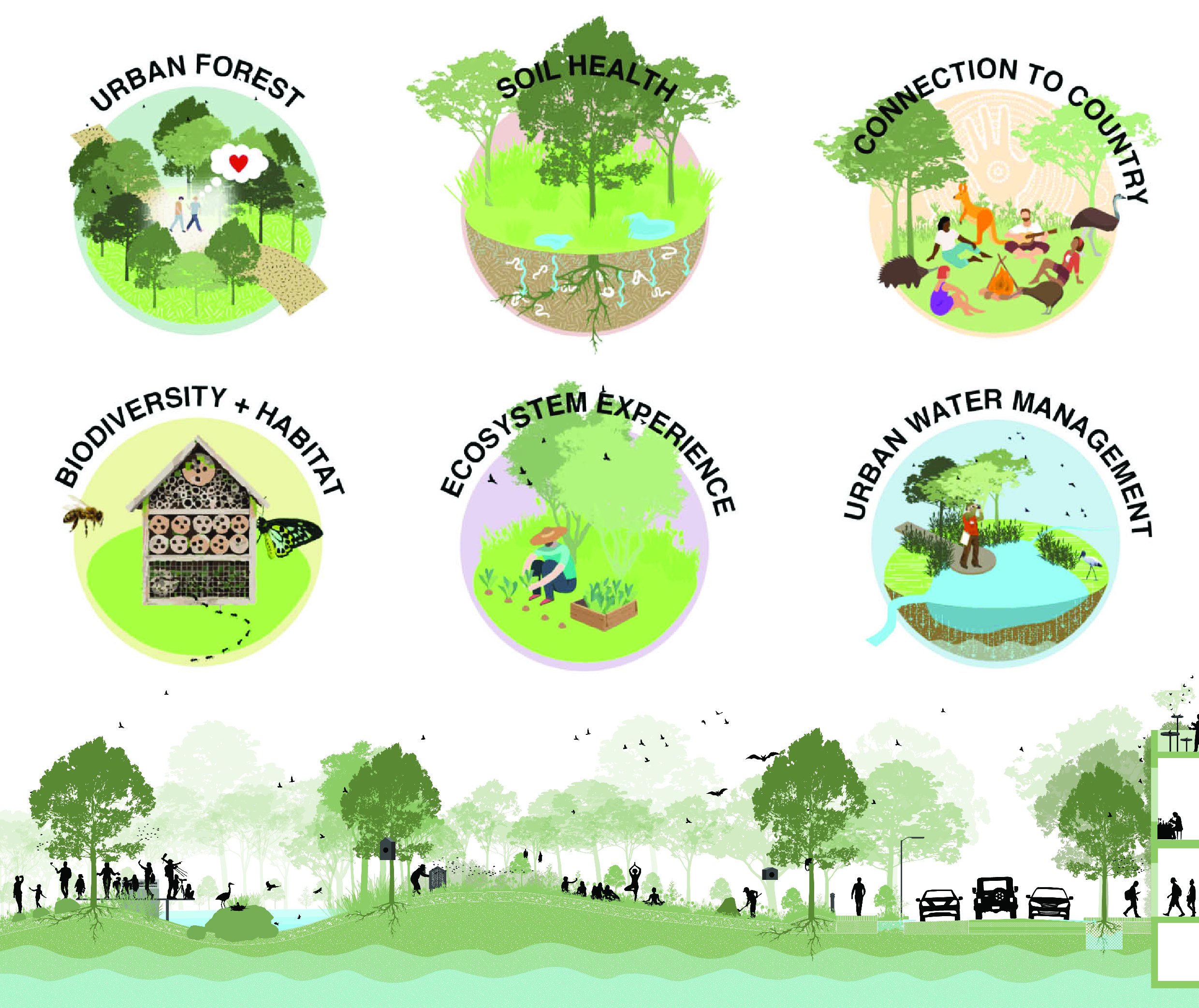
In 2023 Monash released the Nature+ Strategy, one of the key pillars in our Sustainability Strategy. This strategy endeavours to re-frame the relationship between non-human and human stakeholders on our campuses and tries to make evident how designing more with and for nature benefits humans on a plethora of levels, and in so doing, renders us all healthier, happier and more connected to the world around us.
The Nature+ Plan is synthesized into six key goals:
Monash University is creating campus ecosystems that support nature, contribute to positive biodiversity outcomes and mitigate and adapt to a changing climate. Decisions with regards to masterplanning, landscape, built form and systems connectivity planning will play a key part in realising the broader and specific goals outlined in the Nature+.
Further relevant SDGs:
 Jock Marshal Reserve
View
Jock Marshal Reserve
View
The Jock Marshal Reserve (JMR) at the Monash Clayton campus is a three-hectare biodiverse ecological facility managed by the JMR Management Committee within the School of Biological Sciences. A cornerstone for environmental education and research at Monash University, the JMR contains the highest concentration of biodiversity values within the University, providing valuable refuge for skinks, possums, amphibians and many native bird species, while also attracting some unwanted introduced species such as foxes.
Since 2021, management of these species has been guided by the Jock Marshall Reserve Management Plan and the Jock Marshall Reserve Operational Plan.

Further relevant SDGs:
Urban Ecosystem: Thriving Habitats
View
Monash University’s landscapes and indigenous flora are recognised by the Australian Institute of Landscape Architects as being nationally significant and have an estimated value of more than $100 million. The campus masterplans feature commitments to sustain a rich biodiversity on each campus, sensitive to local contexts. The masterplans for each Australian campus include clear deliverables and metrics for the infrastructure and landscape development to achieve University aspirations, including sustainability goals.
In the face of climate unpredictability, Monash has committed to improve campus landscapes to be adaptable, sustainable ecosystems equipped to thrive for years to come. More information on the University’s work to improve campus ecosystems to create greater amenity for humans and better habitats for flora and fauna can be found on the Monash Biodiversity site.
Further relevant SDGs: