2023 Publications Performance
View
2023 Publications Performance
View

Monash Research Outputs: 80
Mean Field Weighted Citation Impact (FWCI): 0.9
3 Year Rolling Mean FWCI: 1.19
 Revitalising Informal Settlements and their Environments (RISE) Program
View
Revitalising Informal Settlements and their Environments (RISE) Program
View
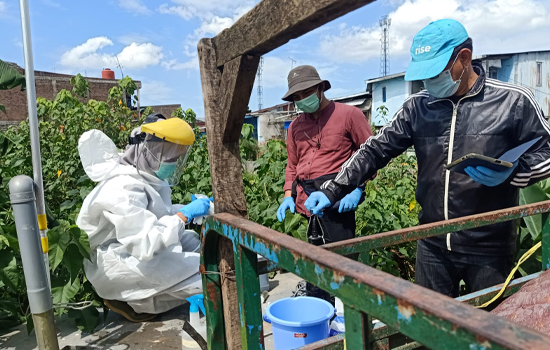
The Revitalising Informal Settlements and their Environments (RISE) program utilises water sensitive technology innovation to transform quality of life across urban informal settlements in Indonesia and Fiji. Working with communities, governments, local leaders and partner institutions, RISE is co-designing location-specific solutions that integrate green infrastructure to strengthen the whole-of-life water and sanitation cycle.
In 2023 the RISE program reported successful water-sensitive revitalisation in an informal settlement in Batua, Indonesia, utilising infrastructure to collect wastewater from residences and pump it to constructed wetlands to filter contaminants. Results from the program showed the system was performing well, reducing the concentration of key pollutants including E.coli by 99.6%.
Further Relevant SDGs:


 Investigating Food and Water Insecurity and Depression among Women
View
Investigating Food and Water Insecurity and Depression among Women
View
A collaborative research project involving a variety of disciplines across Monash University, Emory University, and Hasanuddin University investigated the link between food and water insecurity and depression among women in Makassar, Indonesia during the COVID-19 pandemic. The study found that depression is associated with joint resource insecurity and highlighted the vulnerability of women in low socio-economic countries, particularly in urban informal settlements.
Further relevant SDGs:



 Integrated Water Management in Sumbawa, Indonesia
View
Integrated Water Management in Sumbawa, Indonesia
View
The MSDI Water team partnered with Yayasan Plan Indonesia to apply gender equitable and socially inclusive Integrated Water Management practices in a water planning project in Sumbawa, Indonesia in order to create richer outcomes for minority groups within local communities, including women, children, people with disabilities and Indigenous peoples. MSDI supported the establishment and ongoing multi-stakeholder inclusive IWM forum in Sumbawa and produced guidelines that can support other projects.
Further Relevant SDGs:

 Unit Statistics and Highlights
View
Unit Statistics and Highlights
View
In 2023, Monash offered 51 units directly related to SDG6 with 4114 total enrolments.
The units highlighted below are a small sample of the units at Monash relating to clean water and sanitation:
Knowledge Exchange on Water Sensitive Solutions
View
Monash Sustainable Development Institute (MSDI) welcomed the first PhD student from an international campus to arrive as a visiting scholar under the Monash Malaysia PhD Global Mobility Program. Geetha Maniam from the School of Pharmacy at Monash Malaysia engaged in knowledge exchange on water-sensitive solutions, focusing on nature-based wastewater management and rural water transformation in Malaysia.

Further relevant SDGs:

 Monash and CSIRO Partnership to Revitalise Citarum River
View
Monash and CSIRO Partnership to Revitalise Citarum River
View
The Citarum Project, a partnership between Monash University, Universitas Indonesia, Universitas Padjadjaran, the Indonesian Government, communities and local NGOs, received a two-year funding commitment from CSIRO to develop and implement a waste monitoring program for the Citarum River.
Co-led by Monash Art, Design & Architecture and the Monash Sustainable Development Institute, the Citarum Project aims to create clean, healthy and productive rivers and communities around the Citarum River by co-designing new infrastructure, behaviour programs, business models and institutions to help communities move away from dumping or discharging waste into the environment, and shift towards circular solutions that recycle, remanufacture and reuse waste

Further relevant SDGs:


Improving Wastewater Treatment and Rainwater Harvesting in Indonesia
View
Monash University entered a new collaboration with the Indonesian Government, the Australian Government, Makassar Government and Hasanuddin University to develop nature-based solutions for wastewater treatment and rainwater harvesting for informal settlement communities in Makassar Indonesia. The initiative, which is part of the Monash-led RISE Program, will enhance access to critical water and sanitation services and climate resilience for over 300 households.

Further relevant SDGs:
Building Community Water Literacy
View
Water Sensitive Cities Australia (WSCA), a research-to-practice partnership within MSDI, is now implementing their ambitious mainstreaming strategy to see water sensitive cities principles and practices applied in every city, every day. This year, with the support of WSCA’s partners, such as Monash Climate Change Communications Research Hub, the team has been delivering a national community water literacy project to foster better community impact on our water systems, as well as a lifecycle costs project to better understand the cost to build, operate and maintain green infrastructure.
Further relevant SDGs:
Potable Water Consumption
View
Harvested stormwater is used for irrigation of campus grounds and toilet flushing in multiple buildings across Monash. The University has reduced reliance on potable water through improved process efficiency for harvested water management. Water conservation, water harvesting and community awareness have been the main strategies in the University’s water management plan.
In 2023, Monash University’s Australian campuses consumed 480,815 kilolitres (kL) of potable water and 113,381 kilolitres of reclaimed water.
 Building Standards and Water Sensitive Urban Design
View
Building Standards and Water Sensitive Urban Design
View
Monash University’s Design and Construction Standards incorporate a range of requirements to reduce potable water use, including through use of efficient fixtures and fittings, improving drought tolerance of campus landscapes and prioritising non-potable water options where possible.
The University uses Water Sensitive Urban Design practices to ensure that campuses are purifying water resources on campus, reducing peak damaging peak flow and maximising efficiency of water harvesting systems and infiltration into campus landscapes while also reinvigorating and reinstating natural waterway habitats.
Further relevant SDGs:
Stormwater Pollution
View
The Monash Design and Construction Standards feature Grounds and Landscaping Requirements to ensure all construction activities are carried out in accordance with best practice guidelines issued by the Environment Protection Authority Victoria and Melbourne Water to minimise risk of stormwater pollution, from contaminated runoff of chemicals, sediments, or other associated construction refuse.
Further relevant SDGs: