
‘Extremely rare event’: bone analysis suggests ancient echidnas lived in water
New research questions the evolutionary history of some of our most interesting mammals. A small bone found 30 years ago at Dinosaur Cove could turn what we know about the evolution of echidnas and platypuses on its head.
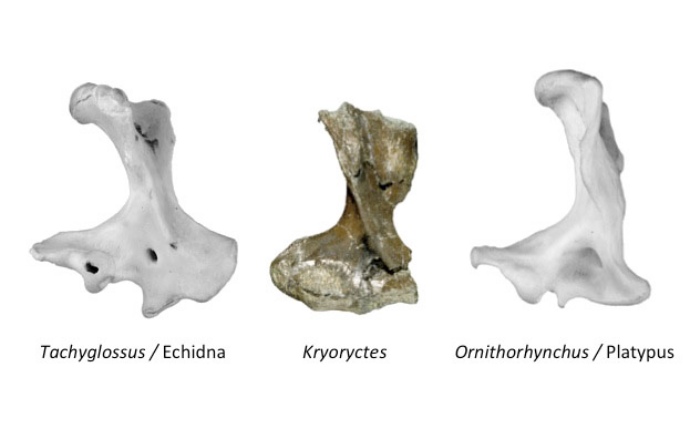
The egg-laying monotremes have played a central role in our understanding of mammalian evolution, but their fossil record is poor and their evolutionary history is controversial. Credit: Thomas H. Rich and Patricia Vickers-Rich
Professor Patricia Vickers-Rich from the Monash University School of Earth, Atmosphere and Environment, a contributing author to the research, emphasises the significance of this discovery: "This finding challenges our long-held beliefs about the evolutionary pathways of monotremes,” Professor Vickers-Rich said. “The evidence suggests that both echidnas and platypuses may have evolved from a water-dwelling ancestor, which is a remarkable shift in our understanding."
Until now, the accepted understanding about these egg-laying monotremes – arguably the most unusual mammals on the planet – was that they were both descended from a land-bound ancestor. And while the platypus ancestors became semiaquatic, the echidnas stayed on the land, or so the story went.
But following a UNSW-led analysis of the bone – which was discovered by a team from Museums Victoria – it now looks like echidnas and platypuses evolved from a water-dwelling ancestor.
Lead author and palaeontologist, Emeritus Professor Suzanne Hand from UNSW’s School of Biological, Earth and Environmental Sciences (School of BEES), says there are about 30 instances where mammals evolved from land-dwelling to live wholly or partly in water, for example, whales, dolphins, dugongs, seals, walruses, otters and beavers. But it’s virtually unheard of to see mammals evolve in the opposite direction.
“We’re talking about a semiaquatic mammal that gave up the water for a terrestrial existence, and while that would be an extremely rare event, we think that’s what happened with echidnas,” she said.
In the study published today in the science journal PNAS, the researchers describe how a single humerus bone discovered in Victoria in the early 1990s challenges the terrestrial ancestor theory. The humerus bone – which is the upper arm bone between the shoulder and elbow – is the only bone known that belongs to the extinct species, Kryoryctes cadburyi, named in 2005.
Outwardly, the single humerus looked more similar to those found in echidnas than in platypuses, and led some scientists to conclude it may have been an ancestor of modern echidnas. But other scientists have suggested it was an early common ancestor to the platypus and echidna, known as a stem-monotreme. Whether Kryoryctes lived life solely on land like modern echidnas, or were amphibious like the living platypus, has been debated.
To answer these questions, Professor Hand and colleagues decided to have a closer look at the fossil, including the internal microstructure of the bone using CT and other scanning techniques.
“While the external structure of a bone allows you to directly compare it with similar animals to help work out the animal’s relationships, the internal structure tends to reveal clues about its lifestyle and ecology,” she said.
When the researchers looked at the internal structure of the ancient humerus bone, they were surprised to discover it didn’t match the light bones of echidnas.
“The internal structure revealed platypuses have very thick bone walls and a very reduced cavity within the bone for the bone marrow, while echidnas have very thin bone walls,” said Professor Hand.
“The microstructure of the fossil Kryoryctes humerus is more like the internal bone structure seen in platypuses, in which their heavy bones act like ballast allowing them to easily dive to forage for food. You see this in other semiaquatic mammals.”
The researchers have concluded that this analysis adds far more weight to the idea that stem-monotremes started off as semi-aquatic animals. Somewhere along the line, they argue, ancestors of echidnas moved onto the land where their bones became lighter as they adapted to a new way of life. But unfortunately, the fossil record of platypus and echidna ancestors is sparse, and it’s not possible yet to say exactly when this happened.
Further information
Silvia Dropulich
Marketing, Media & Communications Manager, Monash Science
T: +61 3 9902 4513 M: +61 435 138 743
Email: silvia.dropulich@monash.edu