
Professor Ha Bui

Professor Ha Bui
Prof Ha H. Bui is the Head of the Department of Civil and Environmental Engineering at Monash University. He received his undergraduate education in Vietnam and his MSc and PhD in Civil Engineering (Computational Geomechanics) in Japan. During his postdoctoral studies, he was awarded the prestigious JSPS Fellowship to undertake research in natural disaster mitigation. He joined Monash University as a tenured academic in 2012.
Prof Bui’s research focuses on computational mechanics and constitutive modelling, with particular emphasis on multiscale modelling of geomaterial failure and complex multi-physics interactions. Building on this foundation, he develops advanced computational frameworks, early warning systems, and digital twin technologies for geo-disasters and subsurface infrastructure. Internationally recognised for pioneering the application of mesh-free methods, particularly Smoothed Particle Hydrodynamics (SPH), to computational geomechanics, his research has helped establish SPH as a mainstream tool for simulating large deformation and failure in geomaterials. His work aims to develop computationally efficient, physically rigorous models that enable reliable prediction and management of complex geotechnical systems. As founder and lead developer of GeoXPM, an innovative continuum particle-based platform for simulating geomechanics applications involving fracturing and large deformations, he has created a powerful resource for both academic and industry applications. His contributions have been recognised through numerous prestigious awards, including the 2021 ALERT Research Medal, 2025 Chandrakant S. Desai Medal for Excellence in Geomechanics, ARC Future Fellowship Award, Scott Sloan Best Paper Award, and the JSPS Fellowship Award.
Bui Bui holds editorial appointments with two leading journals in computational geomechanics—serving Editor of Computers and Geotechnics (Elsevier) and Accademic Editor of International Journal for Numerical and Analytical Methods in Geomechanics (Wiley)—and serves on the editorial boards of several other leading journals in the field. He is frequently invited to assess grant applications for the Australian Research Council (ARC), Research Grants Council (RGC) of Hong Kong, Canada Research Chairs Program (CRC-P), Swiss National Science Foundation (SNSF), and MBIE Research Fund (New Zealand), among many others.
Awards and honours:
- Chandrakant S. Desai Medal for Excellence in Geomechanics from the International Association for Computer Methods and Advances in Geomechanics (IACMAG), recognising individuals who have made exceptional and sustained contributions to research and education in geomechanics, 2025.
- Scott Sloan Best Paper Award, awarded by the Computers and Geotechnics journal for best papers published in the past 5 years (i.e., 2018-2023) that have made a significant impact on the field of geotechnical engineering, 2025.
- The National Transport Research Award, awarded by the National Transport Research Organisation (NTRO) for a co-authored paper (with a PhD student recipient of the Rising Star Award), recognises outstanding contributions to transportation-related challenges, 2024.
- Best Paper Award, the 11th International Conference on Scour and Erosion (ICSE11), Copenhagen, Denmark, 2023.
- The Inaugural NCI Adapter Evaluation Committee, the National Computing Infrastructures (NCI) Australia, 2022.
- ALERT Research Medal, awarded by the Alliance of Laboratories in Europe for Research and Technology in Geomaterials (ALERT-Geomaterials), 2021.
- ARC Future Fellowship Award, granted by the Australian Research Council (ARC), 2020.
- Engineering Research Accelerator Award, Faculty of Engineering, Monash University, 2019.
- Excellence in Research Award, Department of Civil Engineering, Monash University, 2019.
- Best Paper Award (2018) for papers published in Geotextiles and Geomembranes in 2017.
- Dean’s Recognition for Outstanding Contribution to Services, Faculty of Engineering, Monash University, 2018.
- Editor’s Choice Paper, Canadian Geotechnical Journal, Vol. 55(6):792-809, 2018.
- Excellence in Teaching Award, Department of Civil Engineering, 2014-2015.
- JSPS Fellowship Award for Young Scientists from Japan Society for the Promotion of Science (JSPS), 2010-2012.
- Outstanding Paper Award for Young Researcher granted by the Japanese Geotechnical Society (JGS), 2009.
- Best Paper Award in the 15th International Conference of the International Society for Terrain-Vehicle Systems (ISTVS), 2005.
- Encourage Paper Award in the Symposium on Construction Practice and Construction Machinery granted by Japan. Construction Mechanisation Association (JCMA), 2005.
- Best Paper Award in the Annual Meeting of the Japanese Society for Terramechanics (JaST), 2004.
- “Lagrangian mesh-free particle method (SPH) for large deformation and post-failure flows of geomaterial using elastic-plastic soil constitutive model”, International Journal for Numerical and Analytical Methods in Geomechanics, Vol. 32(12):1537-1573. (Article ranked No.1 in the most cited articles based on citations published in the last three years by Wiley)
- “Smoothed particle hydrodynamics (SPH) and its applications in geomechanics: From solid fracture to granular behaviour and multiphase flows in porous media”, Computers and Geotechnics, Vol. 138, 104315. (Link)
- “A five-phase approach, SPH framework and applications for predictions of seepage-induced internal erosion and failure in unsaturated/saturated porous media”, Computer Methods in Applied Mechanics and Engineering, Vol.401, 115641. (Link)
- “A cohesive damage-plasticity model for DEM and its application for numerical investigation of soft rock fracture properties”, International Journal of Plasticity, Vol.98, pp.175-196. (Link)
- “A thermodynamics-and mechanism-based framework for constitutive models with evolving thickness of localisation band”, International Journal of Solids and Structures, Vol.187, pp.100-120. (Link)
- “Constitutive modelling of compaction localisation in porous sandstones”, International Journal of Rock Mechanics and Mining Sciences, Vol.83, pp.57-72. (Link)
- Incorporation of micro-cracking and fibre bridging mechanisms in constitutive modelling of fibre reinforced concrete, Journal of the Mechanics and Physics of Solids, Vol.133, 103732. (Link)
Qualifications
- Graduate Certificate in Higher Education, Monash University, Australia
- PhD, Civil Engineering (Computational Geomechanics), Ritsumeikan University, Japan
- MEng, Civil Engineering (Computational Geomechanics), Ritsumeikan University, Japan
- BSc (Eng), Aerospace Engineering, Ho Chi Minh University of Technology (HCMUT), Vietnam
Expertise
- Computational Mechanics, Constitutive Modelling, Geomechanics, Geotechnical Engineering, Fracture/Damage Mechanics, Geotechnical Monitoring & Predictions
Research Interests
Bui’s research interests are in the areas of computational mechanics and material modelling, with a particular focus on bridging scales in modelling failure of geomaterials, along with the development of novel real-time monitoring and early warning systems for geo-disasters. The objective of his research is to develop robust computational methods and advanced monitoring systems to address future challenges in geotechnical engineering and geomechanics, with reference to related engineering applications. Typical examples of those problems include gravity-driven flows (e.g. granular flows, landslides and avalanches), coupled flow deformation in porous media (e.g. rainfall-induced landslides, internal erosions, hydraulic fracturing), damage and fracture of brittle and quasi-brittle materials (e.g. rock fractures, fatigue in pavements), thermal-hydro-mechanical coupling processes (e.g. expansive soils and desiccation cracking in soils) and soil-structure interactions. Through his research, Bui aims to advance our understanding of underlying processes that govern the macro-behaviour of geomaterials and make use of these understandings to further advance our current predictive capabilities with references to real-life engineering applications.
Research Projects
Current projects

Intelligent Infrastructure Digital Twin Platform
Modern infrastructure is becoming increasingly connected through sensors, autonomous systems and artificial intelligence, yet engineering data remain fragmented across monitoring, modelling and operational platforms. This project develops a next-generation Intelligent Infrastructure Digital Twin Platform that unifies real-time sensing, physics-based simulation, AI-driven analytics and decision support within a common computational framework. Unlike conventional digital twins designed for individual assets, the platform is scalable across multiple infrastructure systems, including transportation networks, tunnels, underground assets, urban environments and natural hazards. By continuously integrating field observations with predictive simulations, the platform enables infrastructure owners and governments to monitor system performance, anticipate failures, optimise operations and evaluate future scenarios before they occur. The research provides a common digital foundation for resilient, sustainable and intelligent infrastructure, supporting safer cities, more efficient asset management and evidence-based engineering decision making.

Digital Twin Framework for Resilient Geo-infrastructure
Failures of earth structures (e.g., landslides or tailings dam collapses) can lead to catastrophic loss of life, environmental degradation, and billions in economic damages. Australia, with its vast aging network of mining and civil infrastructure, is especially vulnerable. This project aims to deliver a Next-Generation Digital Twin framework that integrates real-time monitoring, multi-physics simulations, and AI-driven deep learning to transform how geohazard risks are managed. The framework will enable dynamic, data-informed decision-making for early warning, design optimisation, and rapid response to geohazard threats. Expected outcomes include improved risk assessment capabilities, more resilient infrastructure, and enhanced disaster preparedness. These innovations will significantly reduce economic losses, protect ecosystems, and improve public safety, supporting national priorities in disaster risk reduction, sustainable infrastructure, and digital innovation.

Mud pumping under rail tracks: from Micromechanics to Predictions (ARC Discovery Project, DP240102765)
Mud pumping under rail tracks is identified as the most frequent issue causing the degradation of rail tracks and increasing their ongoing maintenance cost across Australia and worldwide. This project aims to further the understanding of mud pumping mechanisms across different scales. A novel combined experiment-computational approach will be developed to observe, analyse and link different material properties and external conditions governing the mud pumping process. It will lead to better criteria for mud pumping and numerical tools for field scale failure analysis and risk assessments. The expected outcomes include the enhanced capability to assess the integrity and stability of rail tracks and better design criteria against mud pumping.

Multi-phase modelling and characterisation of mudrush hazard in cave mining (ARC Linkage Project LP220200792)
A mudrush is a sudden, uncontrolled flow of wet fine particles (mud) into an underground mine that damages equipment, infrastructure, and can even cause fatalities. This project aims to develop cost-effective management and monitoring of mudrush hazards within the at-risk Carrapateena cave mine operated by OZ Minerals. Building on recent technological and numerical advances, a novel experimental–theoretical–numerical approach will be used to simulate mudrush risk based on moisture content, particle sizes, compaction, geological conditions, and seismic energy. Outputs will include a practical framework to boost the safety, productivity, and profitability of caving operations to benefit miners and the broader resources industry.

Linking microstructural evolutions across the scales of granular failure (ARC Future Fellow Project, FT200100880)
This project expects to transform the understanding of granular materials and their behaviour by establishing explicit links between the macroscopic responses of the materials and their evolving microstructural properties. This should lead to revolutionary constitutive models for granular materials that possess true mechanisms of evolving grain-scale structures. The proliferation of these new models should allow development of reliable predictive computational tools for the modelling and assessment of field-scale failure involving granular materials, enhancing the capability to assess the integrity and stability of earth structures, and benefitting the Australian economy, environment and public safety.

A machine learning-driven flow modelling of fragmented rocks in cave mining (ARC Linkage Project LP200100038)
The project aims to develop an integrated method that uses micro scale and macro scale information to predict block scale behaviour so that a better cave mining design can be established. The role of various mineral composition on the energy storage and fracture properties of rocks will be investigated to examine rock fragmentation for block cave mining. Later Machine Learning based models will be developed to establish various predictive models for Block Scale rock mass behaviour and caveability of ore deposit. Finally, we will develop a new constitutive model based on a dual damage concept that will capture the rock fragmentation and simulate the cave propagation in a large scale mine layout using Smoothed-particle hydrodynamics.

Internal soil erosion: from grain-scale insights to large-scale predictions (ARC Discovery Project, DP190102779)
This project aims to further the understanding of internal soil erosion across different spatial and temporal scales. Internal soil erosion is the most frequent cause of failures of water retaining structures. An approach combining advanced X-ray techniques with particle based methods will be developed to observe, analyse and link different material properties and external conditions governing the erosion process. This will lead to better criteria for soil erosion and numerical tools for field scale failure analysis and risk assessments. The expected outcomes of this project include enhanced capability to assess the integrity and stability of earth structures and better design criteria against erosion.

Smart Next Generation Transport Pavements (ARC Research Hub, IH180100010)
The ARC Research Hub for Smart Next Generation Transport Pavements aims to make road, airport and dockyard pavements smart, low cost, long-lasting, safe, green and adaptable to future transport demands. Australia’s road network, upon which the nation depends for its economic and social prosperity, is at risk due to increases in passenger and freight load degradation of the road network, and material and expertise scarcity. The Hub will deliver new materials and modelling, smart construction, and rehabilitation systems required for future demands, while enhancing road safety and reducing environmental impact.

Liquefaction of silty soils (ARC Discovery Project, DP170103793)
The project aims to develop a numerical approach to understand liquefaction in silty soils. Liquefaction of silty soils in submarine landslides, mine tailings dam failures and cargo liquefaction in vessels carrying iron/nickel ores can cause property loss and be fatal. This project will bridge the behaviours across the scales and deliver constitutive models that possess grain scale mechanisms for better prediction of liquefaction induced failure at the large scales. The expected outcomes are liquefaction criteria for silty soils with different silt contents and numerical tools to predict the onset of liquefaction and flow of liquefied soils.

Desiccation cracking in soils (ARC Discovery Project, DP160100775)
The project will develop a novel fully coupled thermo-hydro-mechanical-atmospheric model to investigate the impact of climate effects on the mechanism of drying shrinkage and associated cracking in soils. Understanding of soil desiccation cracking at the microscale will form the basis for describing the marcroscale soil behaviour as applicable to field problems. Project outcomes will lead to construction of safer and more resilient infrastructures in geotechnical and geoenvironmental engineering.

Fatigue cracking in road pavements (ARC Linkage Project, LP130100884)
Some 95% of 900,000 kms roads in Australia are made of unbound granular materials. Majority of these roads have aged significantly and traffic loads and frequency have increased markedly. Road stabilisation by in-situ recycling of old pavement materials using cementitious additives is commonly used as an option with lower environment footprint. The main failure mode of stabilised pavements is by fatigue cracking. Unfortunately, current design methods against fatigue cracking are unsatisfactory and do not take into account key operational factors. This project intends to undertake a bottom-up scientific study to significantly advance the design methods and associated testing of these pavements potentially leading to large cost savings.

Multi-scale modelling of strain localisation in geomaterials with application to slope failures & landslides
Slope failures and landslides cause significant damage to infrastructure and loss of life around the word each year. To protect people and infrastructure against such effects it is important to have proper numerical tools that are capable of predicting such events before they happen. However, modelling such events is very challenging because the slope failures and landslides involve the transitions between solid-like and fluid-like states, phase interaction modelling, appropriate boundary constraints and constitutive modelling; all within the context of motions with complexities on many scales. Furthermore, existing numerical methods are not capable of predicting the large deformation and flow failure behaviour of geomaterials. The purpose of this research is to develop a robust numerical modelling approach capable of accommodating these phenomena with the primary initial goal of predicting possibility of landslide due to heavy rainfall. The basic approach is based on adapting and extending the Smoothed Particle Hydrodynamics (SPH), which is well-suited to modelling large deformation, flow-like phenomena

Computational failure modelling of geomaterials with SPH
This project aims to advance the Smoothed Particle Hydrodynamics (SPH) method to address complex engineering challenges in geomechanics and geotechnical engineering. Building on my pioneering work in SPH for large deformation and failure of geomaterials, it seeks to further enhance SPH for modeling multi-phase, multi-physics interactions with greater accuracy and robustness. A key focus is on improving the simulation of geohazards, such as landslides and soil-structure interactions. As the developer of GeoXPM, a state-of-the-art continuum particle-based computing software, I am working to integrate SPH with machine learning, real-time monitoring, and high-performance computing. This research aims to develop next-generation predictive tools for disaster mitigation and resilient infrastructure design, ensuring practical applications in geotechnical engineering and climate adaptation.
Continuum-discrete modelling of damage and fracture in engineering materials
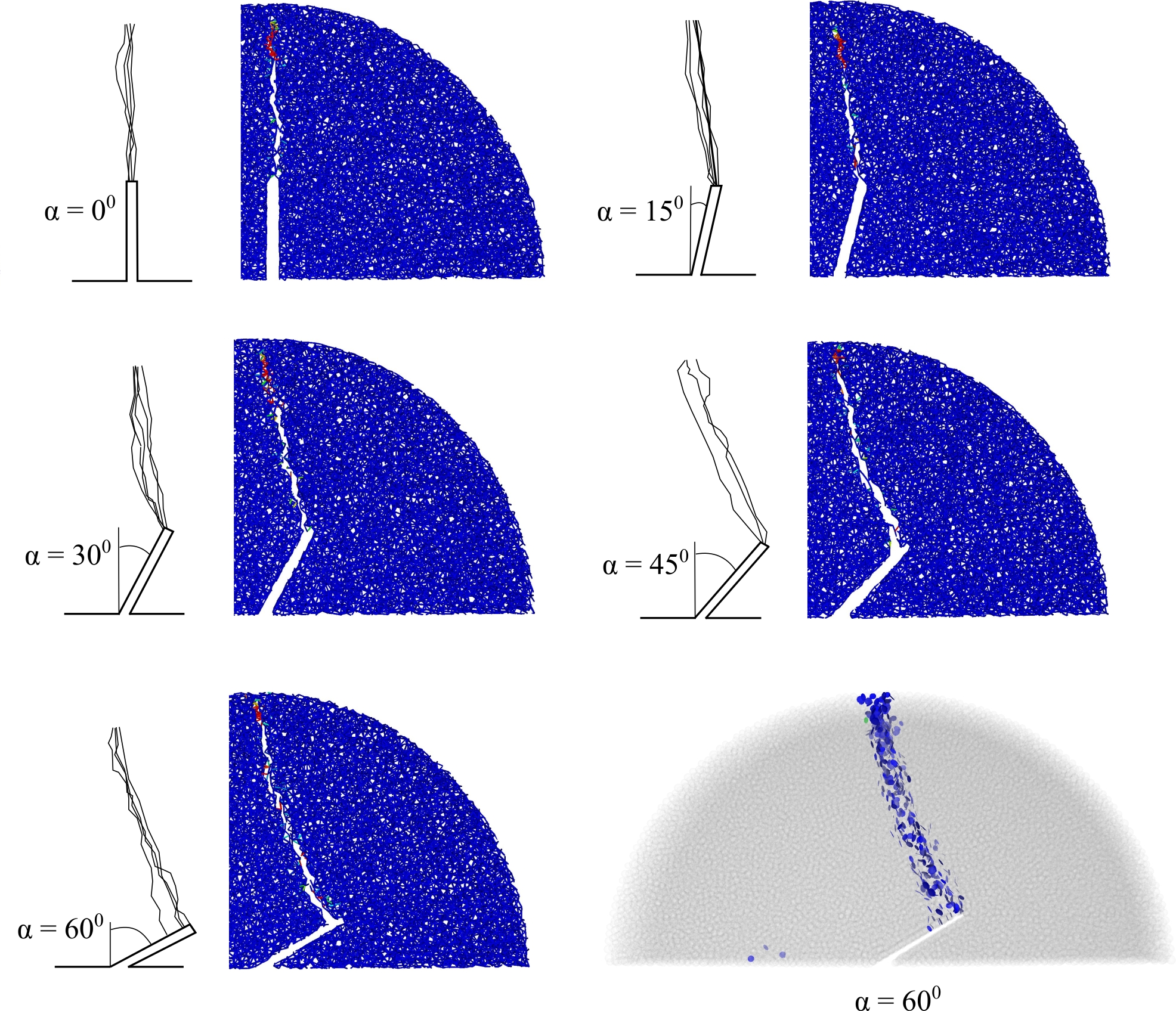
This project aims to develop an advanced computational approach that combines discrete modelling and enriched contact models based on the plasticity/damage mechanics to simulate damage and fracture in brittle and quasi-brittle materials. In this approach, the Discrete Element Method (DEM), a well-known computational method for simulating large deformation and cracking issues, is utilised as a numerical platform to facilitate the implementation of advanced cohesive contact models based on plasticity-damage mechanics. The nature of discrete modelling is analogous to the internal structure of cemented materials, making it more efficient compared with conventional continuum methods to characterise the failure behaviour of cemented materials. This combined cohesive-discrete modelling approach is a unique way to perform numerical experiments of brittle and quasi-brittle materials under different boundary conditions.

Coupled fluid-solid SPH approach to modelling flow through deformable porous media
This project aims to develop an advanced computational framework based on the mesh-free smoothed particle hydrodynamics (SPH) method to study the coupled behaviour of fluid and solid in a deformable porous medium. The key feature of the proposed numerical framework is that both solid and fluid phases are solved simultaneously in two different Lagrangian discretisations (or two different sets of Lagrangian particles) using their own governing equations that are linked through several laws of physics. The capability of the SPH method to model large deformation of the solid materials enables the framework to account for the permeability change due to the dilatant shear behaviour of the solid phase. This suggests that the proposed two-phase SPH framework is a promising approach for future studies of coupled problems that involve complex water free-surface/seepage flows and large deformation of soils which are difficult to be modelled using traditional FEM-based coupled two-phase flow models.
Selected publications are made available for download solely on the same basis that the researcher would supply a single copy of a paper to an individual. It is up to you to ensure that your use of a paper does not infringe copyright law. Copyright of the papers rests with a variety of different parties.
AAAAAAAA
- Akram, M.N., Nguyen, G.D., Sheikh, A.H., Karakus, M., Bui, H.H. (2026). Linking stiffness reduction and residual deformation with sources of dissipation in modelling fracture using bond-based peridynamics. Engineering Fracture Mechanics, 345, 112435. Link
- Hoang, T.N., Nguyen, T.T., Nguyen, T.V., Nguyen, G.D., Bui, H.H. (2026). Modelling soil–structure interaction and liquefaction-induced large deformation under seismic loading using a fully coupled soil–water SPH approach. Acta Geotechnica, xxx, xxx. Link
- Ma, G., Zhou, A., Zhuang P.Z., Bui, H.H. (2026). Modelling of unsaturated slope failures induced by water pipe leakage using smoothed particle hydrodynamics. Canadian Geotechnical Journal, 63, 1-22. Link
- Cheng, K., Shao H., Bui, H.H. (2026). Linking pore flow propagation to pore size: correlations and underlying mechanisms. Computers and Geotechnics, 195, 108072.
- Lian, Y., Bui, H.H., Nguyen, G.D., Bouazza A., et al., (2026). Modelling retrogressive failure of quick clay using fully coupled flow-deformation SPH framework: the Gjerdrum (Norway) landslide case. Canadian Geotechnical Journal, 63, 1-24. Link
- Liu, H., Nguyen, G.D., Bui, H.H., Karakus M., Nguyen H.B.K. (2026). Capturing brittle-to-ductile transitions in porous rocks via meso-scale informed constitutive modelling. Geotechnique, xxx, xxx. Link
- Azhar, F., Bui, H.H., Pauwels V.R.N., (2026). Assessment of Vehicle Stability Processes Under Unsteady Flow Conditions. Journal of Flood Risk Management, 19(1), e7081.
- Ma, G., Zhou, A., Bui, H.H. (2026). Smoothed particle hydrodynamics (SPH) modelling for rainfall-induced unsaturated slope failure considering void ratio dependence and variability. Computers and Geotechnics, 189, p.107625.
- Le, V.T., Nguyen, T.V., Karakus, M., Nguyen, G.D., Bui, H.H. (2025). SPH-based modelling of the entire rock caving process: insights into failure mechanisms, International Journal of Rock Mechanics and Mining Sciences, 194, 106228.
- Nguyen, T.N, Bui, H.H, Lian, Y., Nguyen, T.T., Nguyen, G.D and Bouazza M. (2025). A CASM-X constitutive model for unsaturated soils and its application to model wetting-induced slope collapse using SPH. Computers and Geotechnics, 186, p.107353.
- Cheng, K., Lu, H., Cui, X., Ma, J., Bui, H.H. (2025). Study on redeposition Study on redeposition of eroded finer particles during suffusion with image processing. Canadian Geotechnical Journal, 62, 1-21.
- Le, V.T., Nguyen, T.V., Karakus, M., Nguyen, G.D., Bui, H.H. (2025). A Simple 3D Damage-Plasticity Model with Energy-Based Regularisation in SPH for Modelling Fractured Quasi-brittle Rocks, Rock Mechanics and Rock Engineering, 1-28.
- Mathumidah, K., Tran, K.M., Haque, A., Bui, H.H. (2025). Effects of Weak-Interface Materials on the Axial Load Capacity of Rock-Socketed Piles: A Numerical Investigation. Rock Mechanics and Rock Engineering, 1-24
- Li, Z., Le, V.T., Nguyen, G.D., Bui, H.H. (2025). Rate-dependent constitutive modelling of dynamic fracture in quasi-brittle materials, International Journal of Rock Mechanics and Mining Sciences, 191, 106122.
- Nguyen, N.T., Nguyen, G. D., Karakus, M., Bui, H.H., & Phan, D. G. (2025). Controlling behaviour of constitutive models for rocks using energy dissipations. International Journal of Plasticity, 184, 104196.
- Shi, Z., Nguyen, T.T., Bui, H.H, Lu, Y. (2025). Discrete element modelling of electro-mechanical behaviour in modified cementitious materials, International Journal of Mechanical Sciences, 291, 110152.
- Lu, X.D., Tran, T.S., Saleh, M., Nguyen, T.V., Bui, H.H. (2025). Potential cracking resistance indices for the SCB test utilising 100 mm diameter samples: Experimental investigation and machine learning analysis XGBoost-SHAP, Engineering Fracture Mechanics, 110916
- Hoang, T.N., Bui, H.H., Nguyen, T.T., Nguyen, T.V., and Nguyen, G.D. (2024). Development of free-field and compliant base SPH boundary conditions for large deformation seismic response analysis of geomechanics problems. Computer Methods in Applied Mechanics and Engineering, 423, 117370.
- Ma, G., Bui, H. H., Lian, Y., Nguyen, T. V., & Nguyen, G. D. (2024). Prediction of Backward Erosion, Pipe Formation and Induced Failure Using a Multi‐Physics SPH Computational Framework. International Journal for Numerical and Analytical Methods in Geomechanics, 48(18), 4307-4326.
- Le, T.V., Bui, H.H., Nguyen, G.D., Kodikara, J., Bodin, D., Grenfell, J. (2023). Mechanism-based shift factors to predict the fatigue performance of cemented pavement materials. Acta Geotechnica, Vol.19, p.7149-7168.
- Hoang, T.N., Nguyen, T.T., Nguyen, T.V., Nguyen, G.D. and Bui, H.H. (2024). SPH simulation of earthquake-induced liquefaction and large deformation behaviour of granular materials using SANISAND constitutive model. Computers and Geotechnics, 174, p.106617. Link.
- Pratomo, F.Y., Karakus, M., Nguyen, G.D. and Bui, H.H., Micro-and macro-scale perspectives of Failure in well-controlled indirect tensile tests of brittle rocks. International Journal of Rock Mechanics and Mining Sciences, 183, 105897. Link.
- Lu, D.X., Bui, H.H., Saleh, M. and Giustozzi, F. (2024). Compaction method and specimen geometry effect on the fracture properties of asphalt concrete in the SCB test at intermediate temperature. International Journal of Pavement Engineering, 25(1), p.2381059. Link
- Liao, W., Li, J., and Bui, H.H. (2024). Adaptive Kriging-assisted system reliability method for implicit limit state surfaces and its application in landslide runout risk assessment, Computers and Geotechnics, Vol.172, 106426. Link.
- Lu, D.X., Bui, H.H., and Saleh, M. (2024). Predicting the rutting behaviour of asphalt concrete in the modified wheel tracking test using DEM and a cohesive viscoelastic–elastoplastic-damage contact model, Computational Particle Mechanics, Vol.242, pp. 1–13. Link
- Murali, A. K., Haque, A., and Bui H.H. (2024). Advancing rock-socketed pile design with a unified interface shear strength framework for soft rocks, Rock Mechanics and Rock Engineering, Vol.xxx, xxxx. Link.
- Murali, A. K., Haque, A., and Bui, H.H. (2024). DEM modeling of the load-bearing mechanisms of rock-socketed piles with soft interface materials, Journal of Geotechnical and Geoenvironmental Engineering, Vol.150(7), 04024049. Link
- Phan T.Q., Bui, H.H, Nguyen G.D., and François N. (2024). Strain localization in the standard triaxial tests of granular materials: Insights into meso‐and macro‐scale behaviours. International Journal for Numerical and Analytical Methods in Geomechanics, Vol48(5), p.1345-1371. Link
- Nguyen V.T., Bui, H.H., Tran K.M., Nguyen G.D., Haque A (2024). Effects of pre-shearing stress ratio on the mechanical behaviours of gap-graded soils subjected to internal erosion, Computers and Geotechnics 166, p.105991. Link
- Murali, A. K., Haque, A., and Bui, H.H. (2024). Effect of Smear Distribution on the Load-Bearing Mechanisms of Rock-Socketed Piles in Soft Rocks, Journal of Geotechnical and Geoenvironmental Engineering, Vol.150(1), 04023127. Link
- Phan, D.G., Nguyen, G.D., and Bui, H.H. (2023). Capturing the transition from diffuse to localised failure in constitutive modelling of partially saturated soils. International Journal of Plasticity, 171, p.103783. Link
- Le, T.V., Bui, H.H., Nguyen, G.D., Kodikara, J., Bodin, D., Grenfell, J. (2023). Meso to macro connections to capture fatigue damage in cemented materials. International Journal of Fatigue, Vol.176, p.107890. Link
- Phan, D.G., Nguyen, G.D. and Bui, H.H. (2023). The work input to saturated porous media undergoing internal erosion. International Journal of Solids and Structures, 283, p.112487. Link
- Le, T.V., Tran M.K., Kodikara J., and Bui, H.H. (2023). A two-surface contact model for DEM and its application to model fatigue crack growth in cemented materials. International Journal of Plasticity, 166, p.103650. Link
- Lian, Y., Bui, H.H., Nguyen, G.D. and Haque, A (2023). An effective and stabilised (u− pl) SPH framework for large deformation and failure analysis of saturated porous media. Computer Methods in Applied Mechanics and Engineering, 408, p.115967. Link
- Phan, D.G., Nguyen, G.D., Bui, H.H., and Bennett, T. (2023). The effect of hydro-mechanical coupling on the onset and orientation of localisation bands in partially saturated soils. International Journal of Plasticity, 162, p.103551. Link
- Murali, A. K., Bui H.H., and Haque, A. (2023). A new experimental technique to investigate the load-bearing mechanisms of smeared rock-socketed piles using in situ X-ray CT imaging, Geotechnical Testing Journal, Vol.47(2), GTJ20220128. Link.
- Shi, Z., Lu, Y., Bui, H.H., Hua, L., and Shen, D. (2023). A combined experimental–numerical modelling approach for self-crack monitoring in conductive cementitious materials. Construction and Building Materials, 390, p.131812. Link
- Azhar, F., Pauwels, V.R. and Bui, H.H (2023). Confirmation of vehicle stability criteria through a combination of smoothed particle hydrodynamics and laboratory measurements. Journal of Flood Risk Management, p.e12885. Link
- Ma G, Bui, H.H., Lian Y, Tran KM and Nguyen G.D (2022). A five-phase approach, SPH framework and applications for predictions of seepage-induced internal erosion and failure in unsaturated/saturated porous media, Computer Methods in Applied Mechanics and Engineering, Vol.401, 115641. Link (PDF)
- Lu D.X, Nguyen HTN and Bui H.H. (2022) A cohesive viscoelastic-elastoplastic-damage model for DEM and its applications to predict the rate-and time-dependent behaviour of asphalt concretes, International Journal of Plasticity, Vol.157, pp. 103391. Link (PDF)
- Lian Y, Bui H.H., Nguyen G.D, Zhao S and Haque A. (2022). A computationally efficient SPH framework for unsaturated soils and its application to predicting the entire rainfall-induced slope failure process, Geotechnique, Vol.xx, Link (PDF).
- Phan T. Quoc, Bui H.H. and Nguyen G.D. (2022). Modelling submerged granular flow across multiple regimes using Eulerian – Eulerian approach with shear-induced volumetric behaviour, Physics of Fluids, Vol.34, 063308, Link (PDF).
- Nguyen G.D, Mir A., and Bui H.H. (2022). Enriching constitutive models with meso-scale behaviour: a thermodynamics-based formulation and examples, Open Geomechanics, Vol.3, pp.1-19, Link (PDF).
- Murali, A. K., Tran M.K, Haque A., and Bui H.H. (2022). Experimental and numerical investigation of the load-bearing mechanisms of piles socketed in soft rocks, Rock Mechanics and Rock Engineering, Vol.55(9), 5555-5576. Link (PDF).
- Senanayake, S. M. C. U., Haque, A., & Bui, H. H. (2022). An experiment-based cohesive-frictional constitutive model for cemented materials. Computers and Geotechnics, 149, 104862, Link (PDF).
- Pour A.F, Verma R.K, Nguyen G.D, & Bui H.H. (2022). Analysis of transition from diffuse to localized failure in sandstone and concrete using Digital Image correlation. Engineering Fracture Mechanics, 267, 108465, Link (PDF).
- Verma R.K, Nguyen G.D, Karakus M, Taheri A, & Bui H.H. (2022). A combined numerical-experimental approach to analyzing fracture initiation and development in brittle rocks. Computers and Geotechnics, 145, 104663, Link (PDF).
- Tran M.K, Bui H.H., & Nguyen G.D (2022). DEM modelling of unsaturated seepage flow through porous media, Computational Particle Mechanics, Vol.9, 135152. Link (PDF).
- Linh A. Le, G.D Nguyen, Bui H.H. & Andreda J.E. (2022). Localised failure of geomaterials: how to extract localisation band behaviour from macro test data, Geotechnique, 72 (7), 596-609. Link (PDF).
- Lian Y, Bui H.H., Nguyen G.D., Tran H., and Haque A. (2021). A general SPH framework for transient seepage flows through unsaturated porous media considering anisotropic diffusion, Computer Methods in Applied Mechanics and Engineering, Vol.387, 114168. Link (PDF)
- Bui H.H., Nguyen G.D. (2021). Smoothed particle hydrodynamics (SPH) and its applications in geomechanics: From solid fracture to granular behaviour and multiphase flows in porous media, Computers and Geotechnics 138, 104315. Link (PDF)
- Wu, W., and Bui, H.H. (2021). Point-based methods and their applications in geomechanics, Acta Geotechnica, Vol. 16, 2313. Link (PDF)
- Tran M.K., Bui H.H., & Nguyen G.D. (2021). Hybrid discrete-continuum approach to model hydro-mechanical behaviour of soil during desiccation, Journal of Geotechnical and Geoenvironmental Engineering, Vol.147(10), 04021102. Link (PDF)
- Linh A. Le, G.D Nguyen, Bui H.H., & Andreda JE (2021). Modelling the influence of fines content on the instability of silty sands considering grain scale interactions, International Journal of Plasticity, Vol.143, 103020. Link (PDF)
- Wei, X.D., Nguyen, H.T.N., Bui H.H., and Zhao, G.F. (2021). A modified cohesive damage-plasticity model for distinct lattice spring model on rock fracturing, Computers and Geotechnics 138, 104315. Link (PDF)
- Phan Q.T, Bui H.H, Nguyen, G.D & Bouazza A (2021). Effect of particle rolling resistance on drained and undrained behaviour of silty sand, Acta Geotechnica, Vol.16, pp.2657. Link (PDF)
- Yang E, Bui H.H, Nguyen G.D, Choi E.C, Ng WWC, De Sterck H & Bouazza A. (2021). Numerical investigation of the mechanism of granular flow impact on rigid control structures, Acta Geotechnica, 16, pp. 2505–2527. Link (PDF)
- Lu D.X, Bui H.H & Saleh M (2021) Effects of specimen size and loading conditions on the fracture behaviour of asphalt concretes in the SCB test, Engineering Fracture Mechanics, Vol.242, pp. 1–13. Link (PDF)
- Phan D.G, Nguyen G.D, Bui H.H, Bennett T (2020). Constitutive modelling of partially saturated soils: Hydro-mechanical coupling in a generic thermodynamics-based formulation. International Journal Plasticity, Vol.136, pp.102821. Link (PDF)
- Nguyen N.H.T, Bui H.H & Nguyen G.D (2020). Effects of material properties on the mobility of granular flow. Granular Matter Vol.22, 29-59. Link (PDF)
- Nguyen H.T.N, Bui H.H, & Nguyen G.D (2020). An approach to calculating large strain accumulation for discrete element simulations of granular media, International Journal for Numerical and Analytical Methods in Geomechanics Vol. 44 (11), pp. 1525-1547. Link (PDF)
- Wang Y, Tran H.T, Nguyen G.D & Ranjith P.G & Bui H.H (2020). Simulation of mixed-mode fracture using SPH particles with an embedded fracture process zone, International Journal for Numerical and Analytical Methods in Geomechanics, Vol.44(10), 1417-1445. Link (PDF)
- Yang E, Bui H.H, De Sterck H, Nguyen G.D, Bouazza A. (2020). A scalable parallel computing SPH framework for predictions of geophysical granular flows, Computers and Geotechnics, Vol.121, 103474. Link (PDF)
- Tran M.K, Bui H.H, Kodikara J & Sanchez M. (2020). A DEM approach to study desiccation processes in slurry soils, Computers and Geotechnics, Vol.120, 103448. Link (PDF)
- Nguyen G.D & Bui H.H (2020) A thermodynamics-and mechanism-based framework for constitutive models with evolving thickness of localisation band, International Journal of Solids and Structures, Vol.187, pp.100-120. Link (PDF)
- Tran M.K, Bui H.H, Kodikara J & Sanchez M. (2020). Soil curling process and its influence factors, Canadian Geotechnical Journal, Vol.57 (3), 408-422. Link (PDF)
- Linh A. Le, G.D Nguyen, Bui H.H, Sheikh A.H & Kotousov A (2019). Incorporation of micro-cracking and fibre bridging mechanisms in constitutive modelling of fibre reinforced concrete, Journal of the Mechanics and Physics of Solids, Vol.133, 103732. Link (PDF)
- Tran H.T, Wang Y, Nguyen G.D, Kodikara J & Sanchez M, Bui H.H (2019). Modelling 3D desiccation cracking in clayey soils using a size-dependent SPH computational approach, Computers and Geotechnics, Vol.116, 103209. Link (PDF)
- King L, Bouazza A, Gaudin C, O’Loughlin C.D & Bui H.H (2019). Behavior of Geosynthetic-Reinforced Piled Embankments with Defective Piles, Journal of Geotechnical and Geoenvironmental Engineering, Vol.145(11), pp. 04019090. Link (PDF)
- Nguyen HTN, Bui H.H, Nguyen G.D, Kodikara J & Arooran S. (2019). Discrete element method investigation of particle size distribution effects on the flexural properties of cement-treated base, Computers and Geotechnics, Vol.113, pp.103096. Link (PDF)
- Zhao S, Bui H.H, Nguyen, G.D & Darve F (2019). A generic approach to modelling flexible confined boundary conditions in SPH and its application, International Journal for Numerical and Analytical Methods in Geomechanics, Vol.43, pp.1005-1031. Link (PDF)
- Nguyen T.T, Bui H.H, Ngo T.D, Nguyen G.D, Kreher M.U & Darve F (2019). A micromechanical investigation for the effects of pore size and its distribution on geopolymer foam concrete under uniaxial compression, Engineering Fracture Mechanics, Vol.209, pp.228-244. Link (PDF)
- Yuan, Y., Goñi-Ros, B., Bui, H. H., Daamen, W., Vu, H. L., & Hoogendoorn, S. P. (2020). Macroscopic pedestrian flow simulation using Smoothed Particle Hydrodynamics (SPH). Transportation Research Part C: Emerging Technologies, 111, 334-351.
- King L, Bouazza A, R Kerry Rowe, Joel Gniel, Bui H.H (2019). Kinematics of soil arching in piled embankments, Geotechnique, Vol.69(11), pp.941-958. Link (PDF)
- Lu D.X, Nguyen N.H.T, Saleh M & Bui H.H (2019) Experimental and numerical investigations of nonstandardised semi-circular bending test for asphalt concrete mixtures, International Journal of Pavement Engineering, Vol.22(8), 960-972. Link (PDF)
- Sounthararajah A, Kodikara J, Nguyen HTN, Bui H.H (2018). Experimental and Numerical Investigation of Flexural Behavior of Cemented Granular Materials, ASCE’s Journal of Materials in Civil Engineering, Vol.31(3): 06018030. Link
- Wang, Y, Bui H.H, Nguyen, G.D & Ranjith, P.G (2019). A new SPH-based continuum framework with an embedded fracture process zone for modelling rock fracture, International Journal of Solids and Structures, Vol.159, pp.40–57. Link (PDF)
- Nguyen HTN, Bui H.H, Kodikara J, Arooran S, Darve F. (2018). A discrete element modelling approach for fatigue damage growth in cemented materials, International Journal Plasticity, Vol.112, pp. 68-88. Link (PDF)
- Linh A. Le, G.D. Nguyen, Bui H.H, Sheikh A.H. & Kotousov A (2018). Localised failure mechanism as the basis for constitutive modelling of geomaterials, International Journal of Engineering Science, Vol.133, pp.284-310. Link (PDF)
- Nomeritae, Bui H.H, Daly E. (2018). Modelling transitions between free surface and pressurized flow with Smoothed Particle Hydrodynamics, Journal of Hydraulic Engineering (ASCE), Vol.144(5): 04018012. Link (PDF)
- Sounthararajah A, Bui H.H, Nguyen HTN, Kodikara J. (2018). Early-Age Fatigue Damage Assessment of Cement-Treated Bases Under Repetitive Heavy Traffic Loading, ASCE’s Journal of Materials in Civil Engineering, Vol.30(6): 04018079. Link (PDF)
- King D.J, Bouazza A, Gniel J.R, Rowe R.K, Bui H.H (2018). Geosynthetic reinforced column supported embankments and the role of ground improvement installation effects, Canadian Geotechnical Journal, Vol.55(6), pp.792-809. Link (PDF)
- Bui H.H and Nguyen G.D. (2017). A coupled fluid-solid SPH approach to modelling flow through deformable porous media, International Journal of Solids and Structures, Vol.125, pp.224-246. Link (PDF)
- Nguyen HTN, Bui H.H, Nguyen G.D, Kodikara J. (2017). A cohesive damage-plasticity model for DEM and its application for numerical investigation of soft rock fracture properties, International Journal Plasticity, Vol.98, pp. 175-198. Link (PDF)
- Linh A. Le, G.D. Nguyen, Bui H.H, Sheikh A.H., Kotousov A. & Khanna F. (2017). Modelling jointed rock mass as a continuum with an embedded cohesive-frictional model, Engineering Geology, Vol.228, pp.107-120. Link (PDF)
- Nguyen HTN, Bui H.H, Nguyen G.D, Kodikara J. et al. (2017). A thermodynamics-based cohesive model for discrete element modelling of fracture in cemented materials, International Journal of Solids and Structures, Vol.117, pp. 159-176. Link (PDF)
- Nguyen T.T, Bui H.H, Ngo T.D & Nguyen G.D, (2017). Experimental and numerical investigation of influence of air-voids on the compressive behaviour of foamed concrete, Materials and Design, Vol.130, pp.103-119. Link (PDF)
- Nguyen C.T, Nguyen G.D, Das A., Bui H.H (2017). Constitutive modelling of progressive localised failure in porous sandstones under shearing at high confining pressures, International Journal of Rock Mechanics and Mining Sciences. Vol.93, pp. 179-195. Link (PDF)
- Sounthararajah A, Wong L, Nguyen HTN, Bui H.H, Kodikara J. (2017). Evaluation of flexural behaviour of cemented pavement material beams using distributed fibre optic sensors, Construction and Building Materials, Vol.156, pp. 965-975. (PDF)
- Mukherjee M, G.D. Nguyen, Mir A, Bui H.H, Shen L, El-Zein A & Maggi F (2017). Capturing pressure-and rate-dependent behaviour of rocks using a new damage-plasticity model, International Journal of Impact Engineering, Vol.110, pp. 208-218. Link (PDF)
- King D.J, Bouazza A, Gniel J.R, Rowe R.K, Bui H.H (2017). Load transfer platform behaviour in embankments supported on semi-rigid columns: implications of the ground reaction curve, Canadian Geotechnical Journal, Vol.54(8): 1158-1175. Link (PDF)
- Nusit K, Jitsangiam P, Kodikara J, Bui HH & Leung GLM (2017), Advanced Characteristics of Cement-Treated Materials with respect to Strength Performance and Damage Evolution, Journal of Materials in Civil Engineering (ASCE), Vol.29 (4), 04016255. Link
- King D.J, Bouazza A, Gniel J.R, Rowe R.K, Bui H.H (2017). Serviceability design for geosynthetic reinforced column supported embankments, Geotextiles and Geomembranes, Vol.45 (4), pp. 261-279. Link (PDF)
- Nguyen C.T, Nguyen G.D, Nguyen V.P, Bui H.H, Shen L (2016). A size-dependent constitutive modelling framework for localised failure analysis, Computational Mechanics, Vol.58(2),1-24. Link (PDF)
- Nguyen CT, Nguyen CT, Bui H.H, Nguyen G.D & Fukagawa R. (2016). A new SPH based approach to simulation of granular flows using viscous damping and stress regularisation, Landslides, Vol.14(1), pp.69-81. Link (PDF)
- Nomeritae, Dal E, Grimaldi S, Bui H.H (2016). Explicit incompressible SPH algorithm for free-surface flow modelling: A comparison with weakly compressible schemes, Advances in Water Resources, Vol.97, pp.156-167. Link
- Gui Y, Kodikara J, Bui H.H (2016). Numerical modelling laboratory soil desiccation cracking using UDEC with a mix-mode cohesive fracture model, Engineering Geology, Vol.202, pp.14-23. Link (PDF)
- Nguyen G.D, Nguyen C.T, Bui H.H, Nguyen V.P (2016). Constitutive modelling of compaction localisation in porous sandstones, International Journal of Rock Mechanics and Mining Sciences. Vol.83, pp. 57-71. Link (PDF)
- King D, Bouazza A, Gniel J, Bui H.H (2016) New insight into the compressibility and structured nature of coode island silt, Australian Geomechanics Journal, Vol.51(2), 45-62.
- Islam S, Haque A, Bui H.H (2016) One-dimensional compression behaviour of acid sulphate soils treated with alkali-activated slag, Materials, Vol.9(4), pp.289. Link
- Ranathunga AS, Perera MSA, Ranjith PG, Bui H.H (2016) Super-critical CO2 saturation-induced mechanical property alterations in low rank coal: An experimental study, The Journal of Supercritical Fluids, Vol.109, pp.134-140. Link
- Matsuo T, Mori K, Hiraoka N, Bui H.H, Fukagawa R. (2016). Study of SPH simulation on tunnel face collapse, International Journal of GEOMATE Vol.10 (22), pp. 2077-2082.
- Gui Y, Bui H.H, Kodikara J, Zhang Q.B, Zhao J & Rabczuk T (2015). Modelling the dynamic failure of brittle rocks using a hybrid continuum-discrete elopement method with a Mixed-mode cohesive fracture model, International Journal of Impact Engineering, Vol.87, pp.146–155. Link
- Gui Y, Bui H.H & Kodikara K(2015). An application of a cohesive fracture model combining compression, tension and shear in soft rocks, Computers and Geotechnics, Vol.66, pp142-157. Link
- Nusit K, Jitsangiam P, Kodikara J, Bui H.H & Leung GLM (2015), Dynamic Modulus Measurement of Bound Cement-Treated Base Materials, Geotechnical Testing Journal, Vol.38(3). Link
- CT. Nguyen, Bui H.H & Fukagawa R. (2015). Failure mechanism of true 2D granular flows, Journal of Chemical Engineering of Japan, Vol.48(5), pp 1-8 (doi:10.1252/jcej.14we358). Link
- Yu KL, Singh RM, Bouazza A & Bui H.H (2015). Determining thermal conductivity through numerical simulation of a heating test on a geothermal energy pile, Geotechnical and Geological Engineering. Vol.33, 339-252. Link
- Oya A, Bui H.H, Hiraoka N, Fujimoto M. & Fukagawa R (2015). Seepage flow-stability analysis of the riverbank of Saigon river due to river water level fluctuation, International Journal of GEOMATE, Vol.8, Issue 1, pp.1212-1217. Link
- Nguyen C.T, Bui H.H, Fukagawa R (2015). Failure mechanism of two-dimensional granular columns: Numerical simulation and experiment, Vietnam Journal of Mechanics (VAST), Vol.37(4), pp.256-268. Link
- Bui H.H, Kodikara J, Bouazza A, Haque A & Ranjith PG (2014). A novel computational approach for large deformation and post-failure analyses of the segmental retaining wall systems, International Journal for Numerical and Analytical Methods in Geomechanics, Vol. 38, Issue 13, pp.1321-1340. Link
- Ukwattagea N.L, Ranjith P.G, Yellishetty M, Bui H.H & Xu T (2014). A laboratory-scale study of the aqueous mineral carbonation of coal fly ash for CO2 sequestration, Journal of Cleaner Production, Vol.103, pp.665-674. Link
- Haque A, Tang CK, Islam S, Ranjith PG & Bui H.H (2014). Biochar sequestration in lime-slag treated synthetic soils: a green approach to ground improvement, Journal of Materials in Civil Engineering– ASCE, 26(12): 06014024. Link
- Mohadmed M, Ranjith PG, Sanjayan J & Bui H.H (2014). A primary well sealant for carbon capture and storage wells, Fuel, Vol.117, pp.354-363. Link
- Verghese SJ & Bui H.H (2013). Numerical study of plasticity-based constitutive models for soil in simulation of braced excavation, International Journal of GEOMATE, Vol.5(2), pp.672-677. Link
- Bui H.H & Fukagawa R (2013). An improved SPH method for saturated soils and its application to investigate the mechanisms of embankment failure: Case of hydrostatic pore-water pressure, International Journal for Numerical and Analytical Methods in Geomechanics, Vol.37(1), pp.31-50. Link (PDF)
- Hiraoka N, Oya A, Bui H.H & Fukagawa R (2013). Seismic slope failure modelling using mesh-free SPH method, International Journal of GEOMATE, Vol.5(1), pp.660-665. Link
- Nguyen CT, Bui H.H & R Fukagawa (2013). Two-dimensional numerical modelling of modular-block soil retaining wall collapse using mesh-free method, International Journal of GEOMATE, Vol.5(1), pp.647-652. Link
- Bui H.H, Fukagawa R, Sako K, & Wells J.C (2011). Slope stability analysis and discontinuous slope failure simulation by elasto-plastic smoothed particle hydrodynamics (SPH), Géotechnique, Vol.61(7), pp.565-574. Link (PDF)
- Morizane C, Sako K, Bui H.H, Mizuta T, Fukagawa R & Satofuka Y (2010). Development of numerical simulation method based on SPH to mitigate damages of cultural assets due to riverbank erosion, Journal of Disaster Mitigation of Cultural Heritage and Historic Cities, Vol.4, pp.99-106. (in Hard Copy)
- Bui H.H, Kobayashi T, Fukagawa R & Wells J.C (2009). Numerical and experimental studies of gravity effect on the mechanism of lunar excavation, Journal of Terramechanics, Vol. 46, Issue 3, pp.115-124. Link (PDF)
- Murakami S, Bui H.H, Nakao H, & Izuno K (2009). SPH analysis on tsunami flow around bridge girder, Journal of Japan Society of Civil Engineers, Ser. A1 (Structural Engineering & Earthquake Engineering – SE/EE), Vol.65(1), pp.914-920. Link
- Sako K, Fukagawa R, Yasukawa I, Bui H.H & Nakaya J (2009). Results of ground survey at Kiyomizu temple slope, Journal of Disaster Mitigation of Cultural Heritage and Historic Cities, Vol.3, pp.105-110. (in Hard Copy)
- Bui H.H & Fukawaga R (2009). A first attempt to solve soil-water coupled problem by SPH, Japanese Terramechanics, Vol. 29, pp.33-38. (in Hard Copy)
- Yamashita D, Bui H.H & Fukawaga R (2009). DEM simulation of cohesive soil using capillary force models, Japanese Terramechanics, Vol. 29, pp.39-42. (in Hard Copy)
- Daizo A, Bui H.H & Fukawaga R (2009). Modified DEM interlocking force model for Regolith simulant, Japanese Terramechanics, Vol. 29, pp.29-32. (in Hard Copy)
- Bui H.H, Sako K & Fukagawa R (2008). Numerical simulation of slope failure for mitigation of rainfall-induced slope disaster of an important cultural heritage, Journal of Disaster Mitigation of Cultural Heritage and Historic Cities, Vol.2, pp.111-118. (in Hard Copy)
- Bui H.H, Fukagawa R, Sako K & Ohno S (2008). Lagrangian mesh-free particles method (SPH) for large deformation and failure flows of geomaterial using elastic-plastic soil constitutive model, International Journal for Numerical and Analytical Methods in Geomechanics, Vol.32(12), pp.1537-1570. Link (PDF)
- Bui H.H & Fukagawa R (2008). Elasto-plastic large deformation analysis of geomaterial using SPH, Japanese Terramechanics, Vol. 28, pp.177-182. (in Hard Copy)
- Daizo A, Bui H.H & Fukagawa R (2008). Development of DEM simulation for lunar soil, Japanese Terramechanics, Vol. 28, pp.194-198. (in Hard Copy)
- Bui H.H, Sako K & Fukagawa R (2007). Numerical simulation of soil-water interaction using smoothed particle hydrodynamics (SPH) Method, Journal of Terramechanics, Vol. 45(5), pp.339-346. Link
- Bui H.H & Fukagawa R (2005). Smoothed Particle Hydrodynamics (SPH) for Soil Mechanics: Treatment of frictional boundary condition, Japanese Terramechanics, Vol. 25, pp.50-57. (in Hard Copy)
- Bui H.H, Kobayashi T, Tamoi K. & Fukagawa R (2004). DEM simulation for deformation mechanism of soil cutting, Japanese Terramechanics, Vol. 24, pp. 141-146. (in Hard Copy)
Book Chapters / Theses
- Bui H.H & Nguyen G.D (2019). Numerical predictions of post-flow behaviour of granular materials using an improved SPH
model, Lecture Notes in Civil Engineering, Springer Singapore, pp. 895–900, DOI:10.1007/978-981-15-0802-8_143 - Nguyen G.D & Bui H.H (2017). The Roles and Effects of Friction in Cohesive Zone Modelling: A Thermodynamics-Based
Formulation, Lecture Notes in Civil Engineering, Springer Singapore, pp. 288–296, DOI:10.1007/978-981-10-6713-6_28 - Bui H.H, Fukagawa R and Sako K. (2009). Numerical simulation of progressive/multi-stages slope failure due to the increase in groundwater table by SPH, Prediction and Simulation Methods for Geohazard Mitigation, Chapter 18, Edited by Fusao Oka , Sayuri Kimoto, and Akira Murakami, pp.121-126, CRC Press 2009, ISBN: 978-0-415-80482-0, eBook ISBN: 978-0-203-87104-1, DOI: 10.1201/NOE0415804820.ch18
- Bui H.H (2007): Lagrangian mesh-free particles method (SPH) for large deformation and failure flows of geomaterials using elasto-plastic soil constitutive models, Ph.D Thesis, Ritsumeikan University, Japan, March 2007.
- Bui H.H (2004): Development of the discrete element computer code (DEM) to simulate soil excavations, Master thesis, Ritsumeikan University, Japan, October 2004.
Invited Talks (Selected)
- Internal Erosion in Granular Materials: Micromechanics, Constitutive Modelling & Mathematical Model, The 4th International Symposium on Computational Particle Technology, 31 May- 3 June 2024, Nanjing, China (Plenary Lecture)
- Recent advances in computational modelling of large deformation and failure in unsaturated soils with SPH, The 8th Asia-Pacific Conference on Unsaturated Soils 4-6 December 2024, Melbourne, Australia (Theme Keynote Lecture)
- Multiscale modelling of internal erosion: from micromechanics to continuum and failure predictions, The 8th International Conference on Particle-based Methods – PARTICLES 2023, 9-11 October 2023, Milan, Italy (Semi-Plenary Lecture).
- Moving beyond the onset of failure in geotechnical designs. The Spanish Society of Theoretical and Applied Mechanics (SEMTA) Workshop on “Meshfree models for Engineers? Where are they really worthwhile? 1st December 2022 (Invited Lecture).
- Strain localisation in granular materials: Insights into meso- and macro-scale behaviours through discrete modelling, International Research Network in Geomechanics (IRN GeoMech) Workshop, Mechanics of granular materials: What next? 21-22 March 2022 (Invited Feature Lecture).
- Predictions of granular failure across scales: from micromechanics to field-scale applications, ALERT Special Lecture 2021, The Alliance of Laboratories in Europe for Education, Research and Technology, 28 September 2021 (Invited Special Lecture).
- Large deformation modelling of coupled flow-deformation problems in unsaturated porous media using SPH method, The 12th International Conference on Computational Methods (ICCM2021), July 4th-8th (Plenary Lecture).
- An Introduction to Computational Geomechanics: Towards prediction of localised failure of geomaterials, Kyoto University, 05 March 2021 (Invited Lecture)
- Challenges in predicting the onset & post-failure of geomaterials, UTS Geotechnical Webinar Series, 04 September 2020 (Invited Lecture)
- Smoothed Particle Hydrodynamics and its applications in geomechanics, 2020 ALERT Geomaterials Doctoral School, 28-31 September 2020 (Invited Lectures).
- Predicting the onset & post-failure of geomaterials, Invited Webinar, The University of Liverpool, UK, 30 June 2020 (Invited Lecture)
- Recent progress in predictions of the onset and post-failure of geomaterials, AGS Victoria Chapter Seminar, Australian Geomechanics Society (AGS), Melbourne, 19 February 2020. (Invited Keynote Speaker)
- How to connect four-scales in geomechanics: Fundamentals & SPH applications with hydromechanical coupling, International Workshop on Emerging Scales in Granular Media, HKUST, Hong Kong, 14-16 January 2020. (Invited Keynote Speaker)
- Fracturing SPH Particles: A new continuum approach to model desiccation cracking in clay soils, AGU Fall Meeting 2019: Climate Effects on Desiccation Cracking of Soils, San Francisco, USA, 9-13 December 2019. (Invited Keynote Speaker).
- Recent advances in SPH developments and applications in Geomechanics, The 2nd International Conference on The Material Point Method for Modelling Soil–Water–Structure Interaction 8 – 10 January 2019, University of Cambridge, United Kingdom. (Keynote Address)
- Micromechanical insights into the failure mechanism of highly porous materials, VI International Conference on Particle-Based Methods. Fundamentals and Applications, Barcelona, Spain 28 – 30 October 2019. (Invited Talk)
- Large deformation and failure modelling of geomaterials: Coupled hydro-mechanical modelling approaches in SPH, International Symposium on SPH and other Particle-based Continuum Methods and their Applications in Geomechanics, Vienna, Austria, 11-13 September 2019. (Invited Talk)
- Large deformation and failure modelling of geomaterials: How to bridge the gaps between numerical modelling and experiments? International workshop on Advancing Experiment Geomechanics (AEG2016): Experiments in need of theories and theories in need of experiments, Sydney, 31 October – 2 November 2016. (Invited talk)
- A new computational approach to model quasi-brittle material with the SPH method, The 3rd International Workshops on Advances in Computational Mechanics (IWACM-III), , Tokyo, Japan, 12-15th October 2015. (Invited talk)
- Spatial scaling issues in constitutive modelling of geomaterials, The 6th International Conference on Computational Methods (ICCM2015), Auckland, New Zealand 14-17 July. 2015. (Keynote)
- Smoothed Particle Hydrodynamics and its applications to geotechnical engineering, Workshop on Application of Smoothed Particle Hydrodynamics in Environmental Engineering and Geosciences, BAW, Germany, July 30th-1st, 2014. (Invited talk)
- SPH-based soil constitutive model, Workshop on Particle Methods for Geotechnical Applications, Technical University of Hamburg Harburg (TUHH), Germany, Feb. 23, 2011. (Invited talk)
- Mesh free-particle method and its application to river embankment analysis, The 41st Meeting of The Society for Discontinuous Rock Mechanics and Practical Applications , Tokyo, Japan, Feb. 16, 2011. (Invited talk)
- State of the Art of SPH Application to Computational Geomechanics, LMMC Workshop on Fundamental and Application of SPH in Science and Engineering, Leuven Mathematical Modeling & Computational Science Centre (LMMC), Latholieke University Leuven (K. U. LEUVEN), Belgium, Oct. 2010. (Invited talk)
- Numerical Simulations of Dynamics Behavior of Regolith Simulant using DEM and SPH, Japan-Germany Workshop on Lunar Mechanics, Kyoto, Japan, Nov., 2008. (Invited talk)
- Tran, H.T, Βui H.H, Nguyen, G.D, Kodikara, J. & Sanchez, M. (2017). A Continuum Based Approach to Modelling Tensile Cracks in Soils, Poromechanics VI: Proceedings of the Sixth Biot Conference on Poromechanics, July 9-13, 2017, Paris, France. Vandamme , M., Dangla, P., Pereira, J-M. & Ghabezloo, S. (eds.). Reston, Virginia: American Society of Civil Engineers, p. 337-344.
- Wang, Y, Βui H.H, Nguyen, G.D & Ranjith, P.G. (2017). A Mesh-Free Continuum Based Computational Approach to Modelling Rock Fracture, Poromechanics VI: Proceedings of the Sixth Biot Conference on Poromechanics, July 9-13, 2017, Paris, France. Vandamme, M., Dangla, P., Pereira, J-M. & Ghabezloo, S. (eds.). Reston, Virginia: American Society of Civil Engineers, p. 2041-2048.
- Nguyen, T, Βui H.H, Ngo, T.D & Nguyen, G.D (2017). Discrete Element Modelling of the Mechanical Behaviour of a Highly Porous Foamed Concrete, Poromechanics VI: Proceedings of the Sixth Biot Conference on Poromechanics, July 9-13, 2017, Paris, France. Vandamme, M., Dangla, P., Pereira, J-M. & Ghabezloo, S. (eds.). Reston, Virginia: American Society of Civil Engineers, p. 1380-1387.
- Nguyen, N.H.T, Βui H.H, Nguyen, GD, Arooran, S & Kodikara, J. (2017). Numerical Study of Particle Size Distribution Effect on the Failure of Asphalt Mixtures Using Discrete Element Method, Poromechanics VI: Proceedings of the Sixth Biot Conference on Poromechanics, July 9-13, 2017, Paris, France. Reston, Virginia: American Society of Civil Engineers, p. 1371-1379.
- Zhao, S, Βui H.H, Lemiale, V & Nguyen, G.D (2017). SPH simulation of strain localisation in geomaterials using a visco-plastic constitutive model, Poromechanics VI: Proceedings of the sixth Biot Conference on Poromechanics, July 9-13, 2017, Paris, France. Vandamme, M., Dangla, P., Pereira, J-M. & Ghabezloo, S. (eds.). Virginia: American Society of Civil Engineers, p. 1876-1883 .
- Phan D.G, Nguyen G.D, and Βui H.H (2016). A constitutive model for size-dependent behaviour of soils, Mechanics of Structures and Materials: Advancements and Challenges, pp. 827 -834, Nov 2016, Brisbane, Australia.
- Nguyen TC, Βui H.H, Nguyen GD, Nguyen PV (2015). A conceptual approach to modelling rock fracture using the smoothed particle hydrodynamics and cohesive cracks, ISRM Regional Symposium EUROCK 2015, Austria, 7-10 October 2015 (Accepted 04/05/2015)
- Nguyen TC, Nguyen GD, Βui H.H, Nguyen PV 2015). Spatial scaling issues in constitutive modelling of geomaterials, The 6th International Conference on Computational Methods (ICCM2015), Auckland, New Zealand, 14-17 July 2015 (Keynote Lecture, Accepted 15/01/2015).
- Βui H.H, Nguyen GD, Kodikara J, Sanchez M (2015). Modelling of tensile crack behaviour in clayey soils using the mesh-free SPH method, The 12th Australia New Zealand Conference on Geomechanics, pp.120-127, Wellington, New Zealand 22-25 February 2015.
- Nusit K, Jitsangiam P, Kodikara J and Bui H.H (2015). Cyclic loading responses of cement-treated base materials: An investigation on dynamics modulus, The 12th Australia New Zealand Conference on Geomechanics, pp.948-955, Wellington, New Zealand 22-25 February 2015.
- Yilin G, Kodikara J and Bui H.H (2014). Numerical modelling of sandstone uniaxial compression test using a mix-mode cohesive fracture model, The 8th Australian Congress on Applied Mechanics (ACAM8), pp.1-8, 23-26 November 2014, Melbourne.
- Rajeev P, Bui H.H, Sivakugan (2014). Seismic earth pressure development in sheet pile retaining walls: A numerical study, The 8th Australian Congress on Applied Mechanics (ACAM8), pp.1-8, 23-26 November 2014, Melbourne.
- King D.J, Bouazza A, Bui H.H, Row R.K (2014). Preliminary observation of the behaviour of an instrumented geosynthetics reinforced piled embankment in Melbourne, Australia, 7th International Congress on Environmental Geosynthetics (IGEC), Melbourne, Australia.
- Oya A, Hiraoka R, Bui H.H, Fukagawa R (2014). Stability analysis of Saigon Riverbank subjected to river water fluctuation, The Fourth International Conference on Geotechnique, Construction Materials and Environment, pp.298-303, Australia.
- Yu KL, Singh RM, Bouazza A, Bui H.H (2014). Evaluation of thermal properties through numerical simulation of a heating test on a geothermal energy pile, 7th International Congress on Environmental Geosynthetics (IGEC), pp.346-353, Melbourne, Australia.
- Kodikara J.K, Islam T, Wijesooriya S, Bui H.H, Brian Burman (2014). On the controlling influence of the line of optimums on the compacted clayey soil behaviour, International Conference on Unsaturated Soils: Research and Applications (UNSAT), Vol.1, pp.219-225, July 2014. Sydney, Australia.
- Bui H.H, Kodikara J, Ranjith PG, Bouazza A, Haque A (2013). Large deformation and post-failure simulation of segmental retaining walls using mesh-free smoothed particle hydrodynamics, 18th International Conference for Soil Mechanics and Geotechnical Engineering (18th ICSMGE), Vol.1, pp.687-690, Paris, French
- Hiraoka R, Oya A, Bui H.H, and Fukagawa R. (2013). Dynamic analysis of large deformation of geomaterials using the mesh-free SPH method, The Third International Conference on Geotechnique, Construction Materials and Environment GEOMAT, pp.274-279, Nagoya, Japan.
- C.T. Nguyen, Bui H.H, Oya A Hiraoka R, and Fukagawa R. (2013). Box-shape retaining wall system: Experiments and numerical predictions, The Third International Conference on Geotechnique, Construction Materials and Environment GEOMAT, pp.298-303, Nagoya, Japan.
- S.J. Verghese and Bui H.H. (2013). Numerical study of plasticity-based constitutive models for soil in the simulation of braced excavation, The Third International Conference on Geotechnique, Construction Materials and Environment GEOMAT, pp.694-699, Nagoya, Japan.
- K. Sako, T. Danjo, R. Fukagawa and Ha H. Bui (2011). Measurement of pore-water and pore-air pressure in unsaturated soil, The 5th Asia-Pacific Conference on Unsaturated Soils (AP-UNSAT), pp.443-448, Thailand, Nov.14-16, 2011.
- Bui H.H, and H.D.V. Khoa: Bearing capacity and failure mechanism of shallow foundation smoothed particle hydrodynamics (SPH) analysis, The 2nd International Symposium on Computational Geomechanics (ComGeoII), pp.457-468, Croatia, April 27-29, 2011.
- A. Daizo, Bui H.H and R. Fukagawa: A study of the effect of apparent cohesion on lunar soil simulant FJS-1, The Joint 9th Asia-Pacific ISTVS Conference and Annulal Meeting of Japanese Society for Terrmechanics, Hokkaido, Japan, Sept 27-30, 2010
- Bui H.H, R. Fukagawa, K. Sako : A study of the matter of SPH application to saturated soil problems, The 5th International Smoothed Particle Hydrodynamics European Research Interest Community (SPHERIC), pp.354-361, Manchester, UK, June 22-25, 2010.
- Bui H.H, R. Fukagawa, K. Sako , T. Matsumoto: Earthquake-induced slope failure simulation by SPH, The 5th International Conference on Recent Advances in Geotechnical Earthquake Engineering, CD, San Diego, California, USA, May 24-29, 2010.
- Bui H.H, R. Fukagawa, K. Sako : Slope stability analysis and runout prediction of slope failure by SPH, Geo-informatics and Zoning for Hazard Mapping, pp.174-177, Kyoto, Japan, Dec., 03-04, 2009.
- Bui H.H, K. Sako , R. Fukagawa: Slope stability analysis and slope failure simulation by SPH, The 17th International Conference for Soil Mechanics and Geotechnical Engineering(ICSMGE), pp.1578-1581, Egypt, Oct., 05-09, 2009.
- Bui H.H, R. Fukagawa, K. Sako , J.C. WELLS: Numerical simulation of granular materials based on smoothed particle hydrodynamics (SPH), Powders and Grains 2009 (AIP Conf. Proc.), pp.575-578, Colorado, USA, Jul., 13-17, 2009.
- Bui H.H, R. Fukagawa, and K. Sako : Numerical simulation of progressive/multi-stages slope failure due to the increase in groundwater table by SPH, International symposium on prediction and simulation method for geoharzard mitigation (IS-Kyoto2009), pp.121-126, Kyoto, Japan, May 25-27, 2009.
- Bui H.H, K. Sako , R. Fukagawa, and J.C. WELLS: SPH-based numerical solutions for large deformation of geomaterial considering soil-structure interaction, The 12th International Association for Computer Methods and Advances in Geomechanics (IACMAG), pp.570-578, Goa, India, Oct., 01-06, 2008.
- Bui H.H, K. Sako and R. Fukagawa: SPH-based numerical simulation for slope stability and slope failure considering non-homogeneous slope, the 7th Japan-Korea Joint Geotechnical Conference, Kyoto, Japan, pp.61-68, Nov. 1-3, 2008.
- Bui H.H, R. Fukagawa, K. Sako and S. Ohno: Elastic-plastic model of geomaterial in the framework of smoothed particle hydrodynamics (SPH) method, International Conference on Computational Methods, CD, Hiroshima, Japan, April., 04-06, 2007.
- Bui H.H, K. Sako and R. Fukagawa: Smoothed particle hydrodynamics for soil mechanics, Sixth European Conference on Numerical Method in Geotechnical Engineering, pp.275-281, Graz, Austria, Sept. 6-8, 2006.
- Bui H.H and R. Fukagawa: Investigating the Contact Dynamics between Tool and granular material using Distinct Element Method (DEM), Symposium on Construction Practice and Construction Machinery, pp.183-189, Tokyo, Japan, Nov. 15-16, 2005. (建設施工と建設機械シンポジウム, 2005).
- Bui H.H, K. Sako and R. Fukagawa: Numerical simulation of soil-water interaction using smoothed particle hydrodynamics (SPH) method, The 15th International Conference of the ISTVS, pp.398-418, Hayama, Japan, Sept., 2005.
- Bui H.H, T. Kobayashi and R. Fukagawa: Simulation of excavation on the lunar surface, Proceeding’s 10th European Conference of ISTVS, pp.265-279, Budapest, Hungary, Oct. 3-6, 2006.
- Bui H.H, K. Sako and R. Fukagawa: An approach of smoothed particle hydrodynamics (SPH) for soil mechanics, The 16th International Conference for Soil Mechanics and Geotechnical Engineering(3rd iYGEC), pp.598-609, Osaka, Japan, Sept. 2005.
- Bui H.H, R. Fukagawa, T. Kobayashi and K. Tamoi: DEM simulation of three-dimensional soil failure with cutting-blade, Proc. of the 7th Asia-Pacific ISTVS Conference, pp.113-121, Changchun, China, Sept. 2004.
Conference presentations
- K. Sako, Ha H. Bui , R. Fukagawa: Geotechnical investigation at a river side area in Saigon river, Proceedings of the 1st Vietnam/Japan Joint Seminar on Saigon Riverbank Erosion, Kusatsu, Japan, March 08, 2011.
- R. Hirano, Ha H. Bui, K. Sako, R. Fukagawa: A study of riverbank failure due to increase in river water level by experiment and simulation, Proceedings of the 1st Vietnam/Japan Joint Seminar on Saigon Riverbank Erosion, Kusatsu, Japan, March 08, 2011.
- Ha H. Bui , K. Sako, R. Fukagawa: Seepage induced soil erosion/failure simulation, The 2nd Workshop of Research Training Group “Ports for Container Ships of Future Generation”, Hambur, Germany, Feb.24-25, 2011.
- C. Morizane, Ha H. Bui , K. Sako and R. Fukagawa: SPH法を用いた河川堤防模擬斜面の安定 性評価, 土木学会関西支部, III-23, 2010.
- 台蔵 憲, 志野直紀, Ha H. Bui , 深川良一:修正インターロッキングフォースモデルの提案とそのパラメータに関する一考察, 第45 回地盤工学研究会発表会, pp. 365-366, Aug. 19, 2010
- 台蔵 憲, 村上沙紀, Ha H. Bui , 深川良一:アースドリルの掘削刃の数と回転速度による力学 特性への影響に関する一考察, 平成22年度土木学会全国大会, III-337, 2010.
- S. Murakami, Ha H. Bui , H. Nakao, and K. Izuno: SPH analysis on tsunami flow around girder, The 30th Japan Society of Earthquake Engineering Conference (JSCE), Tokyo, 2009.
- S. Murakami, Ha H. Bui , H. Nakao, and K. Izuno: 津波作用時における橋梁周辺部の流況シミュレーションに関する研究, 土木学会関西支部, 2009.
- T. Matsumoto, Ha H. Bui , K. Sako. R, Fukagawa: Investigating the effect of the artificial stress and boundary condition on the sesmic response of the slope by SPH, The Japanese Society of Civil Engineering Kansai Branch Conference (JSCE-Kansai), 2009.
- A. Daizo, Ha H. Bui and R. Fukagawa: Interlocking Force Model for Regolith Simulant in DEM, The 63th Japanese Society of Civil Engineering (JSCE) Conference, Vol. III-346, pp.691-692, Sendai, Japan, Sept. 10-12, 2008.
- Ha H. Bui , K. Sako and R. Fukagawa: Non-cohesion material flows in rotating drum: Smoothed Particle Hydrodynamics (SPH) and Discrete Element Method (DEM), Proceedings of the 41st Japan National Conference on Geotechnical Engineering (JNCGS), pp. 969-970, Kagoshima, Japan, Jul. 12-15, 2006.
- Ha H. Bui , K. Sako and R. Fukagawa:Large Deformation Simulation of Geomaterials using Smoothed Particle Hydrodynamics (SPH), The 55th National Congress of Theoretical and Applied Mechanics (NCTAM), pp.151-152, Kyoto, Japan, Jan. 24-26, 2006.
- Ha H. Bui and R. Fukagawa: Three Dimensional Simulation Of Excavation Mechanism by DEM, Proceedings of the 40th Japan National Conference on Geotechnical Engineering (JNCGS), pp. 913-914, Hakodate, Japan, Jul. 2005.
- Ha. H. Bui , T. Kobayashi, R. Fukagawa: Study on shear deformation of soil cutting problem, The 59th Japanese Society of Civil Engineering (JSCE) Conference, Vol. III-346, pp.691-692, Nagoya, Japan, 2004.
Competitive grants (over A$32.4M)
- 2024-2028: Theme-based Research Scheme (TBRS) of the Research Grants Council (RGC) in Hong Kong, Digital Twins for Coastal Resilience under Extreme Storm Surges in Hong Kong, with Jidong Zhao (HKUST) and several other CIs, $14.79M. (Leading CI Monash)
- 2025-2026: ARC-LIEF (LE250100091), Ultrafast dynamic tomography and x-ray based rheography facility, with Saadatfar & Einav (Sydney) et al., A$1.4M (Leading CI at Monash)
- 2024-2027: ARC Discovery Project (DP240102765), Mud pumping under rail tracks: from Micromechanics to Predictions, with G.D Nguyen (Adelaide), $491K. (Leading 1st CI)
- 2024-2028: Horizon Europe Framework Programme (HORIZON, LOC3G), Localization in Geophysics, Geohazards and Geoengineering, with Wei Wu (University of Viena) and other 15 Universities across the world, $2.78M. (Leading CI at Monash)
- 2023-2026: ARC Linkage Project (LP220200792), Multi-phase modelling and characterisation of mudrush hazard in cave mining, with Karakus et al. (Adelaide) and various industry partners, $1.3M, (Leading CI at Monash)
- 2020-2024: ARC Future Fellow (FT200100884), Linking microstructural evolutions across the scales of granular failure, $880K.(Sole Leading CI)
- 2020-2024: ARC Linkage Project (LP200100038), A machine learning-driven flow modelling of fragmented rocks in cave mining, with Karakus et al. (Adelaide) and various industry partners, $516k. (Leading CI at Monash)
- 2019-2022: ARC Discovery Project (DP190102779), Internal soil erosion: from grain-scale insights to large-scale predictions, with G.D Nguyen (Adelaide), $325K. (Leading 1st CI)
- 2019-2024: ARC Research Hub (IH180100010), Smart Next Generation Transport Pavements, with Kodikara (Monash) and various CIs & PIs, $10M. (CI, Leading sub-projects)
- 2017-2020: ARC Discovery Project (DP170103793), Liquefaction of silty soils: Micromechanics, modelling and prediction, with G.D Nguyen (Adelaide) & J. Andrade (Caltech), $277K. (Leading CI at Monash)
- 2016-2017: ARC-LIEF (LE170100079), Bridging time/size scales in strain measurements with advanced DIC facility, with Kotooussov & Nguyen (Adelaide) et al., $276k. (Leading CI at Monash)
- 2016-2019: ARC Discovery Project (DP160100775), A multi-scale approach to investigate desiccation cracking in clayey soils, with J. Kodikara (Monash) & M. Sanchez (Texas A&M), $344K. (Leading 1st CI)
- 2013-2017: ARC Linkage Project (LP130100884), Development of advanced deterioration model for the design of stabilized pavement bases, with J. Kodikara (Monash), P. Jitsangiam (Curtin) and various industry partners, $276k. (Leading CI)
- 2013-2017: Smart Water Fund Project, An innovative integrated algorithm for cost-effective management of water pipe networks, with Kodikara, Walker & Zhu (Monash), $665k. (2nd CI)
- 2013-2014: ARC-LIEF (LE130100028), A national facility for in situ testing of soft soils, with Scott Sloan (Newcastle) et al., $300k. (Leading CI at Monash)
- 2010-2012: JSPS Fellowship Award, Development of 3D multi-physics SPH model to investigate riverbank failure problem, Japanese Society for The Promotion of Science, 8.64m yen. (Sole Leading CI)
Other grants and infrastructure allocations
- 2023: Monash Data Futures Institute Seed Grant. Integrating Deep Learning and Physics-based Modelling for Innovative Landslide Hazard Mapping, Predictions and Mitigation, $50k (Leading 1st CI with other CIs from Monash IT, BoM, US and Vietnam).
- 2023: National Computational Infrastructure (NCI) Merit Allocation Scheme (NCMAS), Unravelling micro-macro links in predictions of granular failure (Extended), 10000000 CPU core hours. (Sole Leading CI)
- 2022: National Computational Infrastructure (NCI) Merit Allocation Scheme (NCMAS), Unravelling micro-macro links in predictions of granular failure, 1500000 CPU core hours. (Sole Leading CI)
- 2021: National Computational Infrastructure (NCI) Merit Allocation Scheme (NCMAS), Micromechanics of internal soil erosions and field-scale applications, 1780000 CPU core hours. (Sole Leading CI)
- 2020: National Computational Infrastructure (NCI) Merit Allocation Scheme (NCMAS), Understanding the micromechanical origin of liquefaction in silty soils using advanced computational approach (Extended), 750000 CPU core hours. (Leading CI)
- 2019-2021: Monash Engineering Accelerator Award, Connecting fabric anisotropy to macro-behaviours of granular materials, $150k. (Sole Leading CI).
- 2019: National Computational Infrastructure (NCI) Merit Allocation Scheme (NCMAS), Understanding the micromechanical origin of liquefaction in silty soils using an advanced computational approach, 900000 CPU core hours. (Leading CI)
- 2018: ACARP Project (C27020-Extension), Management of coal bursts and pillar bursts in deep coal mines, with M. Karakus, G.D. Nguyen & A. Taheri, $123k. (Leading CI at Monash)
- 2017: ACARP Project (C27020), Management of coal bursts and pillar bursts in deep mines, with M. Karakus, G.D. Nguyen & A. Taheri, $257k. (Leading CI at Monash)
- 2016: Monash Engineering Seed Funding, A multi-scale approach to dynamic rock fractures, $20k. (Sole Leading CI)
- 2015: Monash Civil Engineering, Development of a high-performance computing platform for large-scale simulations of infrastructure under extreme events, $50k. (Sole Leading CI)
- 2015: CSIRO, Numerical simulations of heavy rainfall-induced landslides using the mesh-free SPH method, with Vincent Lemiale, $45k. (Leading CI)
- 2014: Monash Engineering Seed Funding, Micro-mechanical investigation of rock fracture and fragmentation under static loads, $20k. (Sole Leading CI)
- 2013: Monash Engineering Seed Funding, Modelling of fracture and damage in geomaterials using the mesh-free SPH method, $15k. (Sole Leading CI)
Supervision
Research fellow
Vinh Le (MCG Lab, Monash)
Payvement and Rock Fracture
2024 to Present
Tien Nguyen (MCG Lab, Monash)
Internal erosions and Machine Learning
2022 to Present
Thang Nguyen (Lecturer, Monash)
Granular physics and continuum modelling
2024 to 2025
Yanjian Lian (Currently at ETH Zürich)
Multiphysics Modelling
2024 to 2025
Guodong Ma (Currently RMIT)
Internal erosions
2024 to 2025
Ziyun Li (Visiting Reseacher)
Rock fracture
2024 to 2025
Kuang Cheng (Visiting Researcher)
Internal Erosion
2024 to 2025
Rafael Rrange (Visiting Researcher)
Multi-scale modelling
2024 to 2025
Alejandro Cornejo (Visiting Reseacher)
Two-scale modelling
2023 to 2023
Thien Phan (Currently CSIRO)
A multiphase computational framework and its applications to study the behaviour of silty sands
2021 to 2022
Khoa Tran (Currently at Golder Associates)
Micromechanics of granular materials
2019 to 2022
Nhu Nguyen (Currently Lecturer at Deakin University, AU)
Micromechanics of cemented materials
2018 to 2020
Yilin Gui (Currently Senior Lecturer at UTS, Australia)
Hybrid DEM/FEM approach for modelling fracture in geomaterials
2014 to 2015
Postgraduate
Yao Jiang
THM Rock Fracture Modelling
2025 to Present
Tan Duong (MCG Lab, Monash)
Off-shore soil-structure interaction
2025 to Present
Zihao Deng (Visiting Student)
Landslide Hazard Mapping
2025 to Present
Viet Anh Khoa Nguyen
Mud-pumping problems
2024 to Present
Anish Pandit
Offshore soil-structure interaction
2024 to Present
Junjie Wang (Jay)
SPH modelling of rainfall-triggered catastrophic flow landslide
2024 to Present
Jialu Wang
Landslide modelling
2024 to Present
Thi Hoang
Offshore Geotechnics
2023 to Present
Toon Nongnuang
Mud pumping under railtracks: Modelling and Experiment
2022 to Present
Trieu Hoang
Earthquake & Soil Liquefaction
2022 to Present
Tai Nguyen
Landslides predictions
2022 to Present
Truc Truong
Localised failure of geomaterials
2020 to Present
PHD
Zhoufeng Shi
Structure health monitoring and predictions
2020 to 2024
Guodong Ma
Multi-scale modelling of internal soil ersosion
2019 to 2023
Yanjian Lian
Thermo-hydro-mechanical modelling of frozen soils with SPH
2019 to 2023
Vinh Le
Payvement materials: Bridging gaps between laboratory and field scales
2020 to 2024
Fatima Azhar
Vehicle stability in flood by SPH
2020 to 2024
Arun Kumar
Rock-socket pile
2019 to 2022
Tien Nguyen
Micro-mechanics of internal soil erosions
2018 to 2022
Thien Phan
Liquefaction behaviour of silty materials
2017 to 2021
Minh Huynh
A unified micromechanics-based constitutive framework considering fabric evolutions for liquefaction behaviours of clean/silty sands
2017 to 2021
Lu Dai
Advanced asphalt materials: Experiments and Simulations
2017 to 2021
Chanaka Mudiyanselage
Micromechanics of cemented sand
2018 to 2021
Yingnan Wang
Modelling rock fractures using SPH with an embedded fracture process zone
2015 to 2020
Shaohan Zhao
Numerical modelling of strain localisation and failure in dry/unsaturated soils using the smoothed particle hydrodynamics method
2015 to 2020
Hieu Tran
A coupled hydro-mechanical SPH framework to model desiccation cracking in clay soils
2015 to 2019
Khoa Tran
Behaviour of clayey soils during desiccation: Experimental and Micromechanical modelling
2016 to 2019
Thang Nguyen
A micromechanics-based numerical approach for numerical investigation of highly porous materials
2016 to 2019
Nhu Nguyen
A discrete-based approach to model fatigue damage in cemented pavement materials
2014 to 2018
Louis King
Redundancy within geosynthetic reinforced piled embankments
2015 to 2018
Arooran Shounthararaja
Study of fatigue damage of cement stabilised granular materials for pavement design
2014 to 2018
Daniel King
Load transfer platform behaviour in a geosynthetic reinforced piled embankment
2013 to 2017
Nomeritae
SPH modelling of transient flow in pipes
2013 to 2017
Masters
Harry Verhagen
Soil-structure interaction considering large deformation and failure behaviour of soils
2019 to 2022
Edward Yang
SPH computing simulations of geomaterials
2018 to 2021
Ka Lai Yu
Numerical and experimental investigations into thermal aspects of Geothermal energy piles
2012 to 2015
Teaching Commitments
- CIV3247 (2019-present) - Geomechanics II
- CIV5147 (2019-2022) - Advanced Geomechanics
- CIV5888/CIV6888 (2016-present) - Advanced Computational Methods
- ENG1021 (2015-2017) - Spatial Communication in Engineering
- CIV2207 (2012-2017) - Computing and water system modelling
- CIV4212 (2012-2015) - Civil Engineering Practices
Media Outreach
- ABC Radio National: The tech simulating worst-case landslide scenarios
- The Age: ‘Surgery for injured worker as unsafe landslide homes remain off limits
- Herald Sun: New landslide fears as large potholes appear in McCrae
- The News Mornington Penisula: Authorities investigate landslide after council worker injured
- WA Today: Surgery for injured worker as unsafe landslide homes
- The Sydney Morning Herald: Surgery for injured worker as unsafe landslide homes remain off limits
- Ground Engineering: Australian university develops software to model geohazards
- CREATE Magazine: New software for assessing and predicting geo-disaster risk
- Mining Monthly: Monash researchers develop geo-disaster predicter