A new way of engineering reality
As the world marks World Quantum Day 2026, Professor Malin Premaratne of Monash Electrical and Computer Systems Engineering invites us to look beyond the hype of quantum computing to a future of universal and profound change.
He explains: When people hear the word “quantum”, they often imagine a distant future built around quantum computers. I see something even bigger.
“The true quantum age will be the moment we learn to shape light, heat, fields and matter with the same confidence that earlier generations learned to control electricity and fire. That shift will not stay inside laboratories. It will change how we sense the world, heal the body, move information and design materials from the inside out.”
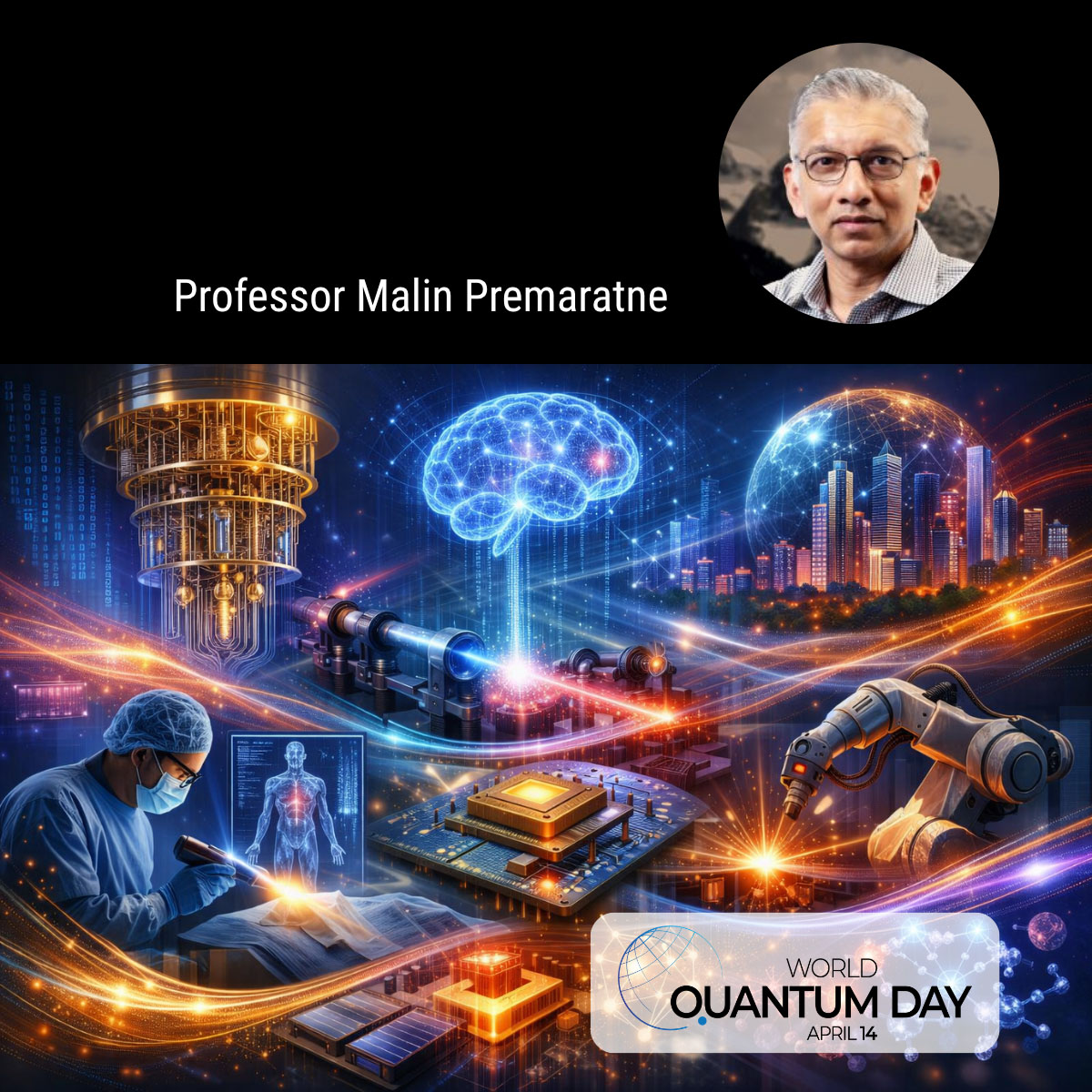
I believe the most powerful quantum technologies will emerge through quantum sensing, quantum optics, advanced lasers, spasers, intelligent materials, and new light-based medical therapies. These are not marginal directions; they are the foundations of a new technological language.
- Quantum sensors will reveal signals and structures that are hidden from us today.
- Quantum optical devices will sharpen imaging, communications, and manufacturing to levels that now seem out of reach.
- Light-driven therapies could make medicine more precise, less invasive, and more responsive to the individual patient.
At the same time, new ideas such as quantum thermal transistors and thermotronic systems may allow us to control heat as elegantly as electronics control charge, opening the door to entirely new classes of energy-aware devices.
“To me, the future of quantum is not a single machine. It is a new way of engineering reality. “The next quantum revolution will not only compute: it will sense, illuminate, heal and transform.”
And in that future, “quantum devices, fields, materials and light will become part of the hidden infrastructure of everyday life.”
Professor Malin Premaratne is a quantum device pioneer, inventor and researcher working at the frontiers of quantum optics, photonics, advanced materials and thermotronics. His work explores how quantum fields, light–matter interactions, and emerging device concepts can create transformative technologies for sensing, communications, medicine, and future energy systems.