Designing better engineering
For more than six decades, the Australian Good Design Awards have recognised projects that combine creativity, technical excellence and real-world impact.
Established in 1958, the program is Australia’s longest-running national design award and one of the country’s most respected platforms for showcasing innovation across industries: from product and digital design to architecture, research and engineering.
Today, the awards are administered by Good Design Australia and endorsed by the World Design Organisation. Together they provide an international benchmark for design excellence and celebrate projects that improve how people live, work and interact with technology and the built environment.
One of the disciplines recognised is Engineering Design, an area where innovation must not only look good on paper but also perform reliably under real-world constraints.
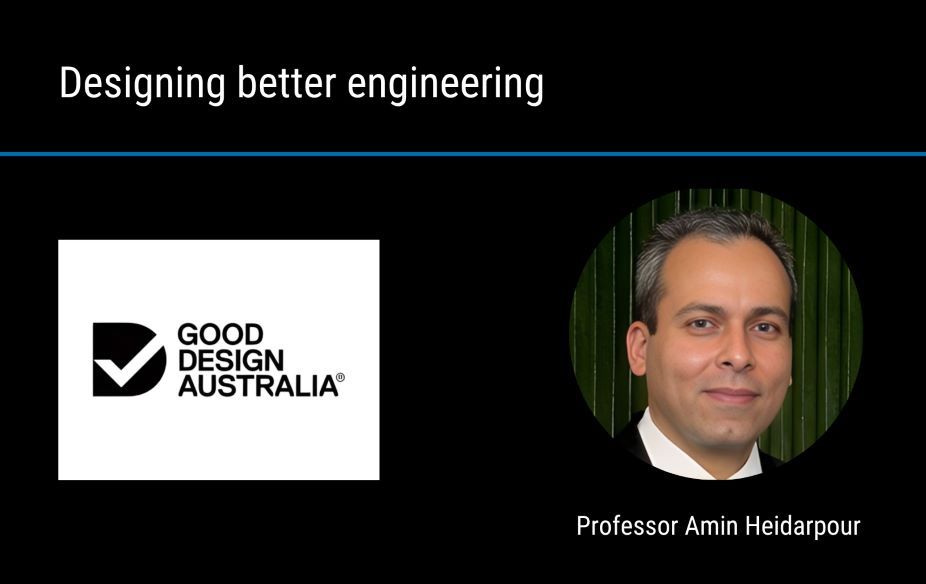
In a recent post from the Good Design Awards, two-time juror Professor Amin Heidarpour - Director of Enterprise and Engagement at Department of Civil and Environmental Engineering at Monash Engineering - shared valuable advice for would-be contestants on what separates a strong entry from a winning one. He said:
- Define the engineering problem clearly. State the technical challenge upfront, including the constraint, limitation or performance gap being addressed. Explain why the problem mattered and why it was difficult to solve.
- Demonstrate measurable impact. Support outcomes with evidence such as performance improvements, efficiency gains, safety metrics, compliance results or testing data. Clear metrics help the Jury assess the significance of the design.
- Lead with the engineer’s perspective. Explain decisions, trade-offs and technical differentiation in clear, precise language. A direct account of how and why the solution works carries more weight than marketing language.
Further Good Design insights
Around the time of the 2025 Good Design Awards, Monash Engineering (ME) had an enlightening conversation with Professor Heidarpour (PH) about industry awards, their importance and impact. Here we share his thoughts.
ME: How do awards and recognition drive collaboration or knowledge-sharing within the engineering community?
PH: Awards bring together professionals from diverse disciplines, industries and regions, creating opportunities for a valuable cross-pollination of ideas.
Recognition also encourages transparency as award-winning teams are often invited to present their work, publish insights or mentor others. This helps foster a culture of collective learning.
Ultimately, it strengthens the engineering community by valuing the sharing of success stories and lessons learned just as much as technical outcomes.
ME: As a Good Design Ambassador, how do you see design advocacy impacting public perception of engineering?
PH: Design advocacy helps reposition engineering from being seen purely as a technical or functional pursuit to one that is fundamentally human-centred.
When the public sees engineers recognised for the design thinking, creativity and empathy behind their solutions, it reshapes perceptions of the profession as both innovative and socially conscious.
Platforms such as the Good Design Awards play an important role in bridging the gap between design and engineering, showing how the two disciplines work together to create solutions that are not only efficient, but also meaningful, sustainable and enriching to everyday life.
ME: What lessons about innovation, ethics or societal responsibility do you hope students take from observing award-winning projects?
PH: Award-winning projects demonstrate that true innovation is not simply about being first or the most advanced. It is about being responsible, ethical and impactful. I hope students recognise that engineering success is measured not only by technical achievement, but also by how thoughtfully a solution addresses social, environmental and ethical considerations.
Observing these projects should inspire them to approach their careers with curiosity, integrity and a strong sense of purpose, understanding that every engineering decision carries broader societal consequences.
ME: How can a focus on good design help engineering tackle emerging global challenges such as sustainability or urbanisation?
PH: Good design is inherently integrative. It brings together systems thinking, creativity and empathy to solve complex problems.
"When engineers embrace good design principles, they move beyond efficiency to consider long-term resilience and sustainability."
Whether addressing climate change, sustainable infrastructure or equitable urban growth, design-led engineering ensures that human, environmental and technological factors are considered holistically.
In this way, good design becomes a powerful strategic tool for tackling global challenges with clarity, innovation and accountability.
In closing, Professor Heidarpour said “Awards…play a pivotal role in setting benchmarks for excellence within the profession. They highlight projects and individuals that exemplify innovation, technical rigor, ethical practice and community benefit.
By recognising these exemplars, the awards reinforce professional standards and encourage others to aspire to the same level of impact and integrity. They also serve as a public showcase of how engineering contributes to solving real-world problems, strengthening public trust in the profession.”