Europe targets ‘Forever Chemicals’: Australian science may hold the solution
The Council of the European Union has formally adopted a directive that updates and expands the list of substances posing risks to surface water and groundwater, reinforcing the European Union’s approach to water quality protection.
The measure amends three cornerstone laws: the water framework directive, the groundwater directive and the directive on environmental quality standards, bringing them in line with the latest scientific knowledge. (Cristina Novo, Smart Water Magazine)
Authors:
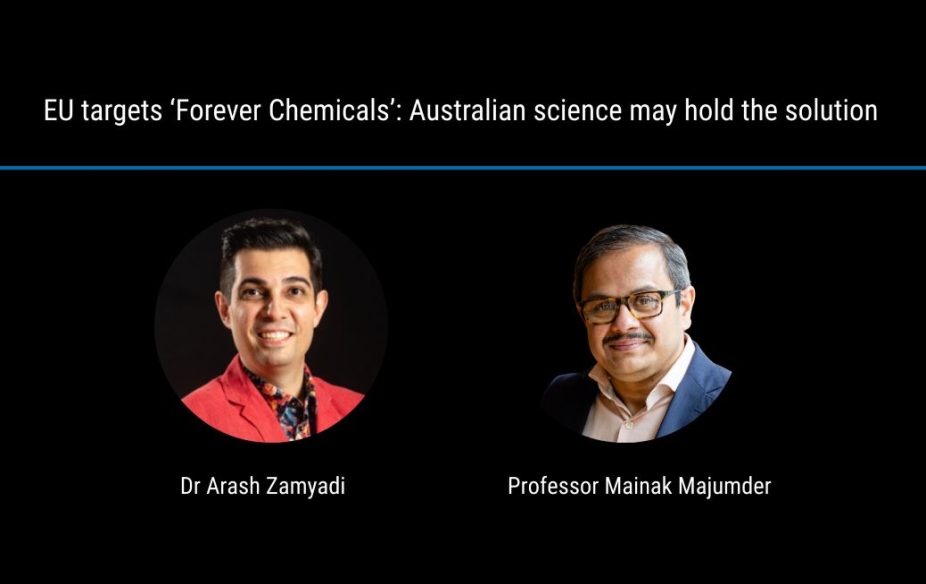
- Professor Mainak Majumder | Department of Mechanical and Aerospace Engineering, Monash University
- Dr Arash Zamyadi | Department of Civil and Environmental Engineering, Monash University
The European Union’s decision to tighten limits on per- and polyfluoroalkyl substances (PFAS) in surface water and groundwater is being interpreted by water scientists as a turning point in environmental regulation, and one with direct implications for Australia.
Under the revised framework, the EU has expanded its list of priority pollutants to include PFAS and strengthened monitoring, reporting and environmental quality standards. Importantly, the directive also requires regulators to consider the combined risks of chemical mixtures rather than assessing substances individually.
For two experts at Monash University, the change signals a fundamental shift: PFAS is no longer treated as a local contamination issue but as a systemic water quality challenge.
A different class of pollutant
Water quality specialist Dr Arash Zamyadi says PFAS behaves unlike most historical contaminants. He explains “These compounds are highly persistent, resistant to conventional breakdown processes, and often shift between phases rather than being destroyed. That means we can’t rely on legacy treatment thinking. We need innovative approaches that capture, concentrate and ultimately eliminate them safely.”
PFAS compounds are highly mobile in water, resistant to degradation and capable of persisting for decades in rivers, reservoirs and aquifers. They also exist as thousands of related chemicals rather than a single substance.
He notes the EU’s move to mixture-risk assessment reflects scientific reality. In natural water systems, multiple PFAS compounds occur simultaneously, and their combined ecological or health effects cannot be reliably predicted by examining individual chemicals alone.
According to Dr Zamyadi, once environmental thresholds become sufficiently low, monitoring alone cannot ensure compliance. Treatment becomes unavoidable. “As regulatory limits tighten, relying on monitoring alone is no longer sufficient,” he says. “PFAS does not naturally degrade in typical treatment systems. Effective compliance will require integrated solutions that enhance removal efficiency while remaining scalable, energy-conscious and suitable for real wastewater conditions.”
The technology problem behind regulation
The regulatory shift exposes a long-standing technical barrier. Conventional treatment methods - particularly activated carbon adsorption - can remove many long-chain PFAS molecules but are far less effective for the short-chain compounds increasingly found in the environment.
Professor Mainak Majumder, Director of the ARC Research Hub for Advanced Manufacturing with 2D Materials (AM2D), has been working on that problem. His research team has developed a graphene-based nanofiltration membrane designed specifically to capture PFAS molecules. The filter creates nanoscale channels and chemical binding interactions that prevent PFAS from passing through while allowing water to flow.
“Our FluoroBlock membrane technology simultaneously removes and concentrates both short- and long-chain PFAS contaminants from mixtures, and with co-contaminants such as natural organic matter and intervening hardening ions such as Ca and Mg in a single-step treatment process,” Professor Majumder explains. “It achieves this with significantly lower energy consumption than conventional reverse osmosis systems, making it well suited for water purification in both remote settings and typical domestic environments.”
Unlike many laboratory materials, the membrane can also be manufactured using scalable printing processes, meaning it could be deployed in treatment plants, industrial wastewater systems and landfill leachate management. Monash University is collaborating with the Australian company Clean TeQ Water to manufacture this product and position it for early market entry, ensuring the public can have confidence and peace of mind that their health is safeguarded.
Professor Majumder says the technology would need to be integrated with cost-effective PFAS degradation processes capable of breaking down these persistent toxic compounds into benign by-products, thereby minimising potential health risks.
Why Europe matters to Australia
The EU directive effectively moves regulation upstream. Instead of focusing only on drinking water treatment, it requires protection of entire water bodies. Member states will face stricter monitoring obligations and staged compliance timelines extending to 2039.
That approach has international consequences. If environmental limits are imposed at the catchment scale, utilities must remove PFAS across multiple points in the water cycle: groundwater extraction, wastewater discharge, industrial effluent and recycled water. Compliance therefore becomes an engineering capability issue, not just a monitoring exercise.
Dr Zamyadi observes that regulatory developments in Europe frequently become global benchmarks, particularly where environmental standards intersect with food safety, exports and environmental reporting. He notes the European Union’s precautionary regulatory framework and its strong integration of environmental compliance with trade and market access requirements make its standards highly influential and widely adopted beyond its borders.
A stringent regulatory framework means that access to cost-effective, scalable, and highly reliable technologies is essential to effectively address this emerging challenge.
Australia’s policy crossroads
Australia currently manages PFAS primarily through drinking-water guideline values and site-specific remediation programs. However, the EU model is ecosystem-based, emphasising protection of rivers and aquifers as a whole.
According to Dr Zamyadi, the distinction is fundamental. “A drinking-water lens focuses on the point of human exposure, whereas an ecosystem-based framework recognises PFAS as a persistent environmental contaminant that cycles through catchments, sediments and biota. If we only manage PFAS at the treatment plant boundary, we are responding downstream. Protecting entire water bodies shifts the emphasis upstream towards source control, cumulative load reduction and long-term environmental resilience.”
He adds that such an approach also reduces future liability. “Once PFAS accumulates in aquifers or river sediments, remediation becomes technically complex and economically burdensome. Managing at the ecosystem scale is not just environmentally sound: it is a risk management strategy that limits legacy contamination and protects agricultural productivity, exports and community confidence in recycled water.”
The existence of viable removal technology could accelerate policy change. Historically, regulators have hesitated to impose strict environmental thresholds where treatment solutions were uncertain. Demonstrated filtration capability reduces that barrier.
In effect, Europe has created regulatory momentum while Australian researchers have developed a potential technical pathway. The convergence suggests that PFAS regulation may soon move beyond guidance levels toward enforceable environmental standards internationally.
For Australian policymakers, the question is no longer whether stricter PFAS limits will emerge, but whether water infrastructure, treatment capability and regulatory frameworks will be prepared when they do.
Last, conclusion: PFAS removal will not be solved by incremental optimisation of legacy processes. It requires integrated, scalable and energy-conscious innovation grounded in real-world conditions. Monash CEE ozone nanobubble and granular activated carbon platform demonstrates that meaningful performance gains, including enhanced removal efficiency and improved carbon longevity, are achievable without prohibitive energy penalties.
However, operation at skill is still a challenge that require further investigation. As Dr Zamyadi emphasises, progress depends not only on scientific advancement but on trusted collaboration between utilities, researchers and technology partners. When industry is willing to pilot, test and refine emerging solutions, complex challenges like PFAS move from being persistent problems to potentially solvable engineering tasks.
Read more about the European Council - Council of the European Council water quality directive here
Learn more about Dr Zamyadi’s PFAS research here
Learn more about Professor Majumder’s PFAS filtration research here