Safer, smarter human-robot teamwork in Industry 5.0
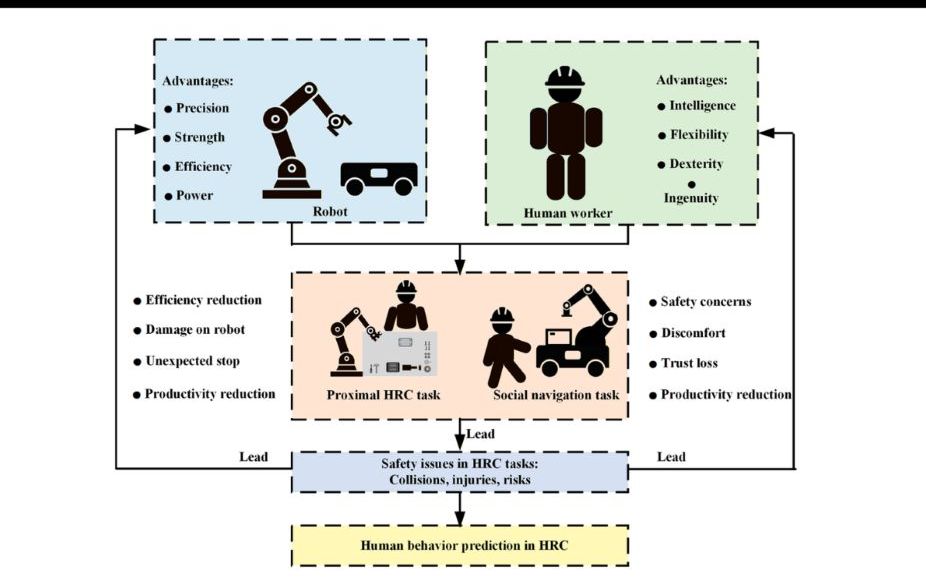
A new review published in the International Journal of Production Research explores how manufacturers can make human-robot collaboration (HRC) safer, more adaptive and more efficient by improving the way robots predict human behaviour in shared industrial environments.
As manufacturing moves toward Industry 5.0, production systems are becoming more human-centred, combining human creativity, judgement and dexterity with robotic precision, strength and speed.
But as people and robots work more closely together, new safety and coordination challenges emerge. If robots cannot accurately anticipate what a worker will do next the risk of collisions, delays and inefficient collaboration increases.
The review examines major approaches used to predict human behaviour in human-robot collaboration, including mechanism-based models built around physical motion and interaction rules, data-driven models that learn from sensors and artificial intelligence, and hybrid approaches that combine both.
Researchers show that while each method has strengths, more integrated approaches are likely to be the most effective for future human-centric manufacturing systems. The authors propose a unified framework that brings together multimodal data, physical world modelling, behaviour prediction and adaptive control.
Co-author Dr Yunlong Tang, Assistant Director of the Monash Centre for Additive Manufacturing (MCAM) says “Industry 5.0 is about designing manufacturing systems around people as well as technology. By improving how robots predict human behaviour, we can move towards environments that are not only more productive, but also safer, more adaptive and more human-centred.”
The review suggests future progress will depend on combining physical models, sensor data and AI in ways that allow robots to respond more intelligently to human movement, intent and changing working conditions.
The research highlights how more intelligent prediction and planning tools could help manufacturers improve safety, strengthen collaboration between workers and robots, and build production systems that are more resilient, efficient and responsive.
Read the full paper here.
Read more in Australian Manufacturing Magazine here.