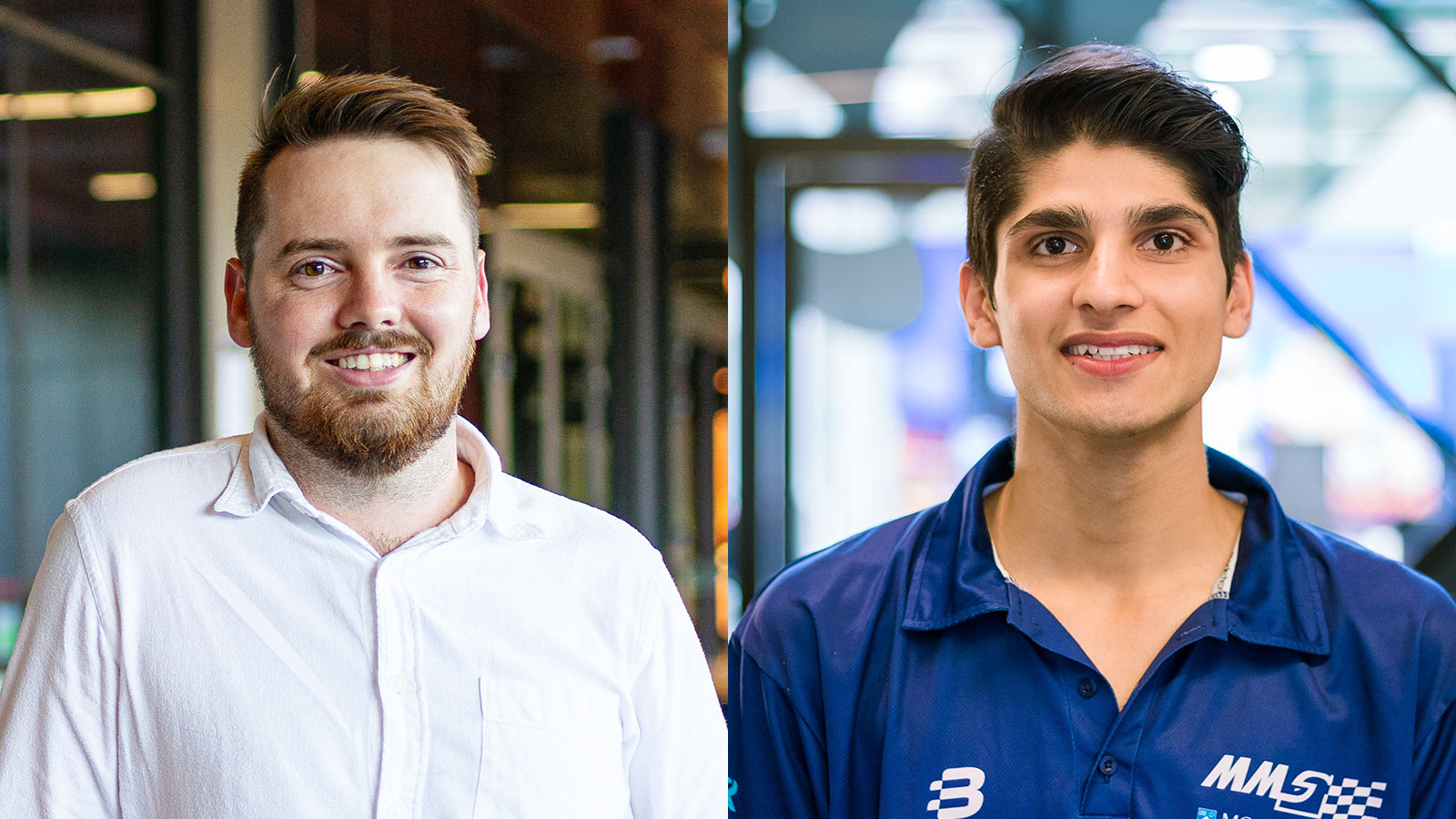
Alex and Nathan

Student-designed, affordable robot Dingo goes viral
Alex Calvert and Nathan Ferguson | Bachelor of Robotics and Mechatronics Engineering
It’s not often a student Final Year Project (FYP) in Engineering goes “viral” on the internet, and that’s not what Nathan Ferguson and Alex Calvert were seeking when they designed and built a robot quadruped for their FYP in robotics and mechatronics.
The small orange robot dog Nathan and Alex named “Dingo” not only turned heads when final year students presented their projects for assessment, it also created a buzz online.
The students’ video demonstrating the Dingo and explaining the background to the project - a requirement for their FYP assessment - has garnered nearly 170,000 views and much praise on their YouTube channel (at last count). As people began sharing the video, the Dingo also received coverage and discussion in online news forums including Reddit, and many positive reviews on tech, robotics and 3D printing websites.
“We definitely didn’t set out to make ourselves famous!” explains Alex. “Our aim was to create a low-cost but capable quadruped robot suitable for use in research by the Monash Robotics Laboratory. I’m interested in both research and design, but I’d already done a summer research project, so I decided my FYP should be more design-focused.”
“And I wanted to work on a project that would involve software, electrical and mechanical engineering,” says Nathan. “I see so many future technologies as being highly integrated across those domains and I wanted that breadth of understanding and experience.”
Nathan and Alex had known each other from classes and student teams but hadn’t actually worked together before embarking on the project that became Dingo, in consultation with their academic supervisor Dr Michael Burke of the Department of Electrical and Computer Systems Engineering.
Walking robots are sought after because they can be used in environments designed for humans and in natural terrain. But high quality, expandable and robust robot quadrupeds available commercially are very expensive and neither affordable nor practical for student projects.
“There were some lower-budget open-source alternatives around, but these generally sacrificed either form or function to meet budgetary requirements,” Nathan explains.
“So we put our efforts into creating an affordable product - costing under A$1500 to make - that was also expandable and modular, allowing various different sensors and actuators to be added depending on the kind of research, as well as having fluid motion and aesthetic appeal,” says Alex.
In fact, the total cost of the Dingo came in at A$1350; by contrast, the original selling price of Boston Dynamics’ robot dog “Spot” was US$74,500.
One key area of innovation in the Dingo’s design involves the mechanics and powering of limb movements. Each leg is driven by three servo motors, but the unique placement of these motors and a newly-devised mechanical linkage help reduce limb inertia and simplify kinematics.
The Dingo’s body can be 3D printed and its creators have shared its design and detailed technical specifications online, allowing anyone to build their own or make modifications using the files they have provided.
“The software we developed for the Dingo is built on open-source code, which allows for easy modification and seamless incorporation of additional code by future users,” adds Alex. “We also developed a virtual simulation of the Dingo, allowing experimental testing of code before it’s implemented on the physical robot.”
Now there’s even a Facebook group where people who are building their own Dingos share their experiences and tips!
Alex says the FYP created not only an opportunity to apply knowledge gained from earlier in his Engineering studies, but also an opportunity to extend and enhance his learning.
Nathan agrees that the FYP was “definitely a highlight” of his Engineering course experience. “It was great having the extended period of two semesters to work on the design and implementation in depth.”
“It’s been highly rewarding to create something we’re proud of and that others have been so impressed by.”
Full design and construction specs for the Dingo are available via the cloud-based collaborative design website GrabCAD and coding via the software sharing and development site GitHub.