Carbon in a Bubble: Cavitation in Ionic Liquids
Carbon in a Bubble: Cavitation in Ionic Liquids
Project overview
This project aims to investigate the potential of pressure-driven phase change as an energy-efficient mechanism for removing dissolved gases from low melting point salts, by advancing understanding of the cavitation behaviour of ionic liquids.
This project expects to generate new knowledge in the area of fluid mechanics through an innovative combination of advanced computational simulations and synchrotron X-ray measurement techniques developed by the investigators.
Expected outcomes of this project include expanded understanding of the physics of ionic liquids, and the ability to engineer more efficient gas separation systems. The project aims to benefit the chemical and energy sectors through improved energy efficiency.
“For many years we've known that cavitation bubbles and dissolved gas can have an effect on the way that fuel injectors in cars and aircraft engines operate. We've always been trying to eliminate these problems as inconveniences. In this project, we're asking a new question - what if we could harness this interesting fluid-mechanical behaviour for beneficial purposes? What was once seen as a problem could potentially become a great opportunity.”
For more about this project, click here
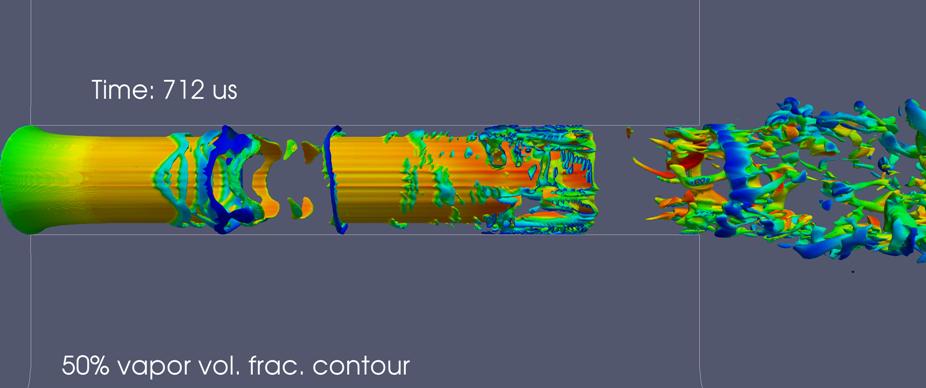
Computer simulation of fuel cavitating inside a model of a fuel injector nozzle. Credit: D. Duke, C. Powell & D. Schmidt. The simulation was performed on the “Blues” cluster at Argonne National Laboratory