How machine learning could make graphene reliable
A new review published in Small Structures takes a critical look at why chemical vapour‑deposited (CVD) graphene - long promoted as an ultra‑thin, impermeable corrosion barrier - continues to deliver highly inconsistent results across the research community.
Co-authors Pragyan Goswami, Professor Alankar Alankar and Professor Raman Singh report that while pristine graphene can dramatically slow corrosion thanks to its atomic‑scale impermeability, even microscopic discontinuities such as pinholes, grain‑boundary gaps or wrinkles can reverse its protective effect.
These defects create small exposed anodic sites adjacent to a highly cathodic graphene surface, accelerating corrosion rather than preventing it. The review highlights that such inconsistencies stem largely from variations in CVD parameters including temperature, pressure, gas flow rates, substrate crystallography and nucleation behaviour.
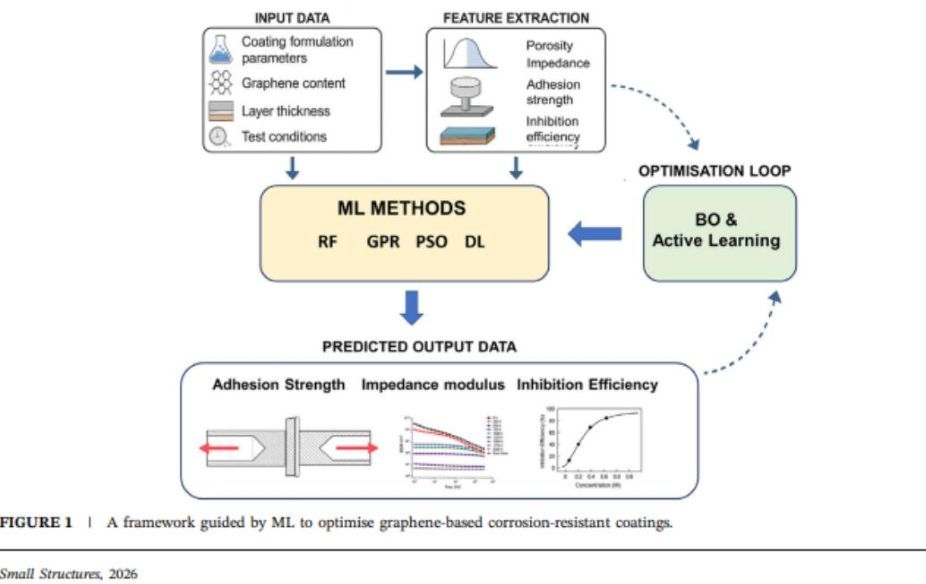
To address this, the authors propose a shift toward machine learning‑guided optimisation. They outline how ML models can analyse large datasets of CVD conditions, identify hidden correlations influencing defect formation and predict coating performance with greater reliability.
The review also points to the emerging role of large language models in rapidly synthesising literature, generating hypotheses and accelerating experimental planning. Together, these tools could enable more consistent, defect‑minimised graphene coatings and reduce the trial‑and‑error burden that has slowed progress in the field.
Read the full article here.
About the authors
- Pragyan Goswami is a PhD Researcher with the IITB-Monash Research Academy, Indian Institute of Technology, Bombay
- Professor Alankar Alankar works with the Department of Mechanical Engineering, Indian Institute of Technology, Bombay
- Professor Raman Singh works with Mechanical & Aerospace Engineering and Chemical and Biological Engineering at Monash University