New membrane design boosts hydrogen–carbon dioxide separation
Researchers from Monash University and Ningxia University have unveiled a new membrane that could significantly improve the way hydrogen is separated from carbon dioxide, a process central to clean energy and industrial gas production.
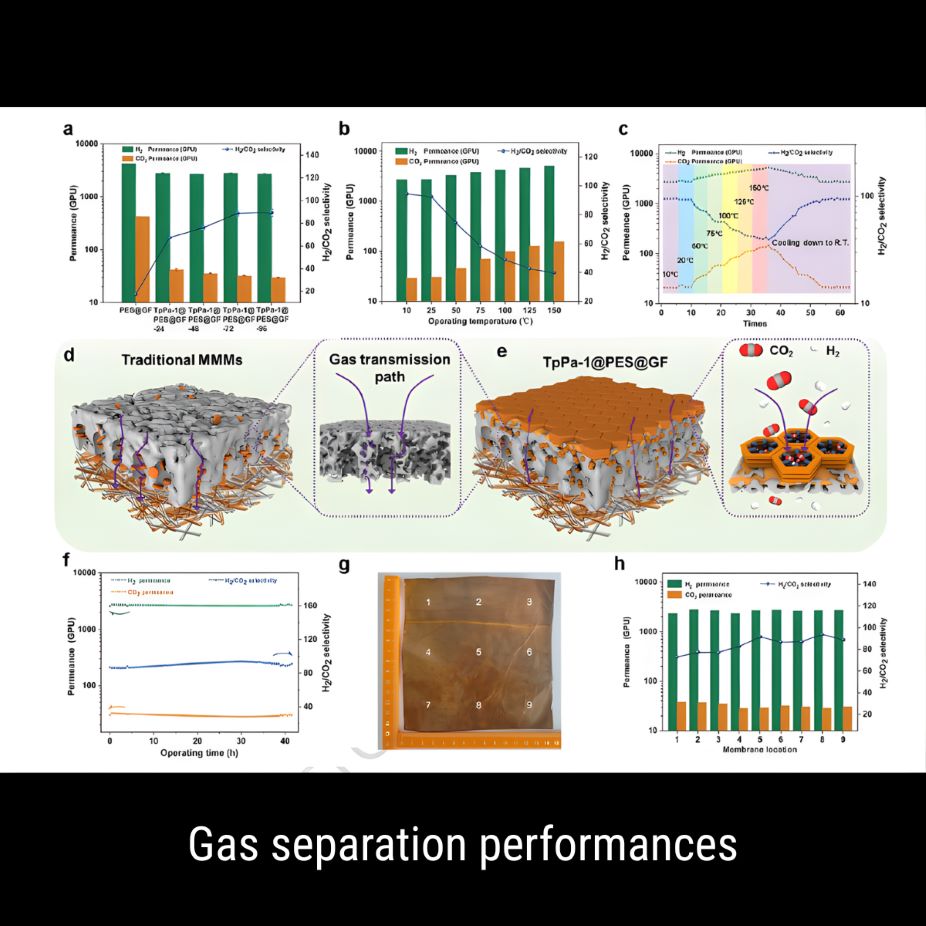
The team developed an asymmetrical mixed matrix membrane that combines a thin, highly selective covalent organic framework (COF) layer with a durable polymer support.
This structure allows hydrogen to pass through quickly while effectively holding back CO₂, overcoming a common trade-off between speed and selectivity in membrane technologies.
Crucially, the membrane avoids microscopic defects at the boundary between the COF and the polymer, a frequent weakness in earlier designs that can undermine performance.
In laboratory tests, the membrane delivered high hydrogen flow rates alongside strong H₂/CO₂ selectivity, placing it among the top performers reported for this type of separation.
Researchers say the fabrication method is compatible with larger-scale production, raising the prospect of more energy-efficient hydrogen purification for applications ranging from industrial processing to low-emissions energy systems.
Co-author Sir John Monash Distinguished Professor and Australian Research Council (ARC) Laureate Fellow Professor Huanting Wang of Monash Chemical and Biological Engineering explains "The interfacial polymerization method developed in this work enables the formation of the selective layer with minimal defects and its close integration with the large-pore supporting layer, which is key for significantly improved separation performance.
I have had the privilege of collaborating with Professor Zheng Wang at Ningxia University, who was a postdoctoral research fellow with me at Monash University."
Read the research paper in Springer Communications here.