Proteins, the unexpected saboteurs of biodegradable implants
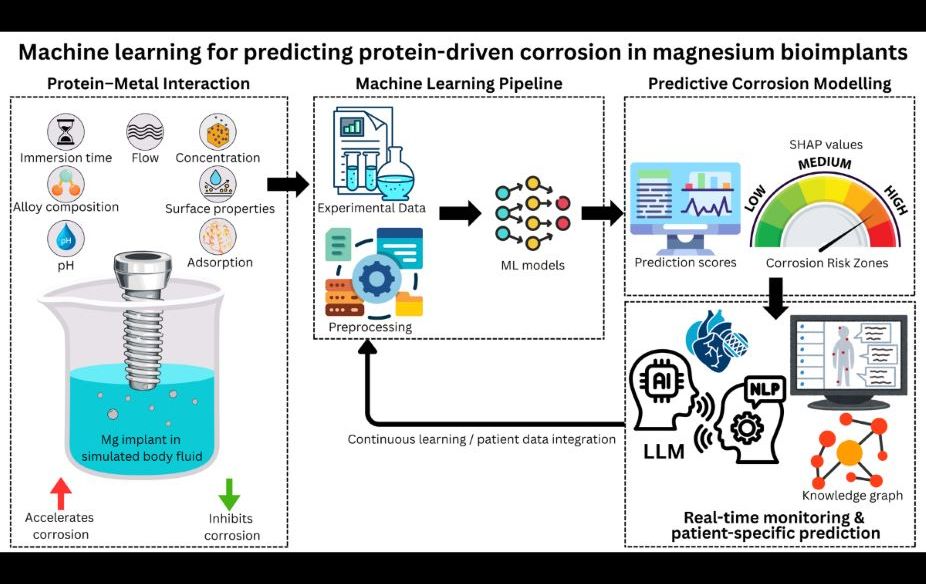
A new paper from PhD candidate Bharath M N (IIT Bombay & IITB-Monash Research Academy), Professor Raman Singh (Monash University) and Professor Alankar Alankar (IIT Bombay & CMInDS, IIT Bombay) highlights how proteins in body fluids influence the performance of magnesium-based bioimplants and how machine learning may help predict these effects.
Magnesium-based implants are increasingly attractive for temporary medical devices such as screws, plates and stents because they biodegrade naturally in the body and support bone regeneration. However, their degradation behaviour in biological fluids remains difficult to predict.
Proteins such as albumin and fibrinogen can either slow down or accelerate corrosion, depending on environmental conditions and concentration.
In this comprehensive review, the team synthesises experimental evidence and mechanistic understanding to address these conflicting observations and introduces data-driven approaches to predict implant behaviour.
Key contributions of the review include:
- Mechanistic insights into protein-mediated corrosion of magnesium bioimplants
- A synthesis of experimental findings across physiological environments
- Application of machine learning and AI frameworks to analyse complex protein–metal interactions
- Exploration of large language models and knowledge graphs to support inverse alloy design and predictive modelling
- A pathway toward safer, more predictable biodegradable implants through AI-enabled design
By integrating materials science with modern AI tools, this work demonstrates how data-driven frameworks can improve prediction of implant degradation and guide the design of next-generation magnesium-based biomedical implants.
These insights bring us closer to implants that degrade at the right pace, perform reliably in the body, and translate more effectively from research to clinical applications.
Published in Progress in Materials Science - one of the highest-impact journals in the field (Impact Factor ≈ 40) - read the full review here.