The hidden cause of pipe failures
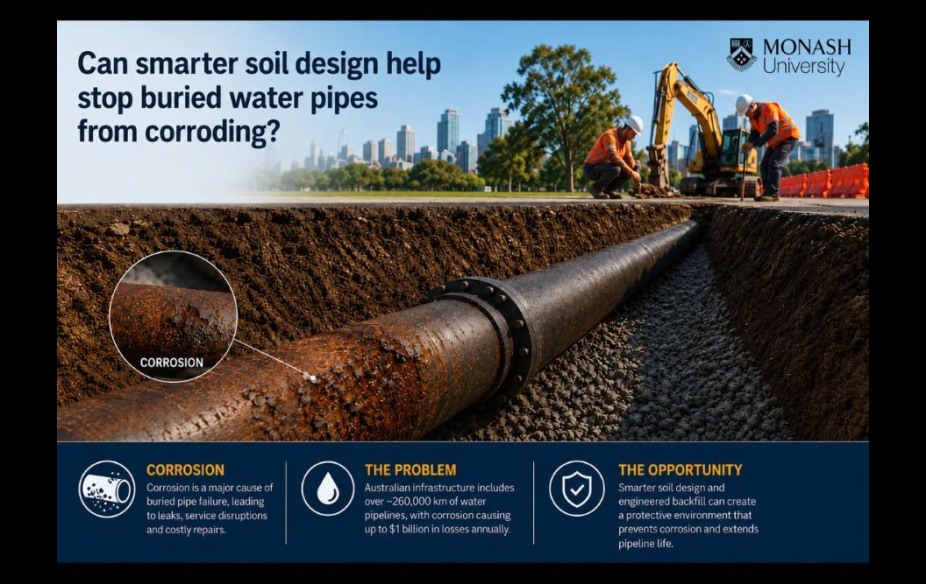
A new international study has focused on an often-overlooked factor behind failing water pipelines: the soil surrounding them.
Led by a team from Monash Civil and Environmental Engineering, researchers have reviewed how “backfill” - the material used to refill trenches after pipes are laid - can play a critical role in preventing corrosion in buried ductile iron pipelines.
Their findings suggest smarter choices in these materials could significantly extend the lifespan of essential infrastructure.
Corrosion is a major cause of pipeline damage worldwide, leading to leaks, costly repairs and service disruptions. While protective coatings on pipes are commonly used, the study illustrates that once coatings degrade, the surrounding soil environment becomes a key driver of deterioration.
The research shows factors like moisture, oxygen levels and the chemical makeup of backfill materials can dramatically influence how quickly corrosion occurs.
The study also considers the growing interest in using recycled materials - such as crushed concrete or reclaimed aggregates - as backfill. These options not only reduce waste and environmental impact, but may also improve corrosion resistance when properly designed.
However, predicting long-term performance remains challenging. Conditions underground can vary widely over time, with changes in temperature, moisture and soil structure all affecting how pipes degrade.
The authors say a more holistic approach is needed - combining engineering, materials science, and environmental considerations - to design backfill that protects pipes while also supporting sustainability goals.
In simple terms, what’s buried around a pipe may be just as important as the pipe itself.
Read the full article in Geotechnical and Geological Engineering here.