Georgia Brooks
With a love of complexity and helping others, Georgia wears her heart on her sleeve
Georgia Brooks | Bachelor of Mechanical Engineering (Honours) & Bachelor of Biomedical Science
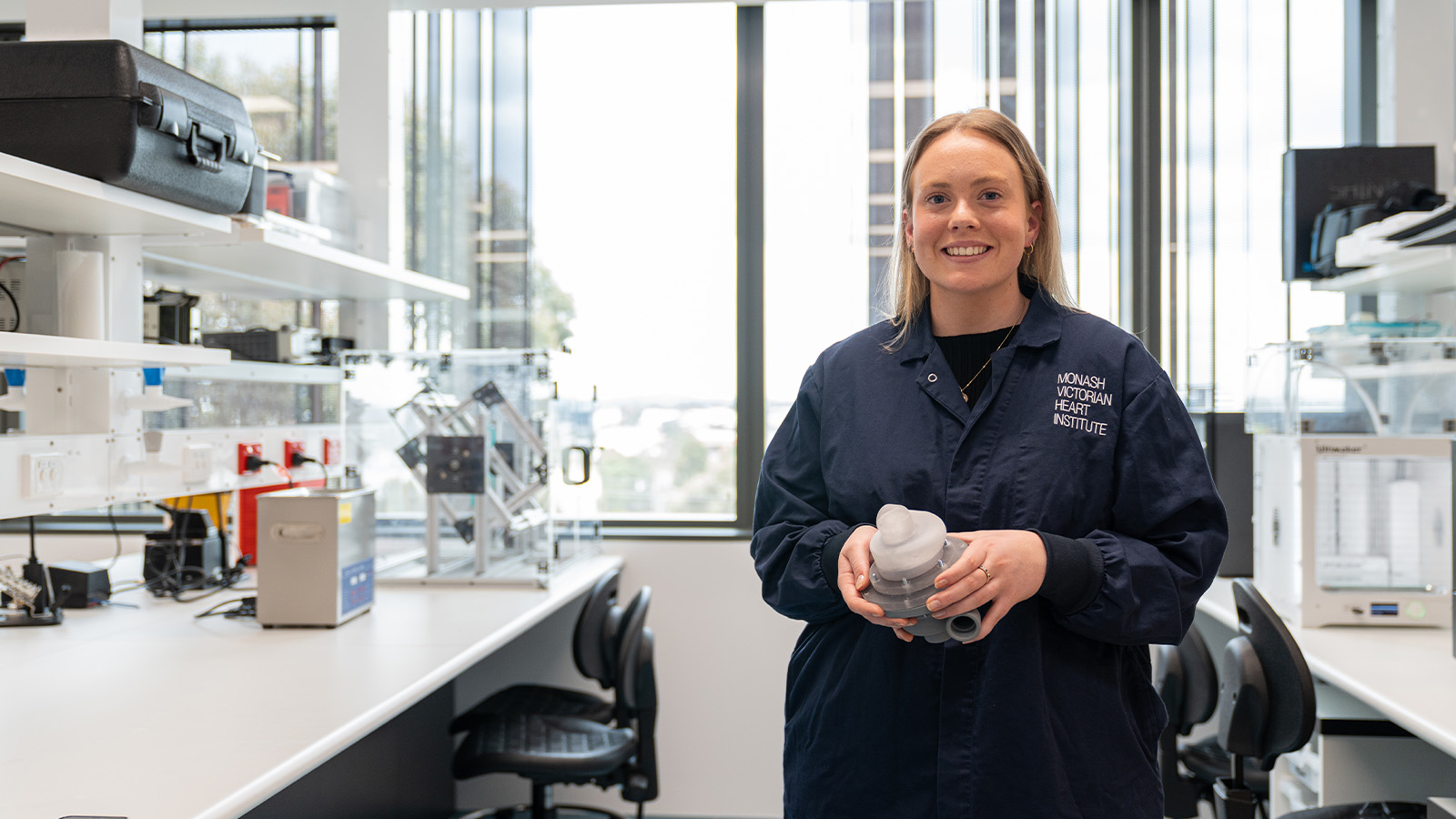
In October 2023, Georgia Brooks boarded a flight to Dallas, Texas, together with an unusual and precious travelling companion: the prototype of a new artificial heart.
Designed and built over many months by a multidisciplinary team of students at Monash University, the heart was on its way to a conference of the International Society for Mechanical Circulatory Support (ISMCS) to be evaluated and judged by industry and medical experts in the Heart Hackathon, the world’s first design competition for a total artificial heart.
Georgia, then in the final year of a double degree in mechanical engineering and biomedical science, was presenting the design as co-lead of the Monash Heart Hack team.
Made up of students from Engineering, Medicine, Biomedical Science and even Law, the Heart Hack team had grown out of Monash Young MedTech Innovators (MYMI), a student-run initiative aimed at creating positive impact through medical technology and healthcare innovation.
“I not only had the privilege of representing our team at the ISMCS, but also the opportunity to meet like-minded engineers and professionals who are passionate about game-changing healthcare technology,” Georgia recalls.
Innovations in heart design
Key engineering innovations in the Monash team’s design included an impeller – the rotating part of a centrifugal pump to move fluid – with backward spinning blades to reduce shear stress, a brushless motor system using magnetic levitation (“maglev”) principles to generate motion, and a shaftless electrical system.
Importantly, the Monash heart included three scalable components: a central core to house the motor and electrical components, along with right and left chambers to take over the pumping functions of the right and left ventricles of the heart respectively.
“The use of current artificial hearts is limited by strict patient selection criteria, particularly the body size of the patient,“ Georgia explains, “but our modular design meant the components could be produced in different sizes, meaning more patients could potentially benefit.”
Monash Heart Hack ultimately took second place in the Heart Hackathon, which was won by a team from the University of Bath in the UK.
“It was super competitive, with all teams giving very strong presentations, and the scoring came down to just a few points,” says Georgia. “I was so proud to present our device on behalf of the team and we were all very pleased with our design and the result.”
Skills gained from teams experience
Although her student team experience was extra-curricular, Georgia found it very complementary to her course work.
“Not only did I have the opportunity to work on a project within the niche world of cardiovascular engineering, I also gained many practical and personal skills I was able to apply to my studies,” she says.
“I think it’s helped make me a more confident and more valuable engineer.”
Perhaps surprisingly, engineering hadn’t been on Georgia’s study or career radar when she was at high school in Hamilton, New Zealand, and she describes her decision to study engineering at Monash as “last-minute but life-changing”.
“In high school, I was absolutely fascinated with medicine, but I also had an incredible physics teacher who opened my eyes to many complex ideas.”
“I wanted to study something challenging that involved solving complex problems and helping others, but it was my desire to keep as many doors open as possible that inspired me to choose Monash and a double degree in engineering and biomedical sciences.”
When it came time to select an engineering specialisation in her second year, Georgia chose Mechanical Engineering as she saw it aligning closely with her studies and interests in Biomedical Science.
Mechanical nous to solve medical problems
“I love learning how things work, especially complex systems, and thinking about how problems can be solved through mechanical expertise… even in the cardiovascular system,” she says.
Georgia also had a valuable opportunity to gain industry experience and develop her software skills through a Co-operative Education Program internship at medical technology company 4DMedical, which develops four-dimensional lung imaging for diagnosing and managing respiratory diseases.
Since graduating, Georgia has taken up a role with a management consulting firm as a specialist in engineering and technology.
Ultimately, she wants to pursue a career that will allow her to continue to feed her curiosity about the world while providing opportunities to help others, she says, “particularly if I can work in a team or organisation whose members value kindness, innovation, and collaboration”.
Based on her own experiences, Georgia’s advice to younger students is to keep as many doors open as possible and to take advantage of every opportunity presented.
“Find out what drives you, what makes you excited about your day and about your future - if you’re curious and motivated by being challenged and helping others, then don’t let engineering pass you by.”
Find out more about the Bachelor of Engineering (Honours) degree, the Biomedical Engineering and Mechanical Engineering specialisations, and what it’s like to study engineering at Monash.
Follow the links to learn more about the Co-operative Education Program and Monash Young MedTech Innovators.