Manning Peart
Pathology lab processes are put to the test using digital twin technology
Manning Peart | Bachelor of Environmental Engineering (Honours) & Bachelor of Commerce
Engineering student Manning Peart is passionate about efficiency and automation; in fact, you could say it’s in the blood!
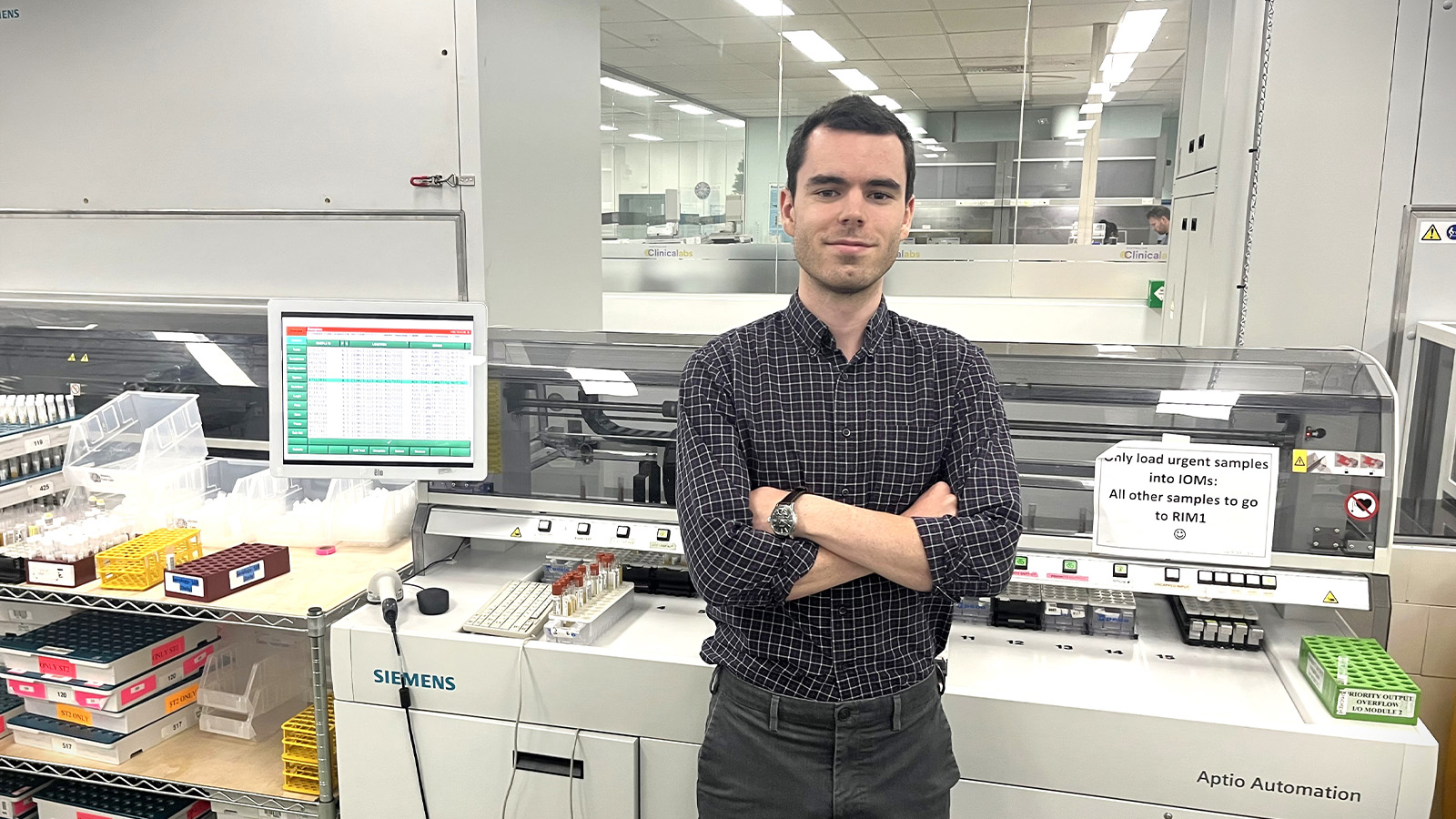
He’s working on a project applying the latest in smart technology to high-volume processing of pathology specimens at leading pathology provider Australian Clinical Labs, which operates 73 accredited laboratories across all mainland states.
Part way through his double degree in Commerce and Environmental Engineering at Monash, Manning took up a one-year opportunity via the Engineering Co-operative Education Program (“Co-op”) to work for infrastructure company Acciona as part of the massive project to replace dangerous and congested road-rail crossings in the suburbs of Melbourne.
He was invited to give a talk about his Co-op experience to employer partners at an industry event at Monash, and it was there his career direction jumped the tracks.
“As part of the event, we were taken on a guided tour of the Monash Innovation Labs including the Monash Smart Manufacturing Lab and I found myself fascinated by the kind of work being done there, particularly the use of digital twins,” Manning explains.
“Virtual engineering”
Digital twin technology involves creating a virtual copy of complex machinery or an automated process so that it can be “tinkered with”, monitored and optimised without the need to disrupt the real thing.
Inspired by the possibilities of “virtual engineering", Manning undertook a Final Year Project (FYP) using the digital twin environment to apply lean manufacturing methodologies and techniques to an automated 3D printing service.
He also joined the newly-established Monash Automation student-led team based at the Monash Smart Manufacturing Lab.
“Both our academic advisor Professor Yunlong Tang and Dr Keenan Granland, who manages the lab, answered any questions I had and supported me through my learning,” Manning says.
“Keenan is a passionate and knowledgeable mentor, and based on the experience I got through my FYP, he recommended me for the Australian Clinical Labs Co-op project.”
Simulated biochemistry system
Manning’s challenge at Australian Clinical Labs was to develop a simulated version of the biochemistry track used by the pathology provider to test thousands of blood and urine specimens, then model and adjust settings and control logic to optimise use of the high-volume equipment.
"This involved researching the biochemistry track and instruments to build the digital model, then running simulations to test for asset utilisation and bottlenecks,” says Manning.
“One of the key benefits of a digital twin simulation is that it allows you to evaluate the overall effectiveness of a system and make adjustments to various parameters without the downtime and reduced output if you have to undertake physical experimentation.”
“We were able to arrive at the ideal throughput settings under various scenarios so Australian Clinical Labs can improve their automated biochemistry track processes."
“Can-do attitude”
Campbell Heath, National Business Improvement Manager at Australian Clinical Labs, says the Co-op program has been a great way for both the business and Manning to learn from each other and develop a superior solution by complementing each others’ skill sets.
“The highlight of our Co-op experience with Manning and the Smart Manufacturing Lab at Monash Innovation Labs has been the can-do attitude towards tackling such a technically and intellectually complex task,” says Campbell.
“The team and Manning in particular are very competent in the field of process excellence and we were confident Monash had the backup within its ranks to support such a complex project.”
Manning Peart says his favourite thing about his Co-op program with Australian Clinical Labs is that it required him to truly integrate and apply his knowledge of automation, lean manufacturing, programming and project management.
“It was the perfect challenge,” Manning says, “and I've really enjoyed learning to make good, simple decisions amidst the complexity of the system I'm analysing and optimising.”
"I can’t recommend the Co-op program highly enough - it’s where I've learned the most about my passions and the knowledge and skills I will need to continue on this career path."
“It was the perfect challenge and I've really enjoyed trying to make good, simple decisions amidst the complexity of the system”
“The highlight has been Manning’s can-do attitude towards tackling such a technically and intellectually complex task”