Nina Langer
Developing technologies to save lives and ease the burden of Cardiovascular Disease
Nina Langer I PhD Candidate, Department of Mechanical and Aerospace Engineering
B.Sc. Mechanical Engineering, RWTH Aachen, Germany
M.Sc. Mechanical Engineering, RWTH Aachen, Germany
M.Sc. Tsinghua University, Beijing, China
Cool at the time…
A love of mathematics and a sense that “engineering sounded cool at the time” led German-born Nina Langer to study engineering.
“I had no real idea what engineering actually involved when I started, but I was lucky to discover that it fascinated and excited me,” she says. Over time, I grew genuinely passionate about it, and I’m very grateful for where it’s taken me.”
After completing Bachelor and Masters studies in Germany and China, Nina was drawn to Monash by the chance to fully focus on her research.
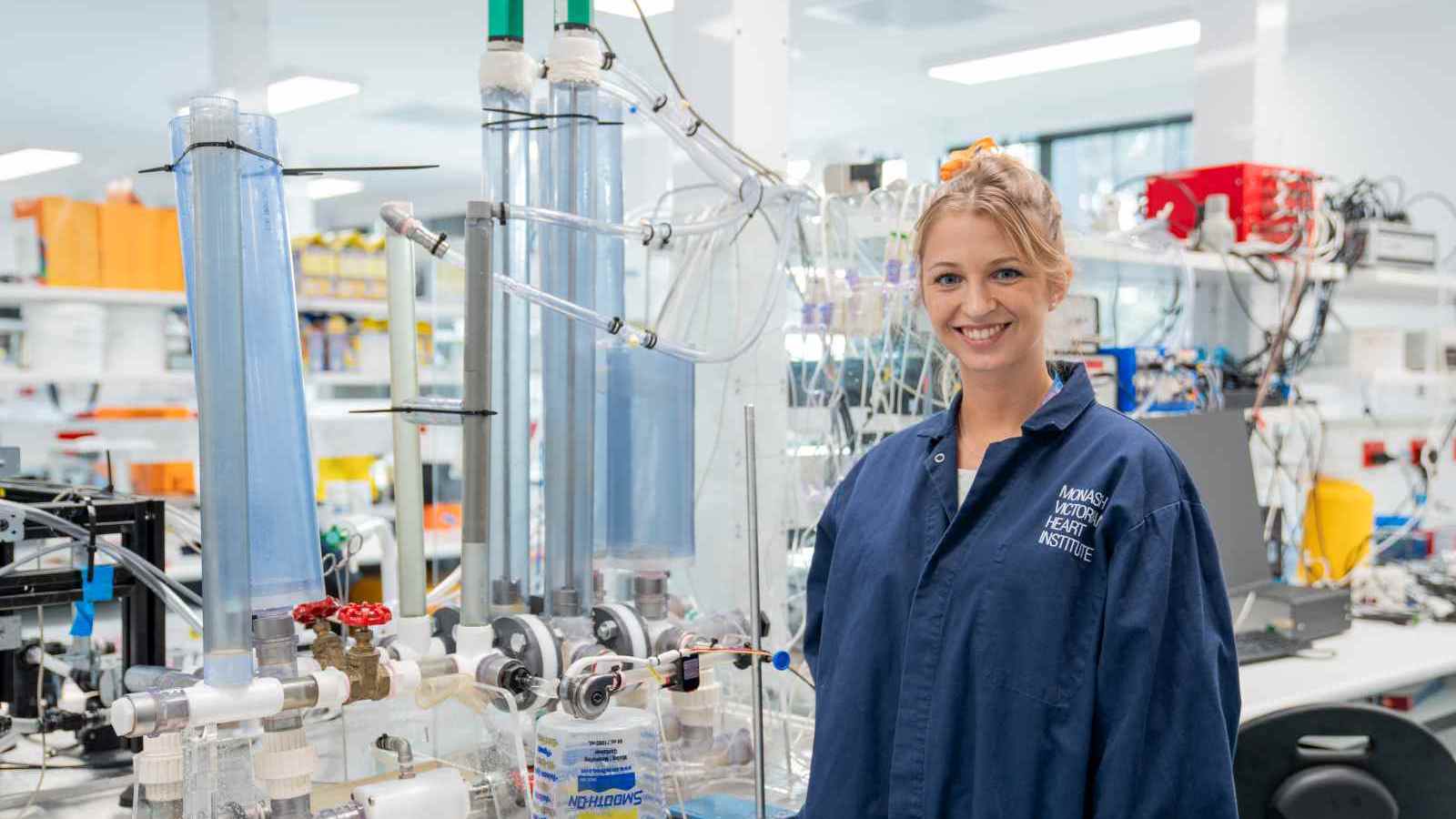
She explains “My research focuses on medical devices for patients with complex heart failure. I work with benchtop models, virtual fitting techniques, and computational simulations (CFD and FSI) to assess existing technologies and explore how we can improve them.”
The intersection of biology and medicine
Always fascinated by biology and medicine, Nina says “Medtech felt like the perfect bridge between those interests and engineering. At first, I followed the opportunity somewhat by chance; friends were working in the field, and it seemed like a good fit. But I quickly realised how impactful and rewarding it was.”
Her research aims to support the development of better devices by providing a deeper understanding of design parameters that often get overlooked in fast-paced commercial settings. Ultimately, this research enables more tailored, effective solutions for an underserved patient group.
Nina’s project has been published in Annals of Biomedical Engineering and in ASIAO Journal.
She has also authored a chapter in Mechanical Circulatory and Respiratory Support (Second Edition) 2025.
Bold, unconventional ideas - chasing impact
Passionate and focused, Nina says “My goal is to create real-world impact. I want to help bridge the gap between engineering innovation and clinical application - especially in MedTech, where understanding the needs of both clinicians and patients is crucial.”
She sees herself working closely with R&D teams, helping steer projects toward the most meaningful outcomes through strong communication, collaboration, and a human-centred design approach.
“I’m chasing impact. I want to work on bold, unconventional ideas that make a meaningful difference in people’s lives. Ideally, I’ll be part of projects that push the boundaries of MedTech and help more people live longer, healthier lives,” she says.
When asked what drives her, Nina replies “What I love most is that patients are at the centre of everything. Cardiovascular disease is a huge burden, not just financially for healthcare systems, but emotionally for patients and their families. Seeing how these technologies can literally save lives is incredibly inspiring. Talking to patients whose lives have been changed by these devices continues to motivate me every day.”
Scholarships and Awards
Nina has received a number of awards and scholarships which have enabled her to study in Australia. They have provided coaching around commercialisation, IP and fundraising; supported conference attendance and the opportunity to present her work, receive expert feedback and build professional networks; and allowed her to undertake a three-month research visit to Massachusetts Institute of Technology:
- Monash International Tuition Scholarship
- Monash Graduate Scholarship
- MedTech Actuator Menzies Scholarship
- Monash and Medical Advances Without Animals travel grants
- International Society for Mechanical Circulatory Support Exchange Scholarship
- Monash Institute of Medical Engineering Women in STEMM Student Leader Award
- Victorian Heart Institute travel grant
“These experiences have significantly shaped both my research and my professional growth,” Nina says.
Reflections on the journey so far
When asked about working in a largely male environment, Nina says she’s been fortunate. “I haven’t knowingly faced discrimination during my studies or in my career so far. In fact, there have even been moments where being a woman has opened doors, with certain programs and initiatives actively supporting female participation in engineering.”
To aspiring women engineers, she offers positive advice. “Don’t let gender be the deciding factor. If engineering is something you’re passionate about, go for it. Back yourself, put in the work, show up, and people will notice what you bring to the table.”
And for those with a singular focus on research, she suggests taking time out. Nina says “A PhD can be all-consuming, but mental health matters just as much as progress. There’s no shame in taking breaks. Balance is hard to find, but it’s so worth it in the long run.”
Of her time at Monash, Nina says “It’s taught me a lot about leadership, especially in the context of building something entirely new like the Heart Hackathon Student Competition. We had to navigate constant unknowns. There were no templates, no clear rules, just us figuring it out. I learned how to manage pressure, align expectations, and keep a team engaged and motivated.”
Hear more from Nina about her research