A new angle on graphene
Researchers from Monash University have uncovered a surprisingly simple way to grow more uniform graphene coatings: slightly tilt the metal surface during manufacturing.
Published in SMALL, the study shows how adjusting the angle of nickel substrates inside a chemical vapour deposition (CVD) reactor can dramatically improve the consistency of graphene coatings, ultra-thin carbon layers prized for their strength, conductivity and corrosion resistance.
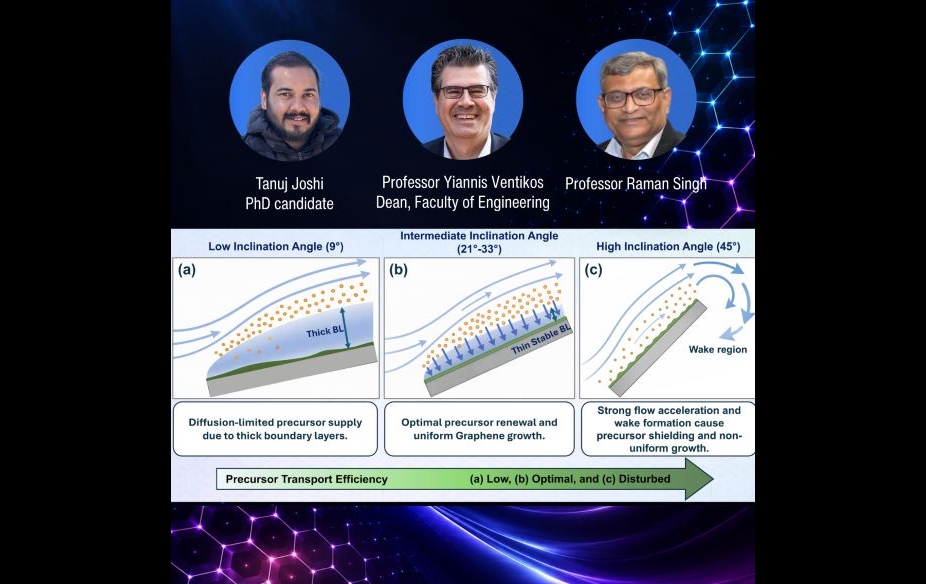
The research, led by PhD candidate Tanuj Joshi from Monash Engineering's Department of Mechanical and Aerospace Engineering (MAE), was conducted under the supervision of Professor Yiannis Ventikos, Dean of the Faculty of Engineering and Professor Raman Singh, also of MAE.
The study demonstrates how subtle changes in substrate orientation can reorganise near-wall transport and precursor renewal inside LPCVD reactors, significantly influencing the spatial uniformity of graphene coatings grown on metallic substrates.
By integrating transient 3D computational fluid dynamics (CFD) with “Raman Spectroscopy” and SEM characterisation, the work establishes a transport-based framework explaining how flow reorganisation governs graphene growth uniformity in hot-wall LPCVD systems.
Key contributions of the work include:
- Identification of how substrate inclination modifies near-wall transport conditions during LPCVD graphene growth
- Experimental validation of CFD-predicted transport behaviour using Raman mapping and SEM analysis
- Development of a mechanistically grounded framework linking flow organisation with coating uniformity
- Reactor-level guidance for improving graphene coating reproducibility in comparable hot-wall LPCVD systems
By integrating computational modelling with advanced materials characterisation, this work demonstrates how transport-informed reactor design can support more reliable, scalable and reproducible graphene coating development for future engineering applications.
Read the full article here.