Monash quantum devices pioneer elected to global photonics board
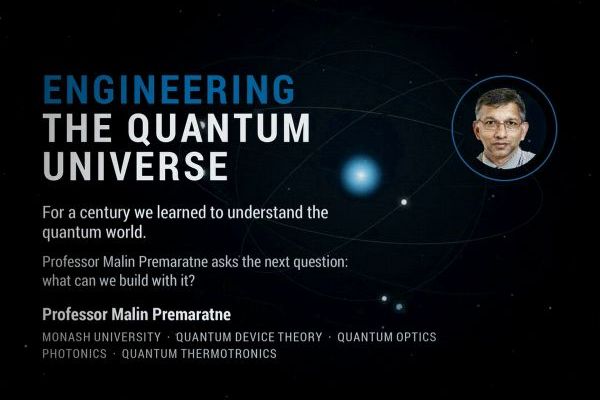
Professor Malin Premaratne, a pioneer of quantum device technology, has been elected to the Board of Governors of the IEEE Photonics Society, the world's leading engineering professional body for the science and engineering of light.
Professor Premaratne, of Electrical and Computer Systems Engineering, was chosen in a vote of the Society's global membership of more than 100,000 researchers, engineers and industry professionals. He will serve a three-year term from 2027 to 2029.
"I am honoured to have been elected by the members of the IEEE Photonics Society to serve on its Board of Governors," Professor Premaratne says. "I see the role as a responsibility to serve a community that has given me a great deal."
The IEEE Photonics Society supports research, engineering and industry in technologies that use light, from optical communications and lasers to sensing, imaging and quantum technologies. It connects its members through its journals, conferences and professional networks, and its Board of Governors sets the Society's direction across publications, technical activities, conferences and membership.
Professor Premaratne brings to the Board extensive experience of its publishing activities through his service on the Society's Publications Committee and the IEEE Publication Council, and of its grassroots work as Chair of the IEEE Photonics Society Victoria Chapter and an Executive Member of the IEEE Victoria Section.
"Through my work on the Society's Publications Committee I have come to care about how our journals and conferences reach the researchers, students and industries that depend on them, and I hope to help them grow in visibility and impact," he says. "I am also keen to bring my own enthusiasm for quantum devices, and the electronics that control them, to the Society's many areas of activity."
A pioneer of quantum device technology
Professor Premaratne is internationally recognised for developing the theoretical foundations of devices that operate at the quantum scale, where light, heat, electromagnetic fields and matter interact. His work connects fundamental physics with applications in sensing, communications, medical technologies and energy systems.
Among his many contributions, he pioneered the theory of the spaser, a quantum-scale laser only a few nanometres in size, with potential applications in ultrafast information processing, sensing and imaging. More recently, he founded the field of quantum thermotronics, in which quantum thermal transistors and circuits allow heat to be controlled and amplified in much the same way that electronic circuits control electrical current, opening a path to managing heat in the quantum technologies of the future. His broader research spans lasers and optical amplifiers, nanophotonics and plasmonics.
He is the author of two books published by Cambridge University Press, including Theoretical Foundations of Nanoscale Quantum Devices, which provides the first systematic treatment of the principles underpinning nanoscale quantum device design and is used by researchers and graduate students worldwide. He has published more than 250 journal papers, supervised more than 75 PhD students and secured more than $12 million in competitive research funding.
An international profile
Professor Premaratne's standing in the field is reflected in his election as a Fellow of six learned societies: the IEEE, Optica, SPIE, the Institution of Engineering and Technology (UK), the Institute of Physics (UK) and Engineers Australia. His IEEE, Optica and SPIE Fellowships recognise his contributions to the theory, modelling and simulation of optical quantum devices through an engineering approach grounded in quantum electrodynamics.
He currently serves on the Australian Research Council's College of Experts, holds the prestigious position of Distinguished Visiting Scientist at NASA's Jet Propulsion Laboratory at Caltech, and is a visiting professor at the University of Melbourne. He has previously held visiting appointments at the University of Oxford, the University of California, the University of Rochester New York and the Australian National University.
He has also given long service to the research community as an editor. He is currently an Associate Editor of APL Quantum and a member of its Advisory Board, and has previously served as an Associate Editor of the IEEE Photonics Journal, IEEE Photonics Technology Letters and Optica's Advances in Optics and Photonics.
Shaping the quantum era
For Professor Premaratne, the next phase of quantum technology will depend on translating advances in fundamental science into new ways of controlling the physical world.
"The true quantum age will be the moment we learn to shape light, heat, fields and matter with the same confidence that earlier generations learned to control electricity and fire," he says. "That shift will not stay inside laboratories. It will change how we sense the world, heal the body, move information and design materials from the inside out."
As a member of the Board of Governors, Professor Premaratne will help set the direction of a global photonics community, advancing research, innovation and the technologies that will shape the quantum era. Monash Engineering congratulates Professor Premaratne and wishes him every success as he takes up the role in 2027.