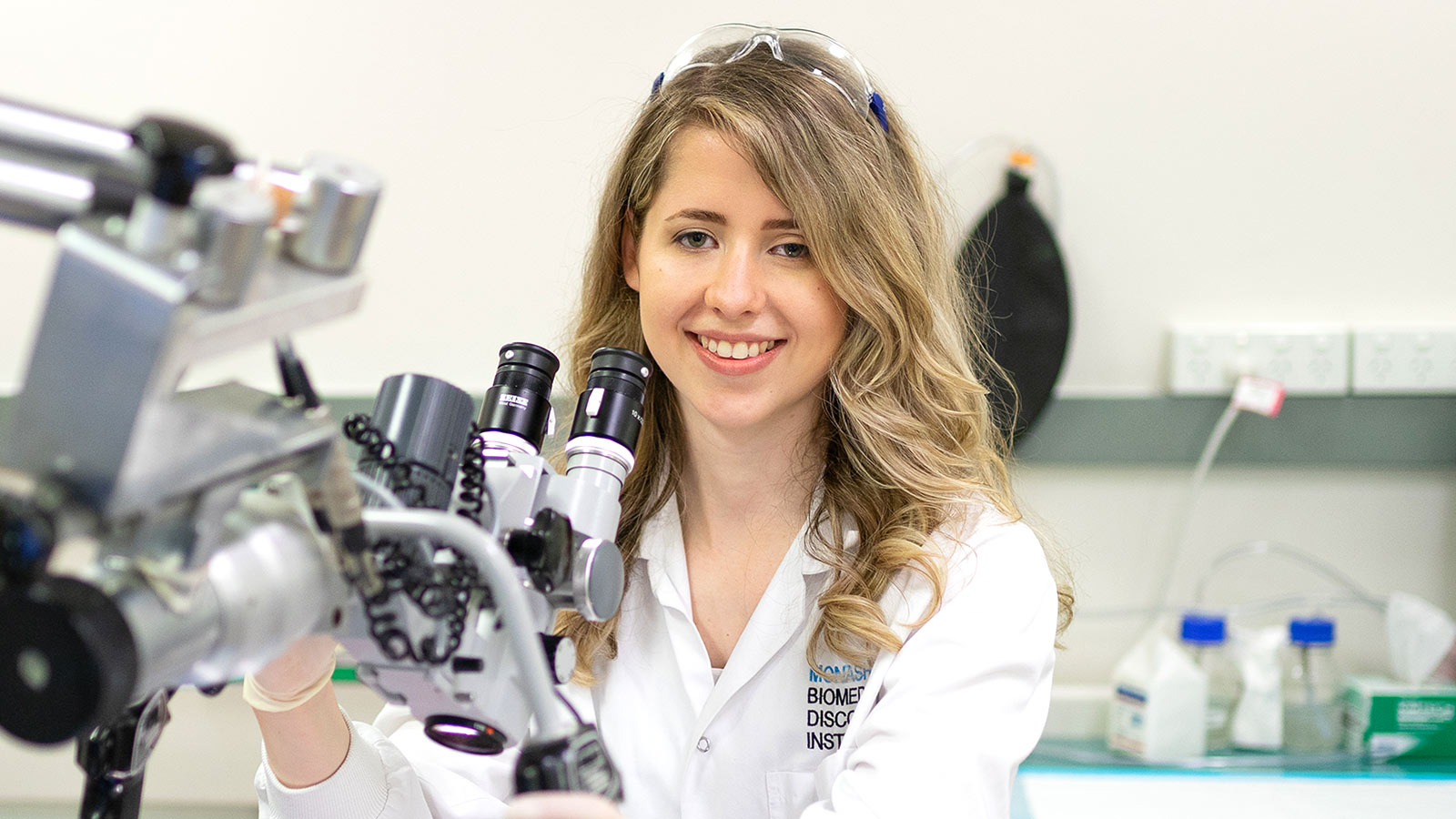
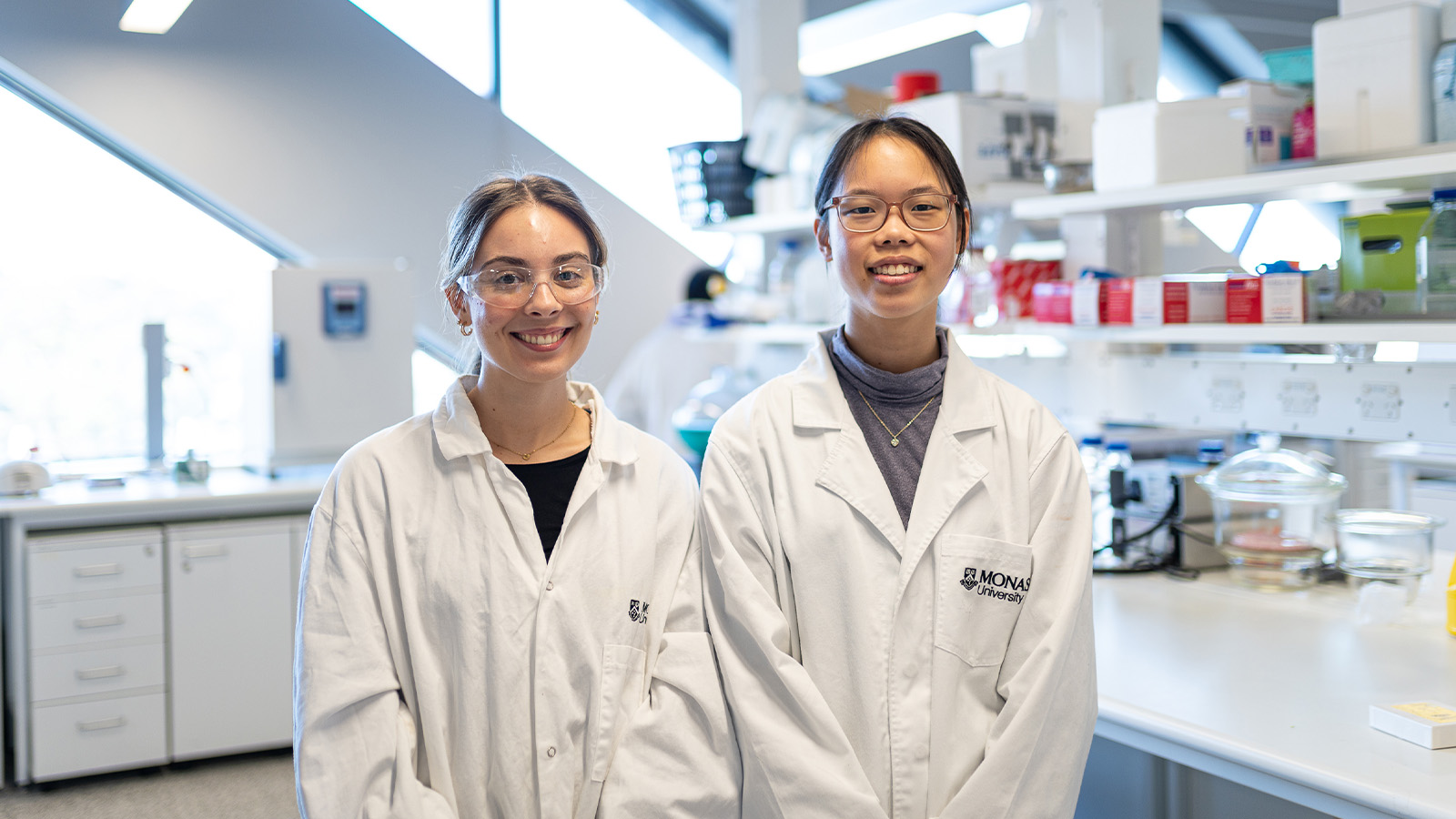
Hannah and Maria
Innovating for a healthier future: Meet two of Monash's first Biomedical Engineering specialists
Hannah Tay and Maria Zarco-Vera are just beginning their careers but they’re already trailblazers. Due to graduate in the coming months, they’re members of the first cohort of students to specialise in Biomedical Engineering at Monash University.
While they have developed different interests over the four-year course and are poised to pursue different career directions, Hannah and Maria agree the Biomedical Engineering specialisation has been ideal for each of them, despite it being brand new when they started.
“I guess it does feel a little like we’re the guinea pigs,” Maria laughs. “We’re engineering students who - for the first time - have been enrolled in subjects involving cellular biology and physiology.”
“The interdisciplinary nature of the Biomedical Engineering course - units from electrical, mechanical, mechatronics and materials engineering together with biology, anatomy and physiology - has been challenging but very stimulating,” Hannah says. “Each class has involved thinking in a somewhat different way, and I think this has made my university experience more interesting and enjoyable.”
Contrary to expectations of some peers who thought Engineering students might struggle in the biomedical subjects, Hannah and Maria say their cohort have always achieved high marks.
“That has helped reassure me that I’m in the right place,” says Maria. “I’m studying engineering but I’m also able to handle other subjects that require quite different skills.”
Hannah: Solving problems with med tech
Hannah had been interested in biomedical science from midway through her secondary school education, motivated by the opportunity to develop tangible solutions to health problems.
“I was planning to do a double degree in Biomedical Science and Engineering, but then the Biomedical Engineering degree became an option and the timing was perfect for me,” she explains.
In particular, the integrated structure of the Biomedical Engineering course has helped give Hannah a strong appreciation of the importance of human-centred design for medical devices.
“You’re not just developing technology - a medical device has to be able to be integrated into someone’s lifestyle.”
Hannah undertook a Summer Research Project using machine learning to look for connections between signals from the brain - as measured by electroencephalography (EEG) - and hand movements.
“The idea behind this research is to develop prosthetics that can be controlled using patients' thoughts,” she explains. “I collected EEG data, then performed signal processing tasks including filtering and feature extraction in an attempt to match each brain signal to the hand movements being performed.”
As she nears the end of her studies, Hannah’s career interests are now focused on medical devices and software engineering.
“A highlight of my course so far has been securing an internship at Hydrix, a medical device company,” she says. “I'll also be doing my final year project there, developing a numerical model for the cardiovascular system that can be used to test the performance of different cardiac support devices or artificial hearts.”
“I’m very happy to find the things I’ve studied in my degree really have prepared me to work as an engineer on real-world scenarios.”
Maria: Research focus on women’s health
Maria has long been attracted to biomedical research as a career.
“I had a strong interest in the human body and how it works, and I liked the idea of working in a lab,” she explains. “But I also found myself drawn to the analytical and problem-solving aspects of mathematics and physics and I felt Biomedical Engineering would allow me to apply them to solving medical challenges.”
As she worked through the course, Maria found herself increasingly interested in women’s health and reproductive medicine.
“Women make up half the world, yet the female hormone cycle and physiology are often left out of considerations in medical research and development,” she observes.
In fact, inspired to learn more about the socioeconomic and bioethical contexts of many of the health challenges faced by women around the world, Maria added a Diploma in International Relations to her study program.
As a Summer Research Project, Maria undertook an internship at the Monash-affiliated Hudson Institute of Medical Research investigating tests for endometriosis, a disease that affects one in nine women in Australia yet can take as long eight years to diagnose from the onset of symptoms.
“Current diagnostic investigations for endometriosis are very invasive, and there’s a real need for innovative techniques for detection and diagnosis that are minimally invasive,” Maria explains.
She is now looking forward to undertaking her final year project in the Applied Microfluidics and Bioengineering (AMB) Lab at Monash with Dr Reza Nosrati, who applies engineering principles to biological systems, particularly in reproductive medicine.
Rich extracurricular life
For Maria and Hannah, the Monash Engineering experience has been overwhelmingly positive and they praise the “rich extracurricular life” that includes student teams, clubs, projects and events to support professional integration and networking.
According to Maria, the quality of students in her classes has been consistently good, and she has found the culture of cooperation and collaboration “contagious” (to borrow a medical metaphor).
“I’ve always been able to find like-minded and supportive people in my classes and project groups.”
Hannah agrees: “It’s been very nice knowing you have a strong support network, especially given we’re the first group to go through this degree experience.”
Find out more about the Biomedical Engineering specialisation