Printing a new future for patient-specific cranial implants
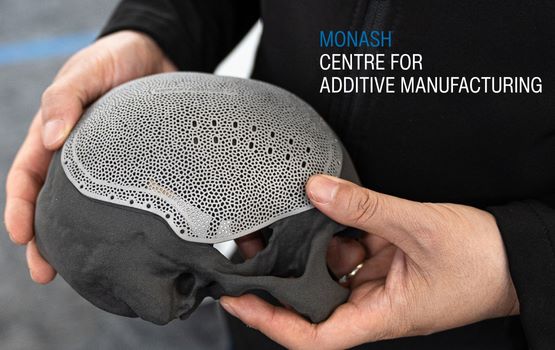
When a patient needs part of their skull reconstructed, every millimetre matters.
A complex cranial defect can be unique to an individual, making the ability to manufacture a precisely tailored implant critical to successful reconstruction.
Now, a collaboration involving the Monash Centre for Additive Manufacturing (MCAM), Personalised Surgery and Actis Medical is helping establish an Australian capability to manufacture patient-specific titanium cranial implants using advanced metal 3D printing.
The work brings together sophisticated manufacturing technology, materials science and engineering expertise to address a complex challenge at the intersection of advanced manufacturing, medical technology and sovereign capability.
At its heart is the ability to turn highly specialised engineering expertise into a reliable, locally based manufacturing process for patient-specific medical implants.
Patient-specific cranial implants are traditionally sourced overseas, potentially requiring patients to wait four, eight or even 10 weeks for treatment.
Through the manufacturing pathway developed by MCAM, production takes place in Australia. Lead times have been reduced to one to two weeks, with urgent cases able to be delivered in as little as seven days.
To date, the collaboration has delivered 15 patient-specific implants, with a reported 100 per cent clinical success rate.
Engineering a solution for every patient
The concept behind a patient-specific cranial implant is straightforward. Rather than adapting a standard implant to fit a patient, the implant is designed around the patient's individual anatomy.
Medical imaging is used to create a digital representation of the skull and the defect. Engineers can then develop an implant geometry tailored to that specific patient before manufacturing it using metal additive manufacturing.
But translating that concept into a reliable manufacturing process is far from simple.
One of the major engineering challenges addressed by the MCAM team is controlling thermal distortion in ultra-thin titanium implants.
In metal additive manufacturing, a high-powered laser selectively melts layers of metal powder to build a component layer by layer. The intense and localised heat involved can create stresses and distortion as the material cools.
For a complex, thin-walled medical implant that must conform closely to a patient's anatomy, even small amounts of distortion can become a significant problem.
With expertise spanning metallurgy, materials science, mechanical engineering, process optimisation and modelling, MCAM researchers have developed a unique manufacturing approach that is reliable and repeatable.
This proficiency sits at the heart of MCAM's role. The Centre brings together around 60 researchers and technical staff across disciplines including metallurgy and materials, mechanical engineering, electrical engineering and computer simulation, with a focus on translating fundamental research into real-world manufacturing solutions.
MCAM platform manager Dr Yang Tian says "We’re proud to use our additive manufacturing expertise to support the next generation of patient-specific medical devices. What makes this work meaningful is seeing advanced engineering translated into solutions that can improve patient outcomes."
From advanced manufacturing to patient care
The project illustrates the potential of additive manufacturing to change not only what can be made, but how it can be made.
Unlike conventional manufacturing approaches, additive manufacturing can produce highly complex geometries directly from digital designs. This makes it particularly suited to customised components where every product may be different.
MCAM's facilities include advanced metal additive manufacturing systems capable of processing titanium, aluminium, nickel and steel alloys, as well as sophisticated equipment for post-processing and materials development.
The Centre operates three medium format EOS printers (250x250x300mm) and two large format GE Concept Laser machines (630x400x500mm and 800x400x500mm). In addition to the 3D printers, in-house post processing is critical when fast turnarounds are required; heat treatment and large format (500mm depth) wire cutting is available to accurately and quickly post process parts.
These are Australia’s largest metal 3D printers and they provide a unique sovereign additive manufacturing capability.
Whilst MCAM provides research capability for all Monash University researchers, the Centre is also open to all Industry and Academic partners. All services can easily be accessed through a pay-for-service arrangement, or via a research agreement to accommodate more complex challenges.
Building sovereign manufacturing capability
The cranial implant program also demonstrates what sovereign manufacturing can mean in practice.
Rather than relying entirely on an international supply chain for highly specialised, patient-specific medical devices, Australian expertise and infrastructure can be brought together to design and manufacture these implants locally.
That creates greater control over the manufacturing process and supply chain, while potentially allowing clinicians and manufacturers to respond more rapidly when patients require customised devices.
It also illustrates the value of research translation: fundamental advances in materials and additive manufacturing developed within a university research environment can ultimately contribute to technologies designed to address real clinical needs.
For MCAM, this is precisely the role of advanced manufacturing research: taking discoveries
in materials science, metallurgy and processing and applying them to complex, real-world manufacturing challenges.
The collaboration with Personalised Surgery and Actis Medical shows how that capability can extend beyond the laboratory, connecting university research expertise with industry and clinical requirements.
As additive manufacturing continues to mature, its greatest potential may not simply lie in producing increasingly complex components. It may lie in the ability to manufacture the right component – precisely designed for a particular person, produced locally, and delivered when it is needed.
For patients requiring complex cranial reconstruction, that capability could make a profound difference.
It is advanced manufacturing with a very human outcome.
Learn more about Monash Centre for Additive Manufacturing (MCAM) here.