The science of the perfect drop
A new Monash Engineering technology could give researchers much greater control over the moment a chemical reaction begins – down to tens of microseconds timing.
What if you could start a chemical reaction exactly when you wanted, in mid-air, using a droplet smaller than
a grain of sand?
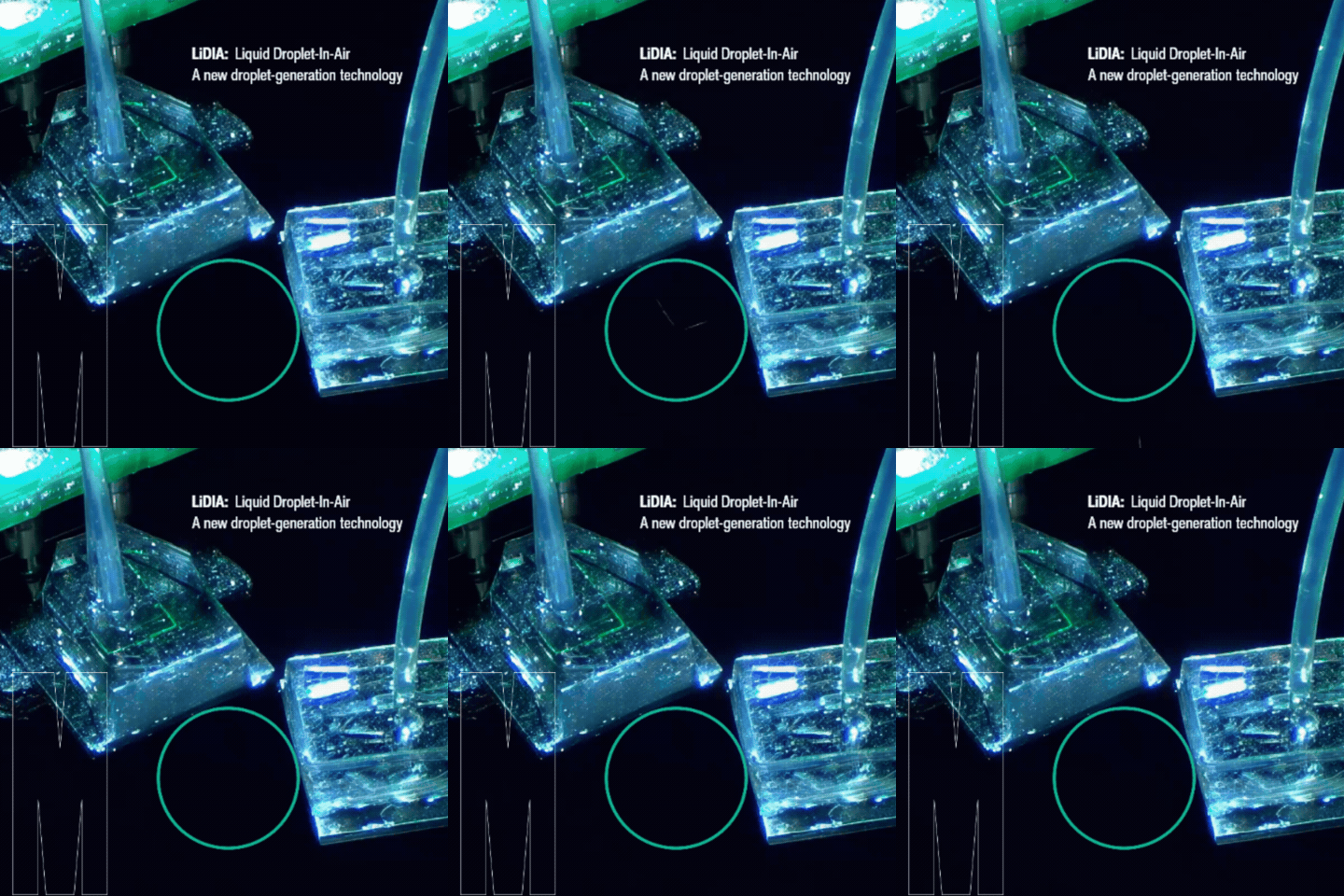
That’s the idea behind LiDIA – “Liquid Droplet-In-Air” - a new droplet-generation technology developed by researchers at Monash University.
The system - developed by Dr. Hao Deng (Monash Mechanical and Aerospace Engineering and Materials Science and Engineering), Professor Jacek Jasieniak (Materials Science and Engineering) and Associate Professor Tuncay Alan (Mechanical and Aerospace Engineering) - can eject individual droplets of liquid on demand with precise control over their size, position and timing.
The advance could help researchers study some of the fastest processes in chemistry, materials science and structural biology, including reactions that happen in fractions of a second.
One pulse, one droplet
At the heart of LiDIA is a deceptively simple idea: one electronic pulse produces one droplet.
The researchers combine sound waves travelling across a tiny piezoelectric device with a controlled flow of air. A short acoustic pulse nudges the liquid, creating a single droplet that is then carried through the device and into open air.
Unlike a conventional liquid jet which continuously produces a stream, LiDIA can remain completely still until it receives a trigger. That means researchers can decide exactly when a droplet is released and can repeat the process as often as 100 times a second.
The droplets are tiny, around 113 micrometres across, with an average volume of just 756 picolitres. For perspective, a picolitre is one trillionth of a litre.
Despite their size, the droplets can be produced with less than five per cent variation in volume, while their flight path can be controlled to within a few micrometres. Their timing can also be controlled to better than
80 microseconds.
Starting a reaction in mid-air
The real opportunity comes when two LiDIA devices are used together.
Two droplets can be fired towards each other so that they collide in mid-air at a scheduled moment, combining the two liquids without either one touching a surface. Because the collision time is set in advance, the moment a reaction would begin is known rather than estimated.
This matters because scientists increasingly want to watch what happens during the earliest stages of a reaction. Powerful instruments such as X-ray free-electron lasers (XFELs) can capture structural changes on extremely short timescales.
But to understand a reaction, researchers first need to know exactly when it started. LiDIA provides a way to create that starting point.
Rather than mixing two chemicals beforehand and trying to work out when the reaction began, researchers can bring two droplets together at a time of their choosing and use a precisely timed probe to observe what follows.
The team demonstrated both halves separately: droplets from two synchronised devices collide and merge reliably in mid-air, and timed reaction initiation was shown by delivering a droplet of calcium chloride into a droplet of sodium carbonate, producing calcium carbonate as the two mixed.
Less liquid, more control
There is another advantage to working with droplets this small: sample efficiency.
Many advanced experiments require expensive or difficult-to-produce samples, so wasting material can be a significant limitation. Continuous liquid jets can consume relatively large quantities of sample even when only tiny amounts are needed for an individual measurement.
Instead, LiDIA delivers a defined number of droplets when required.
Because each pulse produces a known volume, researchers can also use the system for precision dispensing. For example, 12 pulses delivered about 9 nanolitres of liquid, while 24 pulses delivered about 18 nanolitres.
That opens possibilities beyond reaction studies, including precision liquid dispensing, microprinting and sample preparation for advanced analytical techniques.
A tool for watching chemistry happen
The significance of LiDIA is therefore less about making very small droplets for their own sake, and more about giving scientists control over when and where an experiment begins. It demonstrates a new approach to droplet-in-air microfluidics, one in which liquid is delivered not simply in tiny quantities, but as a sequence of precisely timed events.
The researchers say the technology could ultimately be integrated with techniques including Raman spectroscopy, mass spectrometry and serial femtosecond crystallography at XFEL facilities.
Associate Professor Alan says the group is now applying the technique to nanomaterial synthesis, particularly systems that nucleate quickly.
"What happens in the first moments of a reaction determines what the particles become. Controlling when two reagents meet, and following the reaction from that instant, gives us a way to study and eventually steer how they form."
The article was selected for the back cover of Small.
This work was supported by the Australian Research Council Discovery Project scheme (DP260103767). The devices were fabricated in part at the Melbourne Centre for Nanofabrication, the Victorian node of the Australian National Fabrication Facility.
Read the research article here.