A new era of lithium extraction: 95% recovery using near-zero water
Monash University engineers have developed a ground breaking technology that extracts lithium with almost no water, offering a highly sustainable alternative to conventional, resource-heavy mining.
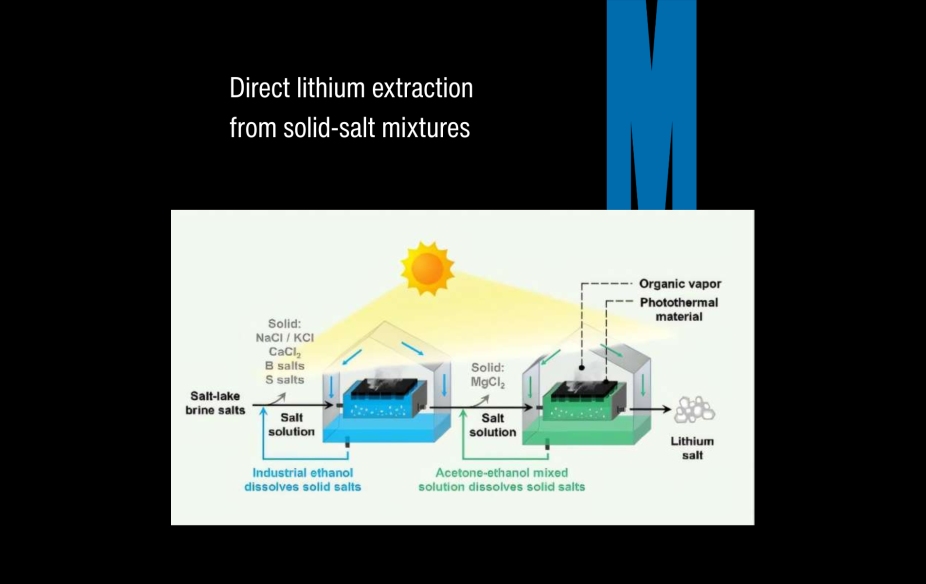
Traditionally, lithium extraction from salt-lake brines suffers from low efficiency and massive freshwater consumption. The research team from Monash Chemical and Biological Engineering - Professor Huanting Wang, Dr Zhikao Li, and PhD candidate Pan Liu - bypassed this by isolating lithium salts within solid mixtures using common industrial solvents like ethanol and acetone.
By leveraging solubility differences, the process achieves a 95% lithium recovery rate and removes stubborn boron and sulphate impurities without needing freshwater inputs.
“This work shows that lithium can be efficiently separated from complex salt mixtures using simple organic solvents, without relying on freshwater or highly chemical-intensive processes,” Dr Li said.
To boost sustainability, the team integrated the system with solar-driven evaporation. This allows over 99% of the solvent to be recovered and recycled using only sunlight.
According to Dr Li, the combination offers a scalable pathway for greener lithium production. “By coupling these processes, we achieve high recovery rates and very high solvent reuse, which significantly reduces environmental impact while maintaining strong performance,” he said.
Read the full study here.
NOTE
Professor Huanting Wang is a Sir John Monash Distinguished Professor and an Australian Research Council (ARC) Laureate Fellow, and also serves as Pro Vice-Chancellor and President (Suzhou) at Monash University.